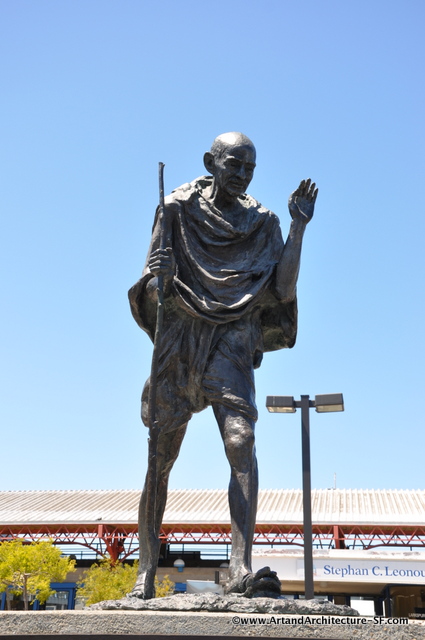
Peace by Bufano

 Posted by on September 12, 2012
Sep 122012
 

800 Brotherhood Way

Peace by Benny Bufano

Located at the entrance to the San Francisco Airport for almost forty years”Peace” was relocated to make way for a parking garage.  After restoration it was moved to Brotherhood Way, where it stands now.

Benny Bufano was born in Italy in 1898, Beniamino Benvenuto Bufano came to the United States at young age with his family. After studying art in New York City, he eventually moved to San Francisco where he taught both at UC-Berkeley and at the California College of Arts and Crafts in Oakland. He died in 1970.

On the back of the circular base is inscribed:

Dedicated April 19, 1958
George Christopher, Mayor

On the front of the circular base is inscribed:

Presented to the Citizens of San Francisco by the San Francisco Chronicle
Dedicated to the Brotherhood of Man and the Ideal of Peace Among all the Peoples of the World

UPDATE – April 17, 2013 – Where is the statue?

Brotherhood Way was originally called Stanley Way. But in 1958, under Mayor George Christopher, the city, which owned all of the land on the south side of the street, turned that property over to a long list of religious institutions and renamed the street to reflect its role as a place for houses of worship. It’s now home to six churches or synagogues and nine religious schools. It has its own (religious) neighborhood association.

On May 19, 2005, the Planning Commission approved an expansion of the Park Merced apartment complex to add up to 182 units on the north side of the street.

There has been a contentious battle over this plan ever since.

Opponents of the project say the area was set aside for educational and religious uses, not housing — and they argue that the expansion of Park Merced will add too much congestion to the area. Supporters say the west side of town needs to accept more housing and more density.

In April of 2010 a Letter of Agreement was executed between the San Francisco Arts Commission and the project property owner to protect the Bufano sculpture adjacent to the project site during project construction. The Agreement identifies a specific site for relocation of the statue. The Agreement also sets forth specific tasks and conditions for de-installing, storing, and re-installing the sculpture at a time agreed upon by the project sponsor and the Arts Commission.  If you are interested in keeping up to date on the progress, here is the link to the SFAC page about the project.

As of February 1, 2013 all the plans have been approved by the City, however, the opponents are continuing their battle in court.  The trees have been removed, the water and sewer pipes are being prepared to be installed and the developer is moving forward.  The Bufano has been removed and I will report where Peace ends up when this is all over.

A little about Park Merced: Metlife owned and carefully maintained the property until the early 1970s, when it sold it to Leona Helmsley and the property began to deteriorate. There were a succession of owners and management companies beginning in the late 1990s. The commercial areas of the development were sold off to investors, and other parts sold to the California State University system. As of 2008, 116 of the original 150 acres are owned and maintained by a single investor, who purchased the property for $700 million and has committed $110 million in upgrades.  The architecture of Park Merced is very unique and I hope to write a post about that in the near future.

2018

This piece is back in its original position off of Brotherhood Way.  It is now amongst the homes of Park Merced but still visible from the street.

Hidden Gems in Bernal Heights

 Posted by on September 8, 2012
Sep 082012
 

82 Coleridge Street
Bernal Heights

This tile mosaic is titled Colloidal Pool and is by Peter Almeida. Done in 1988 it is suggestive of a puddle with ripples moving concentrically over leaf sheaves.

 The view from Coleridge Mini Park

Coleridge Mini Park

Watching the Wind at the Randall Museum

 Posted by on September 6, 2012
Sep 062012
 

Randall Museum
199 Museum Way
Castro

*

The plaque that accompanies the piece reads:

Charles Sowers is an artist whose practice links art and science.  Here wind currents activate over 500 aluminum arrows to reveal the ever-changing ways the wind interacts with the building and its environment.  “My work presents actual physical phenomena, often of striking visual beauty, that draw people into careful noticing and interaction”

This piece is from the Collection of the City and County of San Francisco commissioned by the SFAC for the Randall Museum Funded by the Public Utilities Company.

According to a February 21, 2012 S.F. Chronicle article 

The new exhibit took four years to make, required dozens of prototypes and tests, and ultimately uses 612 individually balanced aluminum arrows spaced 1 foot apart on architectural facade material covering the side of a local museum.

I spent over a year-and-a-half designing and testing wind arrow designs,” he said. “I first prototyped arrow designs in paper. Then I made a prototype panel fitted with six different arrow designs and mounted it on-site for a year of testing.

“I also mounted arrows outside my apartment at Baker Beach, which was great for the intense wind. And I even held them outside my car window. I spent a lot of time figuring out how to mount them on the building.”

Sowers also spent considerable time hand-balancing each arrow, studying the possibilities using computer-aided drafting software. “Balance was a big part of the design,” he said. “Important, and tedious. I balanced every one, working in groups of 25 arrows. My shoulders ached.”
He also had to decide whether the “V” of the arrow’s wings should slope toward the wall or away. “I learned that the V sloping out caught the wind and made it vibrate or oscillate. It was not behaving correctly, so they are sloped inward.”

Sowers, who is 45 and earned his bachelor’s degree in anthropology at Oberlin College – where he studied physics early on – has long been fascinated with the tapestry of nature, whether the swirling of fog, the formation of ice, the unexpected rippling in a mud puddle, or the effects of water and wind on sand.

The Randall Museum was the inspiration of Josephine D. Randall. Ms. Randall received her Masters degree in zoology from Stanford University in 1910. By 1915, she had organized one of the first Girl Scout troops in the United States as well as one of the first Camp Fire Girl troops. She went on to become San Francisco’s first Superintendent of Recreation, a position she held for a quarter of a century. In 1948 she received an honorary Doctorate from the University of California. Under her direction, the San Francisco Recreation Department achieved national recognition as one of the most outstanding services of its kind.

One of Ms. Randall’s long-term goals was the establishment of a museum for children. In 1937 her vision came to fruition. Simply called the “Junior Museum,” it originally opened in the city’s old jail on Ocean Avenue. In 1947, Ms. Randall shepherded a $12,000,000 bond issue for recreation capital projects, including a new museum. In 1951, the museum opened in its current facilities on a 16-acre park over looking San Francisco Bay and was renamed the Josephine D. Randall Junior Museum in honor of its founder.


Fire creates Firehouse Art

 Posted by on September 5, 2012
Sep 052012
 

1091 Portola Drive
St Francis Wood/Mt. Davidson

Station #39

*

 This 30″ Blown Glass Rondella, done in 1997,  is by Mark McDonnell.

Mark McDonnell (1945-   ) is a visual artist whose work can be found in the permanent collections of the Louvre, the Smithsonian Institution, and the Corning Museum of Glass. He has extensively researched and photographed glasshouses and glass architecture. He is the former chairman of the Glass Department at the California College of Arts and Crafts in Oakland, and presently lives in San Francisco.

Having taken up writing Mark McDonnell, explores the intriguing locations that Chihuly is drawn to and his ongoing interest in glass buildings in the 2002 book Chihuly Gardens & Glass .


Noe Valley Natives – Plants that is.

 Posted by on September 2, 2012
Sep 022012
 

295 Day Street
Noe Valley

SAN FRANCISCO WALL FLOWER “ERYSIMUM FRANCISCANUM”

This installation is titled Noe Valley Natives, and these pieces sit on fence posts at the Upper Noe Valley Rec Center.  The artist is Troy Corliss.  In 1993 Troy graduated from the studio art program at the University of California at Davis. While at UC Davis, he studied figure drawing and sculpture. Today, he lives with his wife Anne Liston in Truckee, CA. Corliss has been artist in residence at the Center for Land-Based Learning in Winters, California, the Tahoe Environmental Research Center, and the John Muir Institute of the Environment at UC Davis.

Manufactured in 2007 the flora is forged and fabricated steel.  It was funded by the San Francisco Arts Commission

Rising from the top of six of the center’s gateposts stainless steel and glass plant forms represent the coastal dune and coastal prairie plant communities that once dominated this region of San Francisco. Troy Corliss searched the nearby hillsides, photographed and drew four tiny plants to be cut, forged and welded into these freestanding sculptures. Speaking of his method, Corliss says: “My intent in crafting this work is to emphasize plant diversity through the material handling and the sculptural design of the steel and glass forms”.

BEACH SAGE “ARTEMSIA”

*

YELLOW VERBENA “ABRONIA LATIFOLIA”

COAST BUCKWHEAT “ERLOGONUM LATIFOLIA”


Muertos in the Mission

 Posted by on August 31, 2012
Aug 312012
 

Valencia Street

Between 15th and 19th Streets

Mission District

*

 These tree grates are part of Phase One of the Valencia Streetscape Improvement Project.  They were designed by DPW architects John Dennis and Martha Ketterer and manufactured by Iron Age Grates company.

Phase one of the Valencia Streetscape Improvement Project included removal of the striped center median, sidewalk widening, bulb-outs, more accommodating curbside loading zones for trucks, improved traffic, parking and bicycle lane alignments, the removal of the striped center median, pedestrian scale lighting, art elements, bike racks, and new street trees.

The project included the replacement and addition of 76,000 square feet of sidewalk and the installation of pedestrian bulbouts to provide traffic calming, facilitate street crossing and add space for gathering. Additional improvements included the planting of 106 Brisbane Box and London Plane trees along the sidewalks, new trash receptacles, 69 bike racks, 32 wheel chair accessible curb ramps, 26 roadway-scale lights and 46 pedestrian-scale lights. Four Victorian-themed street posts, uniquely designed for Valencia Street through the San Francisco Arts Commission, were also installed. This public art feature entitled ‘Valencia Street Post’ was installed by artist Michael Arcega.

The cost of the program was $6.1 million and was funded through a combination of a multi-year federal transportation bill called the Safe Accountable Flexible Efficient Transportation Equity Act (“SAFETEA“) and two Transportation for Livable Communities (TLC) federal grants with local matching funds.

Muni brings art to an industrial building

 Posted by on August 25, 2012
Aug 252012
 

700 Pennsylvania

Potrero Hill

*

The Muni Ways and Structures Facility is located at 700 Pennsylvania Street at the base of Potrero Hill. The facility centralizes several Muni functions, including, among others, a machine shop, welding, carpentry, painting, and locksmith. Although the size and shape of the complex is unchanged from its former role as an overhead-door factory, it has been given a colorful new life through the work of San Francisco artist Robert Catalusci. The exterior walls are now painted ox-blood red and graphite with silver and copper-green accents. In addition to custom paint design, the artist designed massive steel gates and four 18-square-foot sculptural panels over the building’s four roll-up doors. The three-dimensional ‘waffle’ pattern of the gates and panels is painted in high-gloss silver that is slightly reflective so that the structures appear to change with the light throughout the day.

Catalusci’s gate and panel designs and bold paint application were inspired by the industrial and transportation orientation of the complex. He selected color to symbolize the ethnic diversity of the design team and Muni workers. For instance, he chose red as the color of international workers, and graphite and silver for their associations with industry and metal work. The artist worked in tandem with city architects, in particular Howard Wong, AIA, and the rest of the design and construction team throughout the five-year renovation project. In addition to the custom paint design, Catalusci, who hails from a family of builders, drafted plans for the huge gates and produced final drawings.

As a fine artist, Catalusci usually creates multi-media and large-scale three-dimensional sculpture based on architecture. He holds a B.F.A. from the San Francisco Art Institute and has exhibited regionally, in several private venues and at the San Francisco Arts Commission Gallery and the Capp Street Project.

Robert Catalusci’s work on the design and construction of the 700 Pennsylvania Muni Ways and Structures Facility was commissioned by the San Francisco Arts Commission for the San Francisco Municipal Railway. The commission is a result of the city’s percent for art ordinance, which provides for an art allocation of 2% of the cost of construction of new or renovated city structures.

Aug 152012
 
Civic Center
Performing Arts Garage
Grove and Gough Streets
 
*
*
The Dancing Musicians and The Dancer by Joan Brown 1986-1986  Bronze
Joan Brown has several pieces around San Francisco.  These pieces were commissioned by the San Francisco Arts Commision.  The flautist and guitar player are twelve feet high and five feet wide and sit on the outside of the fifth floor of the garage.  The smaller dancer sits on the first floor. The simplified silhouettes are based on the classic Greek black-figures found on Etruscan pottery.

Madonna by Benjamin Bufano at SF General

 Posted by on July 28, 2012
Jul 282012
 
Potrero Hill
San Francisco General Hospital
1001 Potrero Avenue
Madonna by Benjamin (Beniamino) Bufano 1974

Benjamin (Benny) Bufano was a prolific artist in his time and has many pieces around San Francisco. This Madonna of Red Granite and mosaic sits on the edge of the comfort garden in San Francisco General Hospital, near building 80. The first buildings designated as San Francisco General Hospital were erected in 1872. Outbreaks of bubonic plague, the spread of tuberculosis, the earthquake of 1906, and the influenza epidemic of 1918 were all trials this hospital saw in its early years. Most of the present buildings were constructed during 1915–20. They were designed by city architect Newton Tharp in an Italianate style, laid out “with green lawns and bright flowering plants to add to the attractiveness of the structures.” Early photographs depict lawns, shrubs, paths, and palm trees between the buildings, formally designed, but — apparently — with no seats or benches to encourage use by staff or patients. The Comfort Garden is a small but well-used outdoor space in the sprawling contemporary “campus” of the hospital. It was established in June 1990 as a “living memorial” to hospital employees who had died. A name plaque in the garden, recording its inception, concludes with the words: “It is meant to be a place of solace where nature’s beauty can bring you comfort.”

San Francisco General Hospital was a subject of the New York Times scathing article about the San Francisco Public Arts Commission and it’s inability to keep track of its collection. The article pointed out that the city acquired 496 art objects for the Hospital when it was renovated in 1972 and by 2007 the commission could only find 49 pieces, by 2011 they had found 141. (There are no further updated numbers at this time)

Fortunately this one is still there and not only easy to find, but in such a delightful spot, it is a pleasure to visit.

If you would like to refresh your memory about Bufano there is a great article about his eclectic life in the Nob Hill Gazette.

Gene Friend Rec Center in SOMA – Tile Art

 Posted by on July 26, 2012
Jul 262012
 
SOMA
Gene Friend Rec Center
270 6th Street
*
A World View by Martha Heavenston Nojima
Martha Heavenston Nojima is known for her tile work, and especially her work with children in the arts.  This particular group of tile creatures was done in 1989 and was commissioned and is owned by the San Francisco Art Commission.
*
*
*
*
 *
The Gene Friend Rec Center caters primarily to families of Filipino descent in the neighborhood but is open to all. Youth programs include gardening, arts and crafts, baseball, basketball, poetry. The center also hosts a School Year Latch Key and a Junior Giants program.
Jun 212012
 
Western Addition
Turk and Fillmore Streets
Northern Police Station
*

*

*

This cast concrete panel by Horace Washington depicts the cultural diversity of the Western Addition and its architectural history. The panel also features the likeness of police officers of the past. The piece is part of the San Francisco Arts Commission collection and was produced in 1987. It is 3 feet high by 8 feet long.

Horace Washington (who has work on the 3rd Street Light Rail project) studied at Columbus College of Art and Design in Ohio before moving to California to study sculpture at the San Francisco Art Institute and then completed his graduate studies at Cal State University, Sacramento. He is a San Francisco sculptor and muralist whose works include numerous projects in a variety of materials for public facilities in northern California including the International Longshoremen’s & Warehousmen’s Union mural/ scultpure, the Northern Police Station sculpture, the Martin Luther King Swimming Pool Tile Murals, and the Plaza East ceramic tile and painted mural. He exhibits his work in San Francisco and has been a guest lecturer at UC Berkeley, Cal State Sacramento, and for the San Francisco Unified School District. He has also taught developmentally disabled adults at the Creativity Explored Art Center. He lives and works in San Francisco.

May 252012
 
Civic Center
Performing Arts Garage
Gough and Grove Streets
 
*
Dancing in the Curve of the World by Josef Norris
Josef Norris is responsible for the murals at Kid Power Park. This piece, done in 2003 was paid for by the San Francisco Arts Commission’s Cultural Equity Fund and the Neighborhood Beautification Fund.


Hayes Valley – Ghinlon/Transcope

 Posted by on April 6, 2012
Apr 062012
 
Hayes Valley/Western Addition
Octavia Boulevard
between Market and Hayes
*
*
*
Ghinlon/Transcope by Po Shu Wang 2005

Commissioned by the SF Arts Commission for the Octavia Boulevard Streetscape Project, these transcopes invite you to observe the comings and goings along Octavia Boulevard and Patricia’s Green. There are twelve of these installed along the medians and the Green. The view through them can be twisted, converted or even upside down. While this was probably a wonderful concept, it fails in execution. To look into them is awkward. While one design is set at a height that works for the handicapped and small children, the other meant for standing adults were difficult for this 5’3″ author to use. Unfortunately, the view holes are so small that you really don’t see much anyway.

This is a paragraph from the SF Arts Commission’s Press Release regarding the installation:
The artist created a series of slender pole-like sculptures equipped with kaleidoscopic lenses that function as miniature observatories providing pedestrians with a transformed view of the surrounding environment and passing cars. The mounted scopes transform vehicular movements, colors, shapes and lights into extraordinary and beautiful real time moving pictures. Each observatory is equipped with a unique mirror lens combination giving the viewer an ever-changing kinetic snapshot of their environment. The sculptures have two standard designs: one for standing adults, and one for person in wheelchairs and/or children. The sculptures have a 60-degree vertical swing and a 180-degree horizontal swing. The slender support column on each sculpture includes the artist’s prosaic interpretation of the unique lens/mirror combination.

Born in Hong Kong, Po Shu Wang is an artist working out of Berkeley, California. His art projects are site-oriented viruses. Each individual artwork is a specific strain that intimately linked with a particular host environment. They co-evolve, mutate, and conflict with their hosts within a larger reality.

These pieces were part of the SFAC 2006-2007 budget and were commissioned for $150,000.

Golden Gate Park – Our National Pastime

 Posted by on February 16, 2012
Feb 162012
 
Golden Gate Park
Our National Pastime by Douglas Tilden – 1889
Presented
to the Golden Gate Park
by a friend of the sculptor
as a tribute to his
energy, industry and ability
Cruet Fondeur, Paris

(John Cruet was a moldmaker in Paris, he also worked with Rodin. Fondeur means owner of the foundry)

Tilden originally displayed the piece as part of the American Exhibit at the Paris International Exposition, where it was extremely well received. It is widely recognized as the single most famous and classic baseball figural art piece ever created. As a result of its popularity at the time, a very small number of replicas was ordered by Tiffany’s. While the exact number of Tiffany replica’s produced is uncertain (possibly as few as four), only three have ever surfaced (two are 34 inches in height, the other 21 inches), one of which is on permanent exhibit in the Baseball Hall of Fame. In 2006 a newly minted small replica sold for over $18,000.

Tilden, sculptor of the Mechanics Memorial on Market Street, remained a recluse for most of his life and died in 1935. In 1987, many of Tilden’s personal artworks were discovered in an abandoned storage facility.

The original base, made of sandstone at the turn of the century, was too badly worn to be refurbished. The new base is made of mahogany granite with a carved-raised panel and gold leaf lettering was done in November, 1998.

Our National Pastime is on JFK Drive across the street from the Conservatory of Flowers.

SOMA – Labyrinth-Habitat

 Posted by on January 30, 2012
Jan 302012
 
SOMA
8th and Natoma Streets
 Labyrinth – Habitat 1999
Johanna Poethig with Episcopal Community Services
Ceramic and paint
Commissioned by the San Francisco Art Commission – Arts in Community Program.

Johanna Poethig has been in this site many, many times.   This mural is on the side of one of the Training Centers for Episcopal Community Services – The Cannon Kip Community House.

According to Johanna’s website this is what the mural is about:

In every culture and on every continent the labyrinth is one of the oldest and most universal symbols. Some of these existing labyrinths, such as the ones at Val Camonica (North of Italy), Kom Ombo (Egypt), as well as various sites in North and South America and Asia, date from 1800 to 1500 B.C. Built on sacred locations, they possess magical powers and various symbolic meanings.

The labyrinth both creates and protects the center, and allows entry only on the correct terms. Entry is thus a step on the path of knowledge. The Hopi Indians, the labyrinth form on which this design is based, called the labyrinth the ‘Mother Earth’ symbol, and liken it to their own underground sanctuaries, the Kivas. It was from here the Hopi emerged from the preceding world. ‘All the lines and passages within the maze form the universal plan of the Creator, which a person must follow on the Road of Life.’

The title of this mural is based on a labyrinth scratched onto a painted pillar 2000 years ago, in the house of Lucretius, a classic author( Pompeii before ad 79), with the text: Labyrinthus, hic habitat Minotauros.
This project will involved residents of Canon Kip in writing and tile glazing workshops in the creation of “Labyrinth – Habitat”. The writing workshops engaged participants in thinking about their own life paths in relationship to the ancient and universal form of the labyrinth. Finished text was then be transferred and fired onto tile. These tile became part of the mural which is a combination of paint and ceramic.

Episcopal Community Services of San Francisco helps homeless and very low-income people obtain the housing, jobs, shelter and essential services.


SOMA – Large Pieces of Marble

 Posted by on December 12, 2011
Dec 122011
 
631 Folsom Street
SOMA

These giant pieces of carrara marble are by Richard Deutsch are titled Frammenti.  Deutsch has been in this site before and I recommend you visit his website.  He is a very accomplished artist with work all over the world.

This piece is titled Fragmented.  The day I was there the fountain was not running, but Deutsch’s website has some really gorgeous photos of the fountain while it is working.


The Mission Kid Power Park

 Posted by on December 4, 2011
Dec 042011
 
The Mission District
Kid Power Park
Hoff between 16th and 17th
Ethel Siegel Newlin,program liaison at St. John’s Educational Thresholds Center (now Mission Graduates) on 16th Street, is responsible for this wonderful little oasis in the city.

Ten years ago, elementary and middle school children in one of Newlin’s programs surveyed the neighborhood and found liquor stores, dry cleaners and thrift shops, but no parks. The nearest one was at 19th and Valencia.

So they went to the Recreation and Park Department’s Open Space Committee to plead their case, and won $200,000. The next year they did the same thing, and won another $200,000. The third year they won $100,000. The following year, State Sen. Carole Migden secured $1.5 million from state open space funds, bringing the kids’ total to $2 million.

They tried buying a few vacant lots in the neighborhood, but couldn’t compete against housing developers in the red-hot real estate market. They had the same problem when they bid on the parking lot on Hoff Street — until the developer learned he was competing against neighborhood kids who wanted a park.

The developer backed out, allowing the Recreation and Park Department to purchase the property on behalf of the Mission kids. Working with Recreation and Park staff, the kids helped design the park, held community meetings and even picked the name.

Overall, more than 150 kids worked on the project, many of them knowing they’d be too old for it when it finally got built.

Berkeley artist Amy Blackstone designed and fabricated the fence and gate panels along with the sculptural trellises that utilize imagery and patterns associated with the dominant cultural heritage of Mission District residents.  The fence was part of the SFAC 2006-07 budget and cost $15,000.

Candlestick Park – Endangered Garden

 Posted by on November 4, 2011
Nov 042011
 
Candlestick Park
The Endangered Garden by Patricia Johanson
“Endangered Garden”, a linear park along San Francisco Bay was commissioned in 1987 by the San Francisco Arts Commission. As co-designer of the thirty million dollar “Sunnydale Facilities”, a pump station and holding tank for water and sewage, Patricia Johanson’s intent was to present this functional structure as a work of art and a productive landscape. Other goals included increasing food and habitat for wildlife, and providing maximum public access to San Francisco Bay. Tidal sculpture, butterfly meadow, habitat restoration, seating, and overlook are all incorporated into the image of the endangered San Francisco Garter Snake, as is a public access baywalk, thirty feet wide and one-third of a mile long that coincides with the roof of the new transport / storage sewer.
This portion is the head of the garter snake.  While it is hard to discern at this point, if you are on the freeway driving into the city from the airport, you know it is a snake.  The colors of the pavement represent  the colors of the garter snake.
“Ribbon Worm-Tide Pools”, is a small sculpture within the “body” of the snake.  It provides a path down to the marsh and mudflats of San Francisco Bay. The intention was for the  worm itself to be  in tangled masses among mussels and barnacles during high tide, but judging by the amount of trash in amongst it, that doesn’t happen very often.
Depressions in the pavement, modeled on California Indian petroglyphs, fill with rainwater for birds. Hundreds of prehistoric shell mounds once dotted the shores of San Francisco Bay, and this site was continuously occupied from around 1500 B.C. by Native Americans who fished in the bay, hunted waterfowl in the marshes, and foraged for shellfish along the mudflats. When excavated in 1910, many human burials and artifacts were recovered from a shell mound on this site, which today lies buried under twenty-five feet of “landfill”.

Sunset District – Propeller on the Walk Way

 Posted by on November 3, 2011
Nov 032011
 
The Sunset District
The Great Highway at Riviera
Standing here, looking out towards the Pacific you will find art at your feet.  You will also guess, at this point that it is covered in a lot of sand.
Propeller by Richard Deutsch
This granite and marble terrazzo paving piece has bronze nautical elements inlaid into the surface.
Richard Deutsch has been featured on this site before.  He is an accomplished artist, with work all over the world, and pieces in great museums across the country.
This piece was commissioned by the SFAC for $9000 in 1988

Birds at the J.P. Murphy Playground

 Posted by on November 2, 2011
Nov 022011
 
Inner Sunset
J. P. Murphy Playground
1960 9th Avenue
Woman with Birds by Michael J. Carey
This divine park, that includes several tennis courts and a wonderful rec room is surrounded by these giant hedges.  The hedges make a perfect backdrop for this sculpture.
Michael Carey said: ““My intent with the sculpture for the J. P. Murphy playground is to celebrate the Center’s community purpose and natural setting by evoking a beneficent and free spirit in the work,”
Woman with Birds was funded by the J.P. Murphy Clubhouse Renovation construction budget, in fulfillment of San Francisco’s Art Enrichment Ordinance, and produced by the Public Art Program of the San Francisco Arts Commission. This piece was part of the 2006-07 budget and cost $29,000.
While this piece is in steel if you go to Michael’s website, you will see some wonderful pieces that he has also done of wood.

San Francisco’s Muni Stops

 Posted by on September 29, 2011
Sep 292011
 

Cable cars have been synonymous with San Francisco since the 1800’s.  We correct people all the time in the vernacular of cable car versus trolly, but, we have trolly lines too.  Our muni system is just that.  Muni covers much of the city, and many people that visit our town ride the vintage trolly cars along the embarcadero.  For twenty years the muni system sought to expand its line from 4th and King streets (one block from our baseball park) along 3rd street to Candlestick park.  It finally accomplished this feat.  Originally envisioned as a simple rail line with minimal stations and platforms it grew into a more elaborate system with raised platforms and dedicated roadway.

Street lighting along the entire corridor

During it’s conception the S.F. Arts commission selected a team of ten artists to participate in the project.  Rather than have the art designed and sited independent at the end of the planning and design, the artists were brought in early on to give their input.  As a result of this collaboration, several artists became involved in developing concepts for the corridor as well as for individual sites.

The station marquee pole is a primary element of the canopy.
A beacon at the top flashes to announce an oncoming train.

The design effort lasted about a year and included three community workshops and nine neighborhood workshops.  The result was unifying elements in the design.  These include the trackway paving, station elements, including crosswalks, ticketing, shelters, windscreens and signage, street lighting and color scheme.  They also included unique elements that included, plantings, art elements and special streetscape elements.

Three of the stations have site specific art.  The first of these is stop number one at Fourth and King Streets.

The station marquee represents the spokes of a train wheel, and spins with the wind.
 These are just two of the many names of historic train companies that are etched in the platform pavement.
To top it all off, there are tracks running across the canopy.

North Beach Swimming Pool

 Posted by on September 21, 2011
Sep 212011
 
North Beach
Swimming Pool and Clubhouse
Lombard and Mason Streets
Artist Vicki Saulls was selected for this site-specific commission through the Arts Commission’s Public Art Program which, by city ordinance, allocates 2% of the construction cost of civic buildings, new parks, and other capital projects for public art.
This is the entry door to the North Beach Clubhouse.  “Locus”  is a sliding sculptural door on the eastern side of the clubhouse adjoining the pool building. The surface of the metallic gray door depicts a stylized topographical map of the North Beach neighborhood. Although no locations are identified on the map, viewers can orient themselves by the familiar waterfront pier formations along the upper right edge of the design. North Beach Pool and Clubhouse are located near the center of the work. The sculpture was fabricated in cold-cast aluminum to the artist’s specifications by Kreysler & Associates, a Bay Area fabricator.
This is what the door looks like overall.  The sign, listing summer restroom hours,  proves that to some it is art, and to others, it is just a door.

SOMA – Spider Pelt

 Posted by on September 12, 2011
Sep 122011
 
SOMA
Convention Center
3rd and Clementina
Artist Dustin Shuler, who calls himself an “urban hunter of cars” created this work in 1985. Titled “Spider Pelt,” it is a mounted sculpture of a “skinned” red fiat spider.
The Los Angeles artist has built his artistic career, on hunting cars, skinning them of their sheet metal exteriors, and arranging them into thin, flat compositions he calls “pelts. “Spider Pelt”  created from a 1971 red fiat spider -was commissioned by the Arts Commission for the Moscone Parking Garage.
The piece weighs 150-pounds. “Spider Pelt is on the garage’s south wall, where it is readily visible to Third Street drivers entering the downtown area.  The metal sections are connected by lengths of stainless steel cable, which gives the work its pelt-like flexibility while preventing it from flapping. The Plexiglas windows have been replaced with Lexan, a stronger material with UV protective coating. The cabling hangs on 77 fasteners attached to the garage wall.

Chinatown’s Fire Station #2

 Posted by on September 7, 2011
Sep 072011
 
Chinatown, San Francisco
1340 Powell Street
Fire Station #2
When you are in the building trades you realize that building parts can be art too.  For most people, however, they are just that, parts.  In the case of this fire station, Al Wong has added art that is whimsical, appropriate, and yet truly probably missed by most people that walk by.
This is etched out of the glass in the jut out on the left, when the sun is right it paints clouds on the ground below.
The bay markers also reflect “clouds”

Al Wong graduated with an MFA in 1971 from San Francisco Art Institute, and is now a professor there.  This piece installed in 1994 of Ceramic Frit Marquee Glass is owned by the City of San Francisco and was Commissioned by the SF Art Commission for the San Francisco Fire Department.

Chinatown’s Dragon Mural and More

 Posted by on July 22, 2011
Jul 222011
 
Chinatown – San Francisco
*

Chinatown is chock a block with murals, and this is one of my favorites.  It is titled Dragons Gate and is by Wes Wong and Lost One.  According to their website Fresh Paint they are “a San Francisco based mural painting company offering a fresh take on aerosol wall painting.”  They are young, and their work shows that link from youth based tagging to professional mural execution”

You can find Dragon’s Gate on the corner of Trenton and Pacific Avenue.

This mural was sponsored in part by SFAC StreetSmArts Program.

Wentworth Street between Jackson and Washington presently holds these two murals.  The first is here thanks to the Art in Store Fronts Project (a San Francisco Arts Commission Program) and is painted by Robert Minervini.  Robert received his MFA from the San Francisco Arts Institute in 2009 and lives in San Francisco.  His works can be seen on his own website.  This mural is entitled “If these Walls Could Talk” and was done in collaboration with Adopt-An-Alleyway youth volunteers. It is a montage of images generated by interviews with local residents and the history of Wentworth Street.
This is also on Wentworth alley, painted by Adopt-An-Alleyway youths. It is a depiction of the “living room of Chinatown” Portsmouth Square.

The mission of the Adopt-An-Alleyway (AAA) Youth Project is to have high school students monitor and organize clean-ups to beautify Chinatown’s forty-one (41) alleyways, provide services to the Chinatown community, and to help these youth develop leadership skills.

They also run an Chinatown Alleyway’s Tour.

Chinatown has three times more alleys than streets and they all are worth exploring.  The locals have done an amazing job in cleaning up the alleys and giving tourists a reason to go down them, with markers, history walks and little finds like this.  By the way, Wentworth Street is nicknamed Salty Fish Alley because of the many dried seafood stores that filled it in the early 1900’s.


Pepe Ozan’s Invocation

 Posted by on July 18, 2011
Jul 182011
 
Potrero Hill – San Francisco

This sculpture is located at the corner of Bayshore Blvd, Cesar Chavez and 26th Street, just to the side of Highway 101. Though it was installed in 2004, to mark the beginning of a new bike path, they just started construction on said path this month.

The sculptor, Pepe Ozan, stated that the piece represents an Eagle-Warrior, an institution that survived all of Mesoamerica’s civilizations throughout 2000 years until the arrival of the Conquistadors. The Eagle-Warriors were a corps of elite who served as leaders in religious ceremonies as well as on the battlefield.

The plaque on this sculpture reads “Presented to Honor the Indigenous Heritage of This Region”

The piece was part of the SFAC 2006-07 budget and cost $14,000.

Pepe Ozan Eagle Warrior

Pepe Ozan (1940-2013)  was an Argentinian sculptor that was very active with Burning Man.

From the Burning Man Blog:

One of Pepe’s lingam sculptures was first burned at Burning Man in 1993, and he created “Pepe’s Tower” each year after that until 2000. In Burning Man’s early years in the Black Rock Desert, the ritual burning of “Pepe’s Tower” on Friday night was traditionally followed by the burning of the Man the next evening. The Friday night ritual became more elaborate each year, and in 1996 it was renamed “The Burning Man Opera”.

“Le Nystere de Papa Loko” opera, 1999 (Photo by Tom Pendergast)
Pepe’s elaborate operas included “The Arrival of Empress Zoe” (1996), “The Daughters of Ishtar” (1997), “The Temple of Rudra” (1998), “Le Mystere De Papa Loko” (1999), “The Thaur-Taurs of Atlan” (2000), and “Ark of the Nereids” (2002), which featured a 35′-long mobile sculpture / musical instrument in the form of a Spanish Galleon crossed with a mythical aquatic creature. These epic performances, remembered fondly by so many in our community, would feature over 2,000 dancers and performers – in a true demonstration of radical inclusion, any and all Burners were invited to participate.

Invocation

My office is only 5 blocks from this spot, and I drive by this spot at least 3 times a week. I am not sure if I really have never seen it, or, more likely, the city finally got around to clearing away overgrown trees and shrubs.

I bring this up, not to point out my intense concentration on the road while I drive, but to discuss a problem that the City of San Francisco has with its art collection It has been said that the cities collection is valued at around $90 million dollars and includes over 4,000 items, one of the richest city-owned art collections in the world.

Sadly, management of the collection is so shoddy that the city cannot say for sure how many pieces it owns. Some pieces have been damaged because of lack of maintenance or poor storage; others have disappeared entirely.

The San Francisco Arts Commission is the city agency responsible for the collection. The page of their website that listed the collection shut down recently, with an apology that they were trying to get a better handle on the collection and bring a more complete list to the public.

Since the Civic Arts Collection’s inception in 1932, a full survey of the city’s holdings has never been done. A complete inventory is under way, but until its scheduled completion in late 2012, the city can only guess at the collection’s size.

Approximately 900 pieces are in storage, while the rest are scattered around parks, hospitals, offices, courtrooms and other public city-owned spaces.

The budget to tally, repair and keep an eye on the collection is minimal, and the staff almost non-existent.

What I suspect here is that this particular sculpture was hidden in the local flora, only to be discovered again after the gardeners arrived.


SOMA – Tutubi Plaza

 Posted by on June 1, 2011
Jun 012011
 
Tutubi Plaza
Russ street, between Natoma and Minna in SOMA, San Francisco.
This is a San Francisco Redevelopment project, first proposed in 2008 it was finally finished in February of 2011.   This pavement installation is by Jovi Schnell.  Jovi was born and raised in Little Rock, Arkansas and lives in San Francisco, she studied at the San Francisco Art Institute as well as some serious time at several art schools in Holland.   This piece is called “Evolves Luminous Flora”.  In reading about this piece here there are so many meanings and symbolism according to the author, that I got lost in that and decided to just enjoy the piece.

It is put down through a process called street print, which is a thermoplastic surfacing system. Apparently they first reheat the asphalt pavement  then imprint the asphalt pavement with a template made from 3/8” flexible wire rope. The patterns are then hand painted with a high grade polyurethane compound.  That I would have enjoyed watching.

Looking back towards Howard Street.

This piece was commissioned by the SFAC for a price not to exceed $15,000.

2018 Update

The street furniture and bollards have been removed and the street is no longer a pedestrian street.  The damage is quite obvious.

Russ Street Tutubi Plaza Art work being destroyed

Learn more, watch our video

Market Street – Blossoms of Interest

 Posted by on May 26, 2011
May 262011
 
Mid Market
U.N. Plaza

Black Rock Arts Foundation and the San Francisco Arts Commission has an Art In Storefronts Program that was intended to help the revitalization of the mid-market area of San Francisco.  I don’t know if that can be done, but I do love the fact that art is being brought out to the public, no matter what the cause.

This piece is by Karen Cusolito.  The definition reads:  “Previously exhibited at the Burning Man event as part of her sculptural series Infinitarium in 2010, Cusolito’s ‘Blooms’ create a ‘scale-reversal’ environment in which visitors are obliged to take notice of the detail and beauty of a usually small wonder of nature. The Blooms sprout up triumphantly amidst the bustle of this urban landscape, making a stand for public art that belongs to all!”

According to Karen’s website:  She studied at Rhode Island School of Design and Massachusetts College of Art. She worked on several public art installations in and around the Boston area before moving to San Francisco in 1996.Her art has taken many forms, from painting and mixed media to the large-scale steel sculptures she’s presently developing.

She finds drawing to be the easiest and most concise form of communication and the human form a rich arena in which to explore and express emotion, intention, and challenge. Much of her work focuses on humanity and the environment and the delicate balance between the two.

Karen is about to embark on a new series that studies the female form throughout history.
Since 2009, she has been running American Steel Studios in Oakland, CA, which provides studio and gallery space to over 100 artists and small businesses.

The 1852 Shoreline

 Posted by on January 27, 2000
Jan 272000
 

162 King Street
South Beach

South Beach Shoreline

Here is a map of San Francisco prior to 1852.

Pre 1852 Map of San Francisco

In this map Townsend is the western-most street on the waterfront, one block northwest of King Street.

Southbeach Shoreline 1852 in sidewalk on king street

Thanks to Found SF and the Oakland Museum, you can see what the area looks like today:

Mission Bay old and New

brass squiggly line in sidewalk

If you are interested in more information about the  water that lies under our fair city, I suggest you take one of Joel Pomerantz’s Thinkwalks.  He is a local expert on the indigenous water of San Francisco, and gives fascinating tours around different parts of the city.

The waterfront art project is part of the San Francisco Art Commission for the Waterfront Transportation Projects.

Mahatma Gandhi and the Controversies

 Posted by on January 17, 2000
Jan 172000
 

Ferry Building
Foot of Market
Embarcadero

Zlatko Paunov

This statue of Mahatma (Mohandas) Gandhi is by Zlatko Paunov.  Presented to the City of San Francisco by the Gandhi Memorial International Foundation, it sits on the water side of the Ferry Building.  Its location is intentional, as to honor Gandhi’s “Salt March to the Sea”  Its objective is to foster principles of nonviolence.

Zlatko Paunov was born in Tryavna, Bulgaria and emmigrated to New York during the communist era.

This seemingly benign statue is not without its critics.

In 2010 the Organization for Minorities of India asked for the removal of the statue that has been in its place since 1988. The group — which seeks to publicize the oppression of Christians, Buddhists, Dalits, Muslims, Sikhs, and other Indian minorities — claimed Gandhi was a racist with violent urges.

“The popular image of Gandhi as an egalitarian pacifist is a myth,” Bhajan Singh, one of the organizers, reportedly said in a statement. “We plan to challenge that myth by disseminating Gandhi’s own words to expose his racism and sham nonviolence.”

The protesters directed their demands at the Ferry Building management, but the statue is actually under the supervision of the San Francisco Arts Commission.

“I suppose Martin Luther King Jr. and Nelson Mandela must have their critics as well,” Arts Commission President P.J. Johnston told the Chronicle in response to the planned demonstration. “These folks are free to lodge their protest, but I doubt that our commission will move to take down the statue.”

The Gandhi Memorial Foundation too is of interest. It was a controversial non-profit organization run by Yogesh K. Gandhi, who claims to be related to Mahatma Gandhi. However, an immediate descendant of Mahatma Gandhi, publicly stated that Yogesh K. Gandhi was a “scam artist”, and “interested primarily in enriching himself.”

The organization’s business dealings were investigated by the United States Senate, in March 1998. On March 8, 1999, Yogesh Gandhi was charged by the United States Department of Justice with “tax evasion, mail and wire fraud and perjury” for dealings related to the Gandhi Memorial International Foundation. The Foundation was reported to have ceased its activities in 1999

This photo shows Gandhi without his eyeglasses.  They are often a victim of theft.  Replacement is done at a cost of approximately $1100.


error: Content is protected !!