Madonna by Benjamin Bufano at SF General

 Posted by on July 28, 2012
Jul 282012
 
Potrero Hill
San Francisco General Hospital
1001 Potrero Avenue
Madonna by Benjamin (Beniamino) Bufano 1974

Benjamin (Benny) Bufano was a prolific artist in his time and has many pieces around San Francisco. This Madonna of Red Granite and mosaic sits on the edge of the comfort garden in San Francisco General Hospital, near building 80. The first buildings designated as San Francisco General Hospital were erected in 1872. Outbreaks of bubonic plague, the spread of tuberculosis, the earthquake of 1906, and the influenza epidemic of 1918 were all trials this hospital saw in its early years. Most of the present buildings were constructed during 1915–20. They were designed by city architect Newton Tharp in an Italianate style, laid out “with green lawns and bright flowering plants to add to the attractiveness of the structures.” Early photographs depict lawns, shrubs, paths, and palm trees between the buildings, formally designed, but — apparently — with no seats or benches to encourage use by staff or patients. The Comfort Garden is a small but well-used outdoor space in the sprawling contemporary “campus” of the hospital. It was established in June 1990 as a “living memorial” to hospital employees who had died. A name plaque in the garden, recording its inception, concludes with the words: “It is meant to be a place of solace where nature’s beauty can bring you comfort.”

San Francisco General Hospital was a subject of the New York Times scathing article about the San Francisco Public Arts Commission and it’s inability to keep track of its collection. The article pointed out that the city acquired 496 art objects for the Hospital when it was renovated in 1972 and by 2007 the commission could only find 49 pieces, by 2011 they had found 141. (There are no further updated numbers at this time)

Fortunately this one is still there and not only easy to find, but in such a delightful spot, it is a pleasure to visit.

If you would like to refresh your memory about Bufano there is a great article about his eclectic life in the Nob Hill Gazette.

Jul 162012
 
The Tenderloin/Polk Gulch
Austin at Polk
*
American Indian Occupation by Jaque Fragua and Spencer Keaton Cunningham
Jaque Fragua is an acclaimed multi-media artist from New Mexico. From his cultural background, he has developed a yearning for creativity and for the intrinsic process that is Art. Experimenting with various mediums, such as aerosol, found-objects, earthworks, poetry, & music, messages of civil unrest, social justice, emotional introspection, and personal healing have heartened his unique perspective on life through art. Fragua has studied at the Institute of American Indian Arts, and in turn, has taught many community-based workshops, such as mural projects/public-art studies, and studio classes for figure drawing & painting. Fragua has worked with fine establishments such as Smithsonian National Museum of the American Indian, Institute of American Indian Arts, & Museum of Indian Arts & Culture to produce progressive/innovative exhibits concerning the plight of Native America.
Spencer Keeton Cunningham (Nez Perce) is originally from Portland, Oregon and along with drawing and painting, he shoots experimental and documentary films. He graduated from SFAI with a BFA in Printmaking in May 2010. Spencer currently works at White Walls Gallery in Central San Francisco. Since 2010, Spencer has shown his prints and drawings internationally in Canada, and most recently Japan, all the while collaborating with Internationally recognized artists as ROA and Ben Eine.

The Haight – Evolutionary Rainbow

 Posted by on April 16, 2012
Apr 162012
 
The Haight
Haight and Cole
*
*
*
*
*

Called Evolutionary Rainbow, this mural was originally done by Joanna (Yana) Zegri in 1967 when she was a manager for the business in the building. She has returned to restore the mural in ’81, ’83, and ’06. This landmark Mural depicts a stage of evolution in each color, visible when you study the mural up close.

Excerpt from San Francisco Bay Area Murals by Timothy W. Drescher:

The earliest community mural in San Francisco was begun by Joana Zegri in 1967. It was never formally titled, but was called Evolution Rainbow because as the colors of its rainbow design progressed from dark to light, details within each color depicted the evolution of animals from early protozoa through dinosaurs up to modern species. ..

The first pause came when the artist, in the middle of painting the mural, took time off to give birth to her first child. After several months she completed the mural, and even restored in in 1981 with stronger paints. In 1982, the business of the wall of which the mural was painted changed hands, and the new owner had the mural painted out….In this instance, the destruction catalyzed community forces in a way that indicates the role such murals play in forming social communities. Protest, petitions, complaints by the store’s customers, letter writing campaigns, and meeting late into the night followed…the store owner contacted Zegri and asked her to repaint the mural.

Hayes Valley – Ghinlon/Transcope

 Posted by on April 6, 2012
Apr 062012
 
Hayes Valley/Western Addition
Octavia Boulevard
between Market and Hayes
*
*
*
Ghinlon/Transcope by Po Shu Wang 2005

Commissioned by the SF Arts Commission for the Octavia Boulevard Streetscape Project, these transcopes invite you to observe the comings and goings along Octavia Boulevard and Patricia’s Green. There are twelve of these installed along the medians and the Green. The view through them can be twisted, converted or even upside down. While this was probably a wonderful concept, it fails in execution. To look into them is awkward. While one design is set at a height that works for the handicapped and small children, the other meant for standing adults were difficult for this 5’3″ author to use. Unfortunately, the view holes are so small that you really don’t see much anyway.

This is a paragraph from the SF Arts Commission’s Press Release regarding the installation:
The artist created a series of slender pole-like sculptures equipped with kaleidoscopic lenses that function as miniature observatories providing pedestrians with a transformed view of the surrounding environment and passing cars. The mounted scopes transform vehicular movements, colors, shapes and lights into extraordinary and beautiful real time moving pictures. Each observatory is equipped with a unique mirror lens combination giving the viewer an ever-changing kinetic snapshot of their environment. The sculptures have two standard designs: one for standing adults, and one for person in wheelchairs and/or children. The sculptures have a 60-degree vertical swing and a 180-degree horizontal swing. The slender support column on each sculpture includes the artist’s prosaic interpretation of the unique lens/mirror combination.

Born in Hong Kong, Po Shu Wang is an artist working out of Berkeley, California. His art projects are site-oriented viruses. Each individual artwork is a specific strain that intimately linked with a particular host environment. They co-evolve, mutate, and conflict with their hosts within a larger reality.

These pieces were part of the SFAC 2006-2007 budget and were commissioned for $150,000.

SOMA – Large Pieces of Marble

 Posted by on December 12, 2011
Dec 122011
 
631 Folsom Street
SOMA

These giant pieces of carrara marble are by Richard Deutsch are titled Frammenti.  Deutsch has been in this site before and I recommend you visit his website.  He is a very accomplished artist with work all over the world.

This piece is titled Fragmented.  The day I was there the fountain was not running, but Deutsch’s website has some really gorgeous photos of the fountain while it is working.


The Mission Kid Power Park

 Posted by on December 4, 2011
Dec 042011
 
The Mission District
Kid Power Park
Hoff between 16th and 17th
Ethel Siegel Newlin,program liaison at St. John’s Educational Thresholds Center (now Mission Graduates) on 16th Street, is responsible for this wonderful little oasis in the city.

Ten years ago, elementary and middle school children in one of Newlin’s programs surveyed the neighborhood and found liquor stores, dry cleaners and thrift shops, but no parks. The nearest one was at 19th and Valencia.

So they went to the Recreation and Park Department’s Open Space Committee to plead their case, and won $200,000. The next year they did the same thing, and won another $200,000. The third year they won $100,000. The following year, State Sen. Carole Migden secured $1.5 million from state open space funds, bringing the kids’ total to $2 million.

They tried buying a few vacant lots in the neighborhood, but couldn’t compete against housing developers in the red-hot real estate market. They had the same problem when they bid on the parking lot on Hoff Street — until the developer learned he was competing against neighborhood kids who wanted a park.

The developer backed out, allowing the Recreation and Park Department to purchase the property on behalf of the Mission kids. Working with Recreation and Park staff, the kids helped design the park, held community meetings and even picked the name.

Overall, more than 150 kids worked on the project, many of them knowing they’d be too old for it when it finally got built.

Berkeley artist Amy Blackstone designed and fabricated the fence and gate panels along with the sculptural trellises that utilize imagery and patterns associated with the dominant cultural heritage of Mission District residents.  The fence was part of the SFAC 2006-07 budget and cost $15,000.

Sunset District – Propeller on the Walk Way

 Posted by on November 3, 2011
Nov 032011
 
The Sunset District
The Great Highway at Riviera
Standing here, looking out towards the Pacific you will find art at your feet.  You will also guess, at this point that it is covered in a lot of sand.
Propeller by Richard Deutsch
This granite and marble terrazzo paving piece has bronze nautical elements inlaid into the surface.
Richard Deutsch has been featured on this site before.  He is an accomplished artist, with work all over the world, and pieces in great museums across the country.
This piece was commissioned by the SFAC for $9000 in 1988

Birds at the J.P. Murphy Playground

 Posted by on November 2, 2011
Nov 022011
 
Inner Sunset
J. P. Murphy Playground
1960 9th Avenue
Woman with Birds by Michael J. Carey
This divine park, that includes several tennis courts and a wonderful rec room is surrounded by these giant hedges.  The hedges make a perfect backdrop for this sculpture.
Michael Carey said: ““My intent with the sculpture for the J. P. Murphy playground is to celebrate the Center’s community purpose and natural setting by evoking a beneficent and free spirit in the work,”
Woman with Birds was funded by the J.P. Murphy Clubhouse Renovation construction budget, in fulfillment of San Francisco’s Art Enrichment Ordinance, and produced by the Public Art Program of the San Francisco Arts Commission. This piece was part of the 2006-07 budget and cost $29,000.
While this piece is in steel if you go to Michael’s website, you will see some wonderful pieces that he has also done of wood.

Mission Bay – Hulls

 Posted by on October 25, 2011
Oct 252011
 
Mission Bay
500 A. Terry Francois Blvd at Pierpoint Lane
*
Hulls by Richard Deutsch

Hulls commemorates Mission Bay’s waterfront, which is steeped in maritime history.  During the 16th century Ohlone Indians, sustained by hunting and fishing, built boats from reeds of the bay’s shallow waters.  The 1800’s saw a vibrant industry of wooden schooners and ferryboat builders, which later lead to the fabrication of large metal World War 1 and II submarines and battleships.

Born in Los Angles, Richards work is extensive with pieces all over the world, as can be seen on his website


Dan Plasma in the Mission

 Posted by on October 18, 2011
Oct 182011
 
Mission District
15th and Valencia
This is the side wall of restaurant Pica Pica.  Dan Plasma had originally painted a tiger mural on this wall, then over the course of a few days other aerosol muralists covered it over with their work.  This made Mr. Plasma rather angry, so when he took the wall back he commemorated the little war with this piece.


Bernal Heights – Odonatoa

 Posted by on October 7, 2011
Oct 072011
 
Holy Park Playground
Holy Park Circle
Bernal Heights
Odonatoa by Joyce Hsu
Bernal Heights is a wonderful area that has some of the cities best weather.  This sculpture sits on top of a delightful park that has views of all around the city.  Bernal had its origin with the 1839 Rancho Rincon de las Salinas y Potrero Viejo Mexican land grant  It remained undeveloped, though, until the 1906 San Francisco earthquake. Built atop bedrock, the hill’s structures survived the temblor, and the sparseness of the development saved much of Bernal from the ravages of the firestorm that followed. The commercial corridor of Cortland Avenue filled in with shops as the pastureland on the hilltop was developed for workers’ homes during the rapid rebuilding of the city. Some of the tiny earthquake cottages that the city built to house quake refugees still exist in this area. During World War II, the area saw another population surge of primarily working class families. During the Vietnam War, the neighborhood was known as “Red Hill” for the anti-war activists in shared households and collectives who moved in among the working class families.

Born in Hong Kong, Joyce Hsu received her BFA from the Mount Allison University in Canada in 1996 and her MFA at the San Francisco Art Institute in 1998. She works out of Oakland and creates all kinds of mechanical sculptures.

This kinetic sculpture of painted stainless is one of many insects that Joyce has created.  It was commission by the SFAC in their 2006-07 budget at a cost of $14,500.

I would like to add this addendum to this post. The blog Bernalwood reposted this and received a comment from Eugenie Marek. Her comment is here :

My memory is a bit fuzzy. Here’s what I remember.
When Holly Park was being renovated, the Arts Commission invited 5 or 6 residents to meet to consider from among projects that had been submitted for this location.

It was a difficult choice because the submissions were all imaginative and well executed. What made it even harder was that two of the artists lived in Bernal. We were given some direction by the Arts Commission facilitator. Because Holly Park is so windy, we looked to select something that included movement. This artist’s work was unique enough to convince us.

Unfortunately, the Odonatao ran into trouble because it was just too responsive to the wind! It was quite something to see when the parts were in motion. The artist tried several times to slow it down, and finally disengaged it.

I’ve always been sad to see it frozen– but it is neat to look at! Certainly one of a kind.

Thank you Eugenie.

The Richmond – Speaking Stones

 Posted by on September 25, 2011
Sep 252011
 
The Richmond District
Richmond Recreation Center
251 18th Avenue
Throughout the park is poetry cast into concrete benches and carved into stones.
The artist, Seyed Alavi titled this piece Speaking Stones.  It was to be a poetry garden with metaphors for health, contentment and community.
Seyed Alavi received a Bachelor of Science degree from San Jose State University and a Masters of Fine Art from the San Francisco Art Institute. Alavi’s work is often engaged with the poetics of language and space and their power to shape reality.
The various concrete benches read from left to right :
They stained my fingers at a touch.  They were crimson yesterday on the branch.  So fresh that this morning I searched for them in vain.  For they had already vanished and fell to the bottom of the pool.
*
*
The stones were not as easy to read, but the snippets were thoughtful.

The problem with this installation is the lack of maintenance.  The stones and the hard concrete require lush plantings to convey their message.  Sadly, the plantings were sparse and the maintenance very poor.  Alavi’s work deserves better.

Victoria Manalo Draves Park

 Posted by on September 11, 2011
Sep 112011
 
SOMA
Folsom Street Between 6th and 7th
Victoria Manalo Draves Park

How many times do we walk by something every day and forget that, yes, it is art. These fence panels are in a park with a fascinating history.

Victoria “Vicki” Manalo Draves (December 31, 1924 – April 11, 2010) was an Olympic diver who won gold medals for the United States in both platform and springboard diving in the 1948 Summer Olympics in London. She was born in San Francisco. Born to a Filipino father and an English mother who met and married in San Francisco. She couldn’t afford to take swimming lessons until she was 10 years old and took summer swimming lessons from the Red Cross, paying five cents admission to a pool in the Mission district.

This 2-acre park is located between Folsom and Harrison Streets, and Columbia Square, and Sherman Avenue, and is adjacent to the Bessie Carmichael Elementary School. In 1996, Mayor Brown and the San Francisco Unified School District (SFUSD) signed a Memorandum of Understanding (MOU) to allow for a series of property transfers between the agencies to construct a new neighborhood park in the South of Market Area. In February 1997, the Board of Supervisors approved an exchange and lease agreement between the City and SFUSD to purchase the Bessie Carmichael School site for a new city park.

Bessie Carmichael School had been a very sad sight. It opened as a temporary school in 1954. Temporary trailers served as classrooms, and they surrounded a blacktop area. It was very, very bleak, and lasted in that state for 52 years. The new school is modern, light, and airy, and far more conducive to learning. 1 out of 5 students at Bessie Carmichael live in transitional housing: a shelter, residential hotel, or an overcrowded living condition. It was time the kids got a nice place to attend school.

The park is also a wonderful spot for children to come and play.

The panels are aluminum.  The were commissioned by the SF Arts Commission for the Park and Recreation Department in the 2006-2007 budget for $60,000.

The artist is Irene Pijoan (1953-2004) Born in Switzerland, she received her MFA from the University of California, Davis.  She was a professor at the San Francisco Arts Institute.

The creatures are of air and the sea and were dedicated to the artists daughter Emiko Pijoan Nagasawa.

Western Addition – Pastime

 Posted by on August 10, 2011
Aug 102011
 
Western Addition – San Francisco
Corner of Franklin, Page and Market Street

It is no secret that I consider graffiti to be an art form.  Do not confuse that with tagging, (those single color scribbles) or bombing (just really, really large tags) which fall into a whole other category.  But the question is, where does graffiti leave off and art begin.  I can not, nor do I want to, answer that question.  The above is why I am on this subject.  This fabulously colored wall is by a graffiti artist known as Pastime.  So is this just graffiti, or is it a fabulous piece of art?

Pastime is a member of the Lords.  According to Graffiti blog Graffhead the:

LORDS Production Crew has been operating in San Francisco for almost two decades, manipulating the stark walls of the urban landscape to make the wasteland a tad more livable for those of us lucky enough to notice and appreciate their nocturnal artwork. For example, the wall across from Amoeba Records on Haight is one of their collaborative murals, generally referred to as “productions” in graffiti lingo. LORDS members have been featured in the documentary ‘Piece By Piece’ (chronicling 20 years of SF graffiti), as well as the independent feature film ‘Quality of Life’ (a fictional drama about SF graffiti writers).

I have borrowed the following photograph from Fatcap another graffiti blog.
This is what all the work I have ever seen by Pastime looks like.  So again, the question: When does tagging become graffiti become art?
This piece is no longer available for viewing, the building has been torn down.

Hayes Valley – Pop Up Art

 Posted by on July 26, 2011
Jul 262011
 
Hayes Valley – San Francisco

I had the privilege of catching Andy Vogt in the process of making this piece.  We chatted for awhile, as he worked putting lath into the chain link fence.  This space surrounds a temporary landing spot for the Museum of Craft and Art.  The museum is presently in a storage unit plunked down on the corner of Hayes and Octavia.    The exhibit around the museum will run through October of 2011 and is entitled Place Making.  The museum invited three artists and architects to design installations based on the sites impermanent condition with architectural themes consisting of proxy, transparency, layering and light.

Andy was the creator of the first of these installations.  He is a San Francisco based artist with a BFA from Carnegie Mellon.  His biggest constraint was putting sculptural elements into this space.  Lath is typically no more than four feet long, but Andy was working with many pieces that were much shorter. Then he had the width and height of the chain link panels which was already installed before he began work.  His work is really rather phenomenal, there is such an earthy quality to working with reclaimed lath, it has such wonderful different tones and age marks, making many personalities blend into one installation.

His website has photos of other installations he has done.

This installation is not longer available for viewing.


Pepe Ozan’s Invocation

 Posted by on July 18, 2011
Jul 182011
 
Potrero Hill – San Francisco

This sculpture is located at the corner of Bayshore Blvd, Cesar Chavez and 26th Street, just to the side of Highway 101. Though it was installed in 2004, to mark the beginning of a new bike path, they just started construction on said path this month.

The sculptor, Pepe Ozan, stated that the piece represents an Eagle-Warrior, an institution that survived all of Mesoamerica’s civilizations throughout 2000 years until the arrival of the Conquistadors. The Eagle-Warriors were a corps of elite who served as leaders in religious ceremonies as well as on the battlefield.

The plaque on this sculpture reads “Presented to Honor the Indigenous Heritage of This Region”

The piece was part of the SFAC 2006-07 budget and cost $14,000.

Pepe Ozan Eagle Warrior

Pepe Ozan (1940-2013)  was an Argentinian sculptor that was very active with Burning Man.

From the Burning Man Blog:

One of Pepe’s lingam sculptures was first burned at Burning Man in 1993, and he created “Pepe’s Tower” each year after that until 2000. In Burning Man’s early years in the Black Rock Desert, the ritual burning of “Pepe’s Tower” on Friday night was traditionally followed by the burning of the Man the next evening. The Friday night ritual became more elaborate each year, and in 1996 it was renamed “The Burning Man Opera”.

“Le Nystere de Papa Loko” opera, 1999 (Photo by Tom Pendergast)
Pepe’s elaborate operas included “The Arrival of Empress Zoe” (1996), “The Daughters of Ishtar” (1997), “The Temple of Rudra” (1998), “Le Mystere De Papa Loko” (1999), “The Thaur-Taurs of Atlan” (2000), and “Ark of the Nereids” (2002), which featured a 35′-long mobile sculpture / musical instrument in the form of a Spanish Galleon crossed with a mythical aquatic creature. These epic performances, remembered fondly by so many in our community, would feature over 2,000 dancers and performers – in a true demonstration of radical inclusion, any and all Burners were invited to participate.

Invocation

My office is only 5 blocks from this spot, and I drive by this spot at least 3 times a week. I am not sure if I really have never seen it, or, more likely, the city finally got around to clearing away overgrown trees and shrubs.

I bring this up, not to point out my intense concentration on the road while I drive, but to discuss a problem that the City of San Francisco has with its art collection It has been said that the cities collection is valued at around $90 million dollars and includes over 4,000 items, one of the richest city-owned art collections in the world.

Sadly, management of the collection is so shoddy that the city cannot say for sure how many pieces it owns. Some pieces have been damaged because of lack of maintenance or poor storage; others have disappeared entirely.

The San Francisco Arts Commission is the city agency responsible for the collection. The page of their website that listed the collection shut down recently, with an apology that they were trying to get a better handle on the collection and bring a more complete list to the public.

Since the Civic Arts Collection’s inception in 1932, a full survey of the city’s holdings has never been done. A complete inventory is under way, but until its scheduled completion in late 2012, the city can only guess at the collection’s size.

Approximately 900 pieces are in storage, while the rest are scattered around parks, hospitals, offices, courtrooms and other public city-owned spaces.

The budget to tally, repair and keep an eye on the collection is minimal, and the staff almost non-existent.

What I suspect here is that this particular sculpture was hidden in the local flora, only to be discovered again after the gardeners arrived.


SOMA – Califor’ya

 Posted by on July 11, 2011
Jul 112011
 
SOMA – San Francisco

This mural is on a building at the corner of 7th and Folsom Streets, (It is on the 7th Street side) in the South of Market area of San Francisco.

It was done by 1:AM short for First Amendment, a gallery at 1000 Howard Street in San Francisco.

According to 1:AM they are “a gallery that stands behind the freedom of speech.  We strive to showcase, teach, and inspire the public on street and urban art through our exhibitions, education, and street productions…  With the gallery, classes, and a veteran mural production team, 1:AM has become a pillar in San Francisco street art culture. ”

I contacted 1:AM to see what the mural was all about and this is what one of the artists told me:

“My name is Robert and I’m one of the artist involved with the mural. We really appreciate the communities interest and curiosity about the mural. We painted this mural more for the public in that area, seeing as how that particular wall is often plagued with graffiti. The theme of the murals we usually paint have to do with the community and the surrounding area. For example, this mural is down the street from court and gets a lot of foot traffic from people either going or coming from court. It’s intended to be a positive and uplifting work of art, for people who usually would be stressed out from either work or just having a bad day, thus the vibrant and exciting colors used along with the playful phrase, ‘cus after all “That’s Califor’ya!” ”

UPDATE 4/2013   There was a slight mishap with a mistaken painting over of this mural.  It is back with a few minor changes – here is the new view.

Califor'ya 1AM

*

Califor'ya

Embarcadero Center –

 Posted by on July 9, 2011
Jul 092011
 
More on the Embarcadero Center, San Francisco.

Walk inside the Hyatt Regency adjacent to Embarcadero Center One, ride the escalator up and, behold,  Charles O. Perry’s “Eclipse”, a 40-foot high geodesic sphere consisting of 1,400 pieces of curved metal tubing joined together in pentagons and supported by three massive steel legs.

Continue out onto Justin Herman Plaza.   Justin Herman was the Executive Director of the Redevelopment Agency.  According to SPUR (San Francisco Planning and Urban Research) “Justin Herman was responsible for guiding the Agency during its early years. As Executive Director of the Agency from 1960 until 1971, Herman oversaw the construction of a number of schools, playgrounds, churches and low-income apartments. He was the architect of much of the changing face of San Francisco at that time. But for all of the benevolence he bestowed, “redevelopment” remained highly controversial. Much of the reason lies in the fact that urban policy in the 1950’s through the 1970’s was distributed in a top-down fashion. It was formulated and implemented by “experts” who knew what was “best” for cities and communities – even in cases where the cure might seem worse than the problem. This professional detachment was to be incendiary when applied to the simmering unease that existed in the many communities of color in San Francisco at that time.”

The Plaza is dominated by the Vaillancourt Fountain.  Near the ground floor restaurants between the Hyatt Regency and Embarcadero One is this wonderful sculpture. Jean Dubuffet’s La Chiffonniere, a stainless steel structure with black epoxy that represents a cartoon-like ragged woman.   Walking around this gem evokes different pictures with every angle.

*Behind the fountain on Market Street you will bump into these two fellas.  “Yin and Yang” by Robert Arneson they were originally commissioned by the University of California at Davis where Arneson taught until 1991 (he died in 1992).

Robert Arneson gained notoriety as an artist in the 1960’s when he became associated with the Bay Area’s funk art movement. At a time when ceramics were relegated to “craft”, his use of clay in irreverent, unorthodox ways challenged the art world’s conceptions of what was considered fine art. His offbeat sense of humor created a firestorm with his portrayal of the murdered mayor, George Moscone.

It is one of the most notorious conflicts between an artist and city politics, the bust was ultimately rejected by the Arts Commission for its inclusion of references to Moscone’s assassination and the subsequent trial of Dan White. Currently the bust is in a private collection.

As a professor at UC Davis, Arneson was an easily accessible member of the community, many people I have known through the years had the pleasure of taking classes from him, and walked away feeling they had made a friend not just taken an art class.

The Arneson pieces were part of the 2006-2007 SFAC budget, they were purchased for $225,000.


Sydney Walton Park

 Posted by on July 5, 2011
Jul 052011
 

This is one of the entries to Sydney Walton Park in the Embarcadero Area of San Francisco.  It sits surrounded by Jackson, Pacific, Davis and Front Streets.  This wonderful park is full of art, and history.  It is just a marvelous oasis in the middle of lots and lots of high rises.  You will also find Kokkari Restaurant across the street on Jackson, one of the best Greek restaurants you will ever have the pleasure of dining in.

The Arch above is the Colombo Market Arch on Front Street, it is the only structural piece remaining from the old San Francisco produce market, a series of brick buildings that occupied this area. This is the part of town nicknamed the Barbary Coast.  By 1892 it had become a raucous district of prostitution, dance halls and thievery. The Coast continued to flourish until 1911, when Major James (Sunny Jim) Rolph initiated a clean-up. Shut down for good in the early 1920’s, it became the Produce District.

Golden Gateway Center, created in the 1960s, was designed as a mixed-use, urban residential community. At that time, it was the largest project of its kind in the country. By law, art was required as part of the project, originally the pieces were slated to be spaced around the project, and indeed some are, but later it was decided to put all the art in the park, and this is the result.   The two-acre site was designed by the well-known landscape architect Peter Walker (managing partner of Sasaki Walker, later to become SWA).

Penquins by Benny Bufano was one of the original pieces and it stands outside the park on Davis Court. Bufano is one of San Francisco’s most prolific artists and you can find his pieces in many places on this website.

“Portrait of Georgia O’Keefe” Marisol Escobar, 1982

O’Keefe sits on an old tree stump like an ancient wizard, loosely dangling her walking stick and flanked by two compact woolly dogs.” This description is based on photographs Marisol Escobar took while visiting the 90-year-old O’Keefe in New Mexico. Her sculpture, with her two pet show dogs, is the product of that visit. Marisol Escobar was born in 1930 in Paris to wealthy Venezuelan parents who were traveling through Europe.  As a child, Marisol was educated in private schools in Los Angeles, then continued her art studies in New York City. In 1963 the Venezuelan Marisol became U.S. citizen.


San Francisco City College Mosaics

 Posted by on June 13, 2011
Jun 132011
 

Two polished marble mosaics stand at either end of the Science Hall on the City College of San Francisco Campus.  These mosaics are by the Swiss-born artist Herman Volz and represent fields such as physics, chemistry, biology, and mathematics in tiny tiles.

Completed on site, the mosaics took two years to install with a staff of eight workmen. Each tile is of varying thickness, resulting in shadows that emphasize their shape. Each marble tile was carefully polished, cemented onto the façade of the building, and then polished again. Begun during “Art in Action” at the Golden Gate International Exhibition (1939-1940), they were restored in 2005.  They are absolutely huge, and it is very difficult to get a good enough photograph to convey the message.  This is taken from several yards away, just to give you a sense of the massiveness of the project.

Volz was educated in Europe and came to the US in 1933, where he became well-known as a painter, lithographer, and mosaic/ceramic artist for the WPA. He exhibited at San Francisco’s Museum of the Legion of Honor from 1937-1941 and won the San Francisco Art Association prize in 1937.

The color palette of the mosaic is also difficult to photograph, I have broken out some of the more easy to photograph pieces for you here.

The quote in this detail photo reads “Give me a base and I move the world.”

Peace in San Francisco

 Posted by on June 11, 2011
Jun 112011
 

This statue of “Pacifica” is in the courtyard of the Diego Rivera Theater on the City College of San Francisco Ocean Avenue Campus.  Originally, an 80 foot tall sculpture of Pacifica graced the Golden Gate International Exhibition on Treasure Island, she was destroyed by the Navy in 1941 when they took possession of the island. Sal Daguarda undertook the project of reproducing a smaller version of Pacifica because of his ties to the long ago event. DeGuarda was a swimmer and performer for the Billy Rose Aquacade, entertaining the crowds during the 1939-1940 Exhibition. One day a photographer took his picture when he was in his swimming suit, and when he asked what it was for, the photographer said for a painting. Little did he know that he would be immortalized in Diego Rivera’s mural that was painted during the Exhibition, and is now on display inside the theater. On the 50th anniversary of the Exhibition, DeGuarda hit on the idea to reproduce the statue as a gesture to the West Coast “Statue of Liberty,” welcoming all people of the Pacific Rim. The result is a 15 ft. tall fiberglass likeness of the original in every detail.

The Art of Concrete at CCSF

 Posted by on June 10, 2011
Jun 102011
 
San Francisco City College
Ocean Avenue Campus

This is called “Sculptural deck and Bicentennial Wings” by Jacques Overhoff.  It was done in 1979.  It is typical of Overhoff work, cast concrete with ceramic tile.  Jacques Overhoff was born in 1933 in the Netherlands and studied at the Graphics School of Design and the University of Oregon.  He moved to San Francisco in the 1950’s.

His civic sculptures range in style from symbolic figures to structural abstractions, as well as, in this case, entire sculptural plazas.  This particular piece has suffered from abuse by skate boarders and taggers and was restored in 2008 by Karen Fix.  Apparently, Overhoff visited from Germany and was happy with the work she did.

I have shot this looking through the wings, over the plaza and into the city.  The next shot is of the “sculptural deck” looking back onto the “wings”


Looking up into the “wings”

This sculpture is outside of Batmale Hall at San Francisco City College, just off of Ocean Avenue.

SOMA – Defenestration

 Posted by on May 17, 2011
May 172011
 
6th and Howard
SOMA
AS OF JUNE OF 2014 DEFENESTRATION HAS BEEN REMOVED
Geo

Defenestration is at 6th and Howard Street in San Francisco.  Not only is it about two blocks from my house but  I also had the privilege of working with its artist Brian Goggin (before this installation) through a charitable organization LEAP, which brings art and architecture into schools.  So, I was very happy to see that it has had a face lift.  Defenestration literally means “Throw out of a window”.  This installation was done by Brian and well over 100 volunteers.  It is on the site of a four story, abandoned tenement building.  And this is the description of the work in Brian’s words. “Reflecting the harsh experience of many members of the community, the furniture is of the streets, cast-off and unappreciated. The simple, unpretentious beauty and humanity of these downtrodden objects is reawakened through the action of the piece. The act of “throwing out” becomes an uplifting gesture of release, inviting reflection on the spirit of the people we live with, the objects we encounter, and the places in which we live.”  The bottom floor works as a rotating gallery for muralists.

Defenestration was installed in 1997, the building has been empty for as long as I can remember.  The city of San Francisco finally purchased the building this last year and it is slated to be turned into Senior Housing in the next 18 months.  I am sure that Defenestration has had a longer run than Brian ever expected, but when it is gone, it will be missed.

Brightening Mid-Market

 Posted by on March 12, 2001
Mar 122001
 

982 Market Street
The side of the Warfield Theater
Mid-Market

Clare Rojas on Market Street

This piece, finished in May of this year (2014), was done by Clare Rojas (who has been in this website before), along with the 509 Cultural Center.

Public Art in San Francisco

The mural was sponsored, to the tune of $40,000, by the Walter and Elise Hass Fund.

Thanks to the Creative Work Fund, I was able to find this photo of the work in progress, as well as an explanation of the piece.

The Luggage Store Art“The proposed mural will be a natural outgrowth of Rojas’s earlier work, which was overtly feminist and employed surreal or unreal figures in a narrative intent. She plans to re-integrate symbolic figures within a large-scale abstract composition for the mural.”

Clare Rojas and her mural on the Warfield Theater on Market Street in  San Francisco

Due to the height of the building, the mural is easy to spot from many parts of town.  Due to the historic nature of the Warfield, the mural will only be up for one year.

The Embarcadero Ribbon

 Posted by on January 29, 2000
Jan 292000
 

The Embarcadero

Ferry BuildiingThe Ferry Building, built in 1898, sits at the foot of Market Street.

In 1953, San Francisco proposed the Embarcadero Freeway that was to connect the Bay and Golden Gate Bridges. Construction started at the Bay Bridge end; after 1.2 miles of freeway were built, neighborhood organizations began to gather and oppose the project. In 1959 the Board of Supervisors voted to stop the construction, marking the first time a government body had ever taken such an action. For years, the stub of freeway running across the waterfront stood as a monument to both grand freeway construction and its opposition. In 1986 the Board of Supervisors put forth a new urban plan for the waterfront that included a measure to tear the freeway section down, but the voters, afraid of gridlock, rejected it. The 1989 Loma Prieta Earthquake changed everything.

embarcadero freeway xlarge 1 Architecture Spotlight: Freeway Demolition and Public Open SpaceThe Embarcadero Freeway

After the earthquake, the California Department of Transportation proposed three scenarios: 1) retrofit the damaged freeway, 2) rebuild a depressed freeway or 3) demolish the freeway and replace it with a grade level street. The third choice was determined to be the wisest and most cost effective decision.

Demolition began and the revival of the waterfront became the mission of the Port of San Francisco and the Planning Department. The Port’s goal was to attract more people to the waterfront and to transform the area from an industrial service road serving the piers to a grand urban boulevard. The planning, which had begun in the 1980s, was revamped, and construction took place from 1993 to 2000.

Freeway deconstruction doesn’t occur often. As a result, there are not a lot of successful examples for designers and planners to learn from. The deconstruction process along what is now simply called The Embarcadero in San Francisco is ongoing. As the Port and city learn how the public utilizes the waterfront area, its redesign and reconstruction continuously evolves.

SF Bay BridgeThe Embarcadero runs under the San Francisco Bay Bridge.

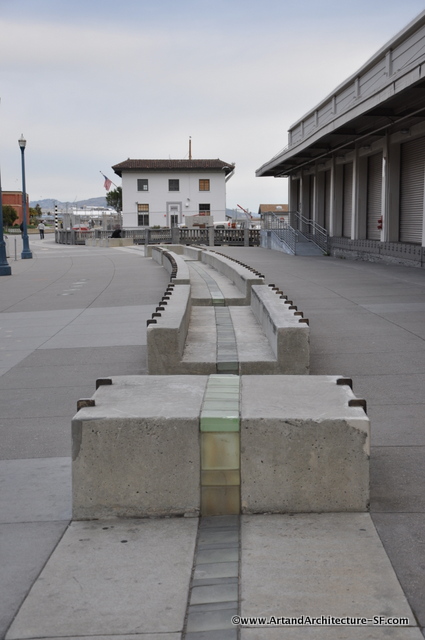
Art Ribbon, one of the first projects to bring design cohesion to the Embarcadero, was a collaboration between architects Vito Acconci, Stanley Saitowitz and Barbara Staufacher. Begun in 1991, it is two miles of lighted glass block set in paving. Due to extensive committee review and resulting modifications to the project, the architects complained Art Ribbon was not the grand idea that they thought the waterfront deserved.

Cupids BowRestaurants and art work are a vital part of the new Embarcadero. See Cupid’s Span


Farmer's MarketFarmers Market at the Ferry Building

Art Ribbon was not only the first step in the process of turning The Embarcadero into a grand boulevard, it was also a pioneering project in which various art and governmental agencies began learning how to interact and live with San Francisco’s vibrant skateboard community.

When Art Ribbon was first constructed, the skateboard community found the sharp edges and different lengths of concrete very appealing; however, chips started appearing almost immediately in the structure from the skateboards. The differing reactions of the architects mirrored the various responses from the community.

Saitowitz asked furiously, “Can’t you understand you’re ruining something that belongs to you, the people?” Solomon, however, responded differently, “I love it that the skateboarders love it, and Stanley hates it that the skateboarders love it.” She felt that skateboarder’s usage was “part of the world.” Acconci also supported the skateboarders with this statement: “Our goal is to make spaces that free people-to make devices and instruments that people can use to do what they’re not supposed to do, to go where they’re not supposed to go.”

Pig EarsPig Ears on the raised portion of the Art Ribbon

Pig Ears on the Embarcadero Ribbon
In 1999 the debate once again become a front burner issue when the city installed SkateBlocks, or “pig ears,” as the police department calls them, on the raised concrete portions of the Ribbon. SkateBlocks are manufactured in Seattle, Washington, by a company called Ravensforge. They are 3-inch high metal brackets that mount onto a surface and are designed specifically to deter skaters and skateboarders.

In December of 1999 the San Francisco Chronicle received a letter to the editor with this comment from reader Caroline Finucane: “I contend that the clips are far uglier and distracting than the skateboard marks and that the kids are actually using the benches in the only way possible. Concrete benches at the water are cold. You can’t sit on them. The Art Commission should lighten up and look at the Art Ribbon as a work in progress, thanks to the skateboarders. By the way, I am a middle-aged lady with a bad leg and I do freeze in my tracks when I hear the kids rolling, but the joy of their riding … pleases me.” Finucane went on to say that the clips were “mean spirited.”

This type of dialogue continuously confronts designers of public spaces, but it also helps to define and redefine how public space is used. Grassroots movements initiated by local communities help designers and government officials stay on top of changing attitudes regarding public property.

In the coming years Art Ribbon will be altered. The present plans call for making much of the Ribbon flush with the promenade. This will essentially make it disappear. Is this just another iteration for the promenade, a spiteful gesture toward skateboarders or the beginning of banal, bland and committee-designed public space?

Embarcadero Art Ribbon

The Abraham Lincoln Brigade

 Posted by on January 16, 2000
Jan 162000
 

Justin Herman Plaza
Embarcadero

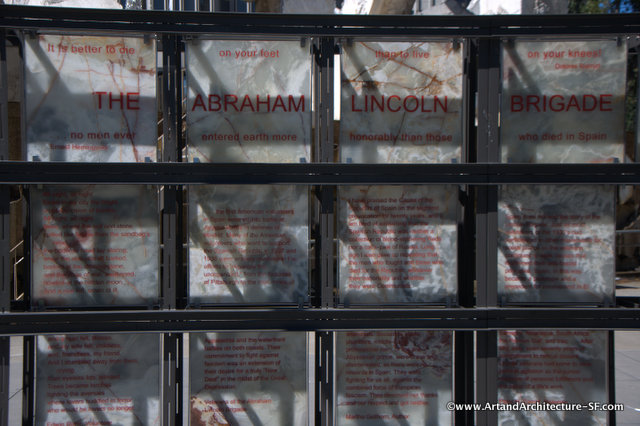
American Lincoln Brigade Memorial
Painted Steel, Onyx, Concrete and Olive Trees


In 1936, General Francisco Franco led a military uprising to overthrow the elected government of Spain. Forty thousand people went to Spain to fight for democracy. The 2,700 Americans who joined the fight were known as the Abraham Lincoln Brigade (ALBA). After Franco gained control of Spain in 1939 with help from both Hitler and Mussolini, the Nazis invaded Poland and World War II began.

The members have continued to fight injustice, supporting various international causes ever since. On Sunday, March 30, 2008, the Veterans of the Abraham Lincoln Brigade unveiled this national monument in Justin Herman Plaza near Vaillancourt Fountain.

The monument was designed by Ann Chamberlain (1951-2008)  and Walter Hood. Visual artist Ann Chamberlain is a former Program Director at the Headlands Center for the Arts who taught at several Bay Area colleges. In collaboration with Ann Hamilton, she designed the card catalog display in the San Francisco Library made with fifty thousand library cards, each with a hand-written note. Walter Hood is professor and former chair of the Landscape Architecture and Environmental Planning Department at the University of California, Berkeley.

The memorial cost $400,000, and was donated by the Abraham Lincoln Brigade Archives and Veterans and Friends of the Abraham Lincoln Brigade.


Fog Bridge #72494

 Posted by on January 13, 2000
Jan 132000
 

Piers 17-19
Embarcadero

Fog Bridge

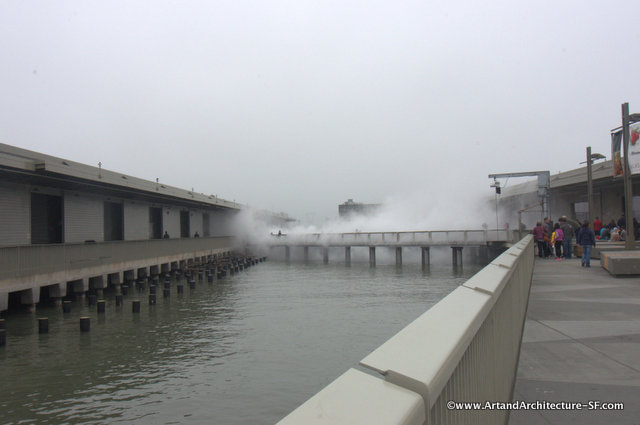
The Fog Bridge sits to the right of the new Exploratorium very near the entrance and was designed by Fujiko Nakaya.

Nakaya’s fog installation stretches across the 150-foot-long pedestrian bridge that spans the water between Piers 15 and 17. Water pumped at high pressure through more than 800 nozzles lining the bridge creates an immersive environment shrouding participants in mist and putting their sense of themselves and their surroundings at the center of their experience.

Although Nakaya’s fog environments have been presented around the world, this is her first project in the San Francisco Bay Area, a region famous for its dramatic fog. With the seventy-fifth anniversary of the Golden Gate Bridge, the completion of the new eastern span of the San Francisco-Oakland Bay Bridge, the America’s Cup, and the reopening of the Exploratorium on the San Francisco waterfront, 2013 is being viewed in San Francisco as the Year of the Bay. Amid all of the water-related activity, Nakaya’s project will heighten public awareness of San Francisco’s dynamic weather and bay ecology for an international public.

Fog Bridge at the Exploratorium


Japanese artist Fujiko Nakaya is the daughter of the physicist and science essayist Ukichiro Nakaya, renowned for his work in glaciology and snow crystal photography. Like her father, Ms. Nakaya’s lifelong artistic investigation engages the element of water and instills a sense of wonder in everyday weather phenomena. Working as part of the legendary group Experiments in Art and Technology (E.A.T.), she enshrouded the Pepsi Pavilion at the 1970 World Exposition in Osaka in vaporous fog, becoming the first artist to create a sculptural fog environment.

Since that first project, Nakaya has created fog gardens, falls, and geysers all over the world. You can experience her permanent fog landscapes at the Nakaya Ukichoro Museum of Snow and Ice in Ishikawa, Japan; the Australian National Gallery in Canberra; and the Jardin de L’Eau, in the Parc de la Villette, Paris. She recently created a fog sculpture for the Guggenheim Museum in Bilbao and consulted with architects Diller Scofidio + Renfro on the Blur Building for the Swiss Expo in 2002 on Lake Neuchatel. Nakaya has also collaborated with artists Trisha Brown, David Tudor, and Bill Viola to develop fog performances and stage sets.

Nakaya collaborated with Thomas Mee, a Los Angeles-based engineer, in the development of her first fog installation in 1970. Mee had originally developed techniques for generating chemical-based artificial fog to protect orchards from frost. Through their collaboration and perseverance, Mee figured out a system for generating water-based artificial fog. The company he founded, Mee Industries, is now operated by his children. Nakaya has been collaborating with Mee for the last forty years.

error: Content is protected !!