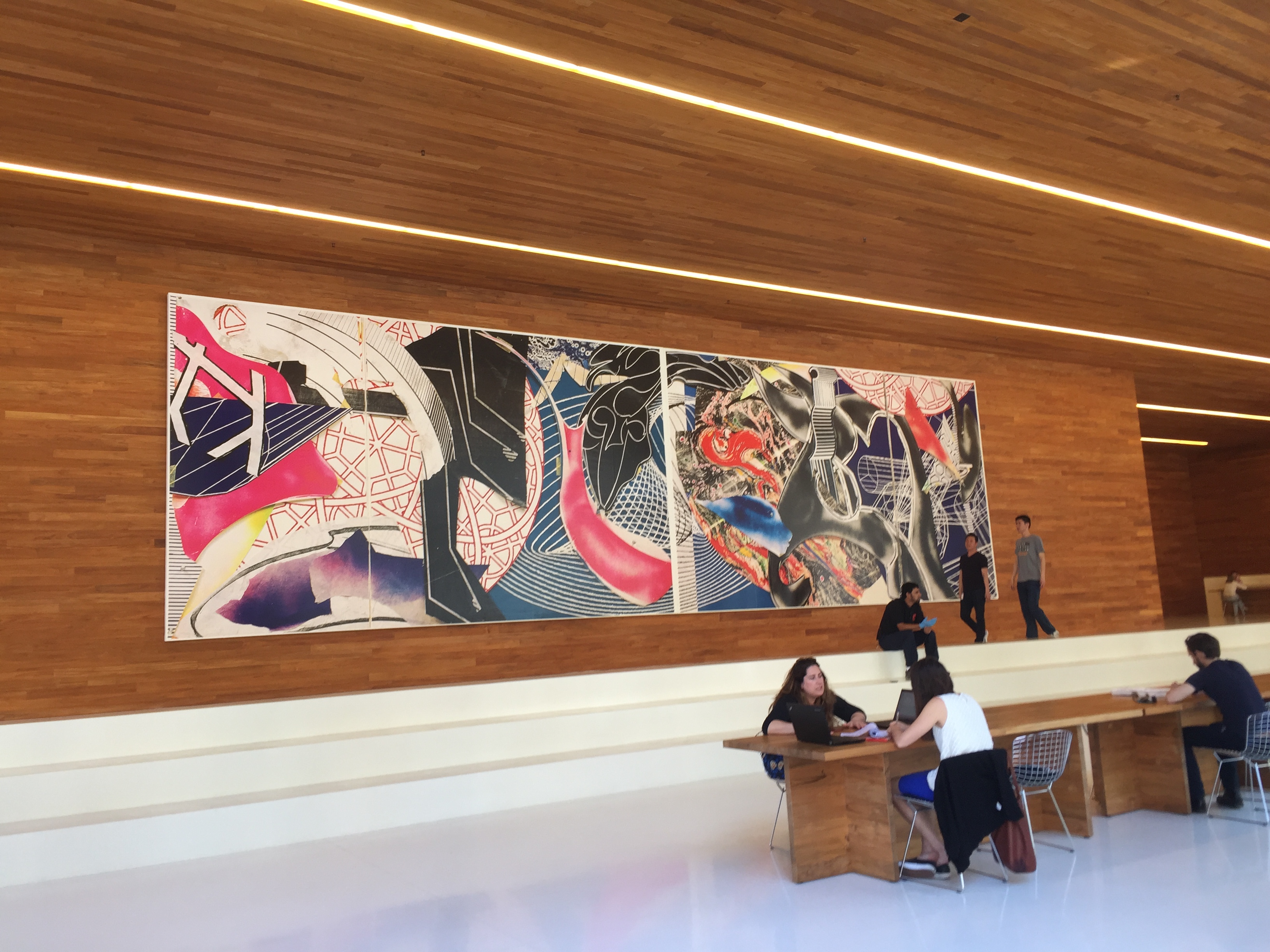
Frank Stella at 222 2nd

 Posted by on September 9, 2017
Sep 092017
 

222 Second Street

222 2nd Street San Francisco

Frank Stella was born in 1936 in Malden, Massachusetts. He studied painting at Phillips Academy in Andover, Massachusetts and at Princeton University. After graduating, he moved to New York and began his career with his renowned series, Black Paintings.

These two pieces by Stella are titled “Riallaro”; a 1997, pixel painting. “The Pequod Meets the Delight”; a 1992, pixel painting,  purchased for $1million.

This area is a Privately Owned Public Open Space in San Francisco.  Open to the public for enjoyment during business hours.

L’Octagon by Pol Bury

 Posted by on April 16, 2013
Apr 162013
 

353 Sansome Street
The Financial District

L'Octagon by Pol BuryL’Octagon by Pol Bury – Marble and Steel

L’Octagon is a result of the 1% for Art program in San Francisco. It is available for viewing between 9:00 am and 5:00 pm. M-F

This lovely sculpture actually moves. The balls slightly fill with water on the bottom and roll approximately 90 degrees, once the water drains they roll back to their upright position.


Pol Bury was born on April 26, 1922 in Haine-Saint-Pierre, Belgium. In 1939 he met the poets Achille Chavée and Andre Lorent and joined their Groupe de recherches surréalistes (Surrealist research group): Ruptures. He then discovered the work of Tanguy and started to paint, influenced by the work of René Magritte.

In 1947 Bury turned towards abstract painting and entered the Jeune Peinture Belge (Young Belgian Painting) group. In 1949 Bury broke away from the group and committed himself to geometric abstraction.

After seeing the Alexander Calder exhibition at the Maeght Gallery in Paris in 1950, Bury began to move away from painting towards three-dimensional work. He moved to Paris in 1961.  He became professor at Paris’s Ecole nationale supérieure des beaux-arts (National School of Fine Arts), where he led a class in monumental sculpture until 1987.

Pol Bury died on September 27, 2005 at the age of 83, in Paris.

The public art requirement created by the downtown plan is commonly known as the “1% for Art” program. This requirement, governed by Section 429 of the Planning Code, provides that construction of a new building or addition of 25,000 square feet or more within the downtown C‐3 district, triggers a requirement that provide public art that equals at least 1% of the total construction cost be provided.

Art at 343 Sansome Street in San Francisco

Credit is given to Pol Bury at the cornerstone of the building.

353 Sansome Street

Sumer #24 by Larry Bell

 Posted by on April 6, 2013
Apr 062013
 

101 Second Street
SOMA Financial District

Summer #24 by Larry BellSumer #24 by Larry Bell – Bronze

Sumer #24 is a result of the POPOS program and the 1% for Art program of San Francisco. While it is viewable through the windows of the building it is available for viewing up close from 8:00 am to 6:00 pm M-F.

Larry Bell (born in 1939 in Chicago, Illinois) is a contemporary American artist and sculptor. He lives and works in Taos, New Mexico, and maintains a studio in Venice, California. From 1957 to 1959 he studied at the Chouinard Art Institute in Los Angeles as a student of Robert Irwin, Richards Ruben,Robert Chuey, and Emerson Woelffer. He is a grant recipient from, among others, the National Endowment for the Arts and the Guggenheim Foundation, and his artworks are found in the collections of many major cultural institutions. Bell’s work has been shown at museums and in public spaces in the United States and abroad over the course of his 40-year career.

Larry Bell’s art addresses the relationship between the art object and its environment through the sculptural and reflective properties of his work. Bell is often associated with Light and Space, a group of mostly West Coast artists whose work is primarily concerned with perceptual experience stemming from the viewer’s interaction with their work.

Art work at the 101 2nd Street POPOS SF

Globe by Topher Delaney

 Posted by on March 22, 2013
Mar 222013
 

299 2nd Street
Courtyard Marriott Hotel – 1st Floor
SOMA – Financial District

Globe by Topher DelaneyGlobe by Topher Delaney – Bronze

This piece is a result of the 1% for Art and POPOS programs in San Francisco.  It is available for viewing from 8:00 am to 6:00 pm. – However, if you step into the Lobby you can view it through the window if the courtyard area is not open.

Topher (Christopher) Delaney‘s  forty year career as an environmental artist has encompassed a wide breadth of projects which focus on the exploration of our cultural interpretations of landscape architecture, public art and the integration within the site spiritual precepts of “nature.”  Her practice, SEAM Studio, has evolved to serves as a venue for the investigation of cultural, social and artistic narratives “seamed” together to form dynamic physical installations.  Ms. Delaney’s projects place an emphasis on the integration of physical form with narratives referencing the currency of a site’s unique historical, cultural, physical and environmental profiles.  Ms. Delaney received her Bachelor of Arts in Landscape Architecture from the University of California at Berkeley after studying philosophy and cultural anthropology at Barnard College.

SEAM studios was responsible for the Fort Mason-SEATS exhibition that can be viewed here.

Public Art at Courtyard by Marriott Hotel on 2nd Street in San Francisco*

Globe by Topher Delaney

Empire Park

 Posted by on March 11, 2013
Mar 112013
 

600 Block of Commercial Street at Kearny
Empire Park
Chinatown

Fountain by Pepo Pichler

Empire Park (once called Grabhorn Park) is a POPOS (privately-owned public open space). It is provided and maintained by, The Empire Group, owners of 505 Montgomery Street. The spire perched atop 505 Montgomery is said to be a replica of the Empire State Building, but that is most likely because a giant inflatable gorilla was hung from the spire to announce the opening of the building.

This tiny little park is an oasis on a beautiful, carless portion of Commercial Street. The delightful water feature is by Pepo Pichler and is the focal point of the courtyard. In the spring, the entrance is draped in white wisteria. Other highlights are gigantic tree ferns planted throughout and potato vines climbing up the surrounding buildings.

Pepo Pilcher was born in 1948 in Klagenfurt, Austria. He studied at the Vienna Academy of Fine Arts. He moved to San Francisco in 1975 and now commutes between Austria and San Francisco.

Empire Park in San Francisco

This street holds so much San Francisco History:

Not far from Empire Park at  650/652 Commercial Street is the former site of the Eureka which was once the site of the Eureka Lodgings, where, paying 50 cents a day, Emperor Norton lived for 17 years, from sometime in either late 1862 or early 1863 until his death in January of 1880.

Emperor Norton in the 1870s. (Source – Collection of the California Historical Society)

In the newspaper offices of The San Francisco Call Building, next door at 636 Commercial one could have found Mark Twain writing at his desk on the 3rd floor during his 18-month tenure in the 1860s, or Bret Harte, working for the Mint just one floor down in sublet offices on the second floor.

Twain once wrote of Emperor Norton: “Oh, dear, it was always a painful thing to me to see the Emperor (Norton I., of San Francisco) begging; for although nobody else believed he was an Emperor, he believed it. … What an odd thing it is, that neither Frank Soulé, nor Charley Warren Stoddard, nor I, nor Bret Harte the Immortal Bilk, nor any other professionally literary person of S.F., has ever “written up” the Emperor Norton. Nobody has ever written him up who was able to see any but his (ludicrous or his) grotesque side; but I think that with all his dirt & unsavoriness there was a pathetic side to him. Anybody who said so in print would be laughed at in S.F., doubtless, but no matter, I have seen the Emperor when his dignity was wounded; and when he was both hurt & indignant at the dishonoring of an imperial draft; & when he was full of trouble & bodings on account of the presence of the Russian fleet, he connecting it with his refusal to ally himself with the Romanoffs by marriage, & believing these ships were come to take advantage of his entanglements with Peru & Bolivia; I have seen him in all his various moods & tenses, & there was always more room for pity than laughter. He believed he was a natural son of one of the English Georges–but I wander from my subject.”
– letter to William Dean Howells, September 3, 1880

Despite this letter, Twain would later base the character of “The King” in The Adventures of Huckleberry Finn, on Emperor Norton.


First U.S. Branch Mint

608 Commerical Street:

The original mint is no longer there. At present, the home of the San Francisco Historical Society occupies the 1875 U.S. Subtreasury Building, which was built after the original mint building was demolished.

Privately-owned public open spaces (POPOS) are publicly accessible spaces in forms of plazas, terraces, atriums, small parks, and even snippets that are provided and maintained by private developers. In San Francisco, POPOS mostly appear in the Downtown office district area. Prior to 1985, developers provided POPOS under three general circumstances: voluntarily, in exchange for a density bonus, or as a condition of approval. The 1985 Downtown Plan created the first systemic requirements for developers to provide publicly accessible open space as a part of projects.

The Downtown Plan also established the “1% Art Program” which is how the fountain came to be.

Mar 072013
 

150 California Street
POPOS on the 6th Floor Terrace
Open 9 am to 6 pm

Arch by Edward Carptenter

Ed Carpenter is an artist specializing in large-scale public installations ranging from architectural sculpture to infrastructure design. Since 1973 he has completed scores of projects for public, corporate, and ecclesiastical clients. Working internationally from his studio in Portland, Oregon, Carpenter collaborates with a variety of expert consultants, sub-contractors, and studio assistants. He personally oversees every step of each commission, and installs them himself with a crew of long-time helpers.

While an interest in light has been fundamental to virtually all of Carpenter’s work, he also embraces commissions that require new approaches and skills. Recent projects include interior and exterior sculptures, bridges, towers, and gateways. His use of glass in new configurations, programmed artificial lighting, and unusual tension structures have broken new ground in architectural art.

Carpenter is grandson of a painter/sculptor, and step-son of an architect, in whose office he worked summers as a teenager. He studied architectural glass art under artists in England and Germany during the early 1970’s

Ed Carpenter at 150 California Street


150 California Street is a 22 story office tower in the heart of the downtown San Francisco´s business district. Its sixth floor roof garden provides landscaped outdoor space for the building´s workers. The owner´s unusual challenges to the artist were first to create a sculpture which would disguise and ameliorate a large air vent and diesel exhaust stack emerging into the roof garden, and second that the sculpture should add to the ambience of the garden for its users. Ed Carpenter´s solution to this brief incorporates both the vent and the stack into an arbor-like aluminum and stainless steel tension structure. Integrated into the structure is a network of tension cables supporting laminated dichroic glass details designed to cast delicate projections and reflections of colored light onto surrounding architectural surfaces. The sculpture provides an arching contrast to the surrounding skyscrapers and creates an inviting space beneath its 54´ span for workers on their breaks.

150 California Street POPOS


Privately-owned public open spaces (POPOS) are publicly accessible spaces in forms of plazas, terraces, atriums, small parks, and even snippets that are provided and maintained by private developers. In San Francisco, POPOS mostly appear in the Downtown office district area. Prior to 1985, developers provided POPOS under three general circumstances: voluntarily, in exchange for a density bonus, or as a condition of approval. The 1985 Downtown Plan created the first systemic requirements for developers to provide publicly accessible open space.

The Downtown Plan also established the “1% Art Program”.

Mar 062013
 

1 Sansome Street
POPOS
Open During Business Hours

The Star Girl at 1 Sansome StreetStar Maiden by Stirling Calder

(Alexander) Stirling Calder attended the Pennsylvania Academy of Fine Arts, in 1885, at the age of 16. Here he studied under Thomas Eakins. He apprenticed as a sculptor the following year, working on his father’s extensive sculpture program for Philadelphia City Hall, and is reported to have modeled the arm of one of the figures. In 1890, he moved to Paris where he studied at the Académie Julian under Henri Michel Chapu, and then was accepted in the École nationale supérieure des Beaux-Arts where he entered the atelier of Alexandre Falguière.

In 1912, he was named acting-chief (under Karl Bitter) of the sculpture program for the Panama-Pacific Exposition, a World’s Fair to open in San Francisco, California in February 1915. He obtained a studio in NYC and there employed the services of model Audrey Munson who posed for him for Star Maiden (1913–15) – (labeled Star Girl on this piece).

For the Exposition, Calder completed three massive sculpture groups, The Nations of the East and The Nations of the West, which crowned triumphal arches, and a fountain group, The Fountain of Energy.

Nations of the West was a massive sculpture group that crowned the Arch of the Setting Sun. The second group, The Nations of the East (including a life-size elephant), crowned the Arch of the Rising Sun.

Bronze’s, if the molds are available, are easy to replicate and therefore there can be many copies of an original piece. This replica was commissioned by Citigroup in 1985 with permission from Margaret Calder Hayes, daughter of Stirling Calder and brother of Alexander (Sandy) Calder.

1 Sansome Street POPOS


Star maiden sits in this atrium and is one of San Francisco’s many POPOS.  What is now the conservatory was the original structure of The Anglo and London Paris National Bank, which through a series of mergers and consolidations over the years became the Crocker Anglo Bank branch of the Crocker Bank in 1956 and continued to occupy the building through 1981.

Completed in 1910 by renowned San Francisco architect Albert Pissis as The Anglo and London Paris National Bank, the buildings original construction was a steel frame, reinforced concrete, granite clad two-story building constructed in traditional temple form complete with 38’ high Doric columns. Like many other banks built in San Francisco at the time, it was designed in the classical temple form to symbolize the significant role of the financial institution in the community.

In 1915 the bank expanded into the adjoining Holbrook Building at 58-64 Sutter Street, and in 1921 another San Francisco architect, George Kelham, was commissioned to design an addition to the building. The resulting design nearly tripled the area of the original building and expanded the Sansome Street frontage from one to five bays. The Kelham addition repeated the same giant order of the original building but placed the entrance in the recessed porch as it stands today.

CitiBank placed a 43-story office tower adjacent to the original bank structure in 1980, preserving only the original bank as the conservatory and a cutaway of the front that can be viewed if one enters the office tower lobby.

original 1 Sansome Street Building

Anish Kapoor in San Francisco

 Posted by on February 22, 2013
Feb 222013
 

235 2nd Street
SOMA Financial District

Making the World Many by Anish KapoorMaking the World Many by Anish Kapoor – Stainless Steel

Making the World Many is part of the 1% for Arts and POPOS programs of San Francisco.  While viewable through the building window, the piece is available for closer viewing from 8:00 am to 6:00 pm M-F.

Anish Kapoor, (born 12 March 1954) is an Indian-born British sculptor born in Mumbai. Kapoor has lived and worked in London since the early 1970s when he moved to study art, first at the Hornsey College of Art and later at the Chelsea School of Art and Design.

He represented Britain in the XLIV Venice Biennale in 1990, when he was awarded the Premio Duemila Prize. In 1991 he received the Turner Prize and in 2002 received the Unilever Commission for the Turbine Hall at Tate Modern. His most notable U.S. public sculptures include Cloud Gate, Millennium Park, Chicago, Sky Mirror exhibited at the Rockefeller Center, New York.

Anish Kapoor became known in the 1980s for his geometric or biomorphic sculptures made using simple materials such as granite, limestone, marble, pigment and plaster.  In the late 1980s and 1990s, he was acclaimed for his explorations of matter and non-matter, specifically evoking the void in both free-standing sculptural works and ambitious installations.  Since 1995, he has worked with the highly reflective surface of polished stainless steel. These works are mirror-like, reflecting or distorting the viewer and surroundings.

Core by Charles Arnoldi

 Posted by on February 20, 2013
Feb 202013
 

101 2nd Street
SOMA – Financial District

Core by Charles ArnoldoCore by Charles Arnoldi – Acrylic on Canvas

Core is a result of the POPOS and 1% for Art programs of San Francisco.  While viewable through the buildings glass it is available for closer viewing from 8:00 am to 6:00 pm M-F.

Charles Arnoldi was born April 10, 1946 in Dayton, Ohio.

While visiting a girlfriend’s grandmother in New York, he took the opportunity to view works by Jackson Pollock and Willem de Kooning. Observing their smudges, smears, and imperfections, he sensed that he too was capable of such work, and decided to attend art school. Arnoldi attended junior college in Ventura, California, where a professor convinced him to apply to the Art Center in Los Angeles. He was accepted with a scholarship, and enrolled in commercial illustration classes. It was the late 1960s, and Arnoldi recalls a stifling classroom environment where male students were required to wear ties. After only two weeks, he left and transferred to the Chouinard Art Institute in Los Angeles in 1968, where he remained for eight months before deciding to abandon his formal education and complete his training through his art practice. Arnoldi began using actual tree branches as a compositional element in his works, combined with painting to create stick constructions. These works did not endeavor to create illusions but rather inhabited physical space.

In the early 1970s, the artist attracted attention for his wall-relief wood sculptures, holding his first solo exhibition at the Riko Mizuno Gallery in Los Angeles in 1971. The following year he was included in Documenta V, Kassel, Germany, 1972. The use of wood has remained a feature of Arnoldi’s oeuvre, although since the 1980s he has often employed it in combination with other media. Roark, in the collection of the Honolulu Museum of Art, is a bronze sculpture that closely resembles wood.

He played himself in the 2005 film, Sketches of Frank Gehry, directed by Sydney Pollack. Arnoldi lives and works in Los Angeles.

A Joan Brown Obelisk at 343 Sansome Street

 Posted by on February 15, 2013
Feb 152013
 

343 Sansome Street
The Financial District

Joan Brown Obelisk at 343 Sansome StreetFour Seasons by Joan Brown

This tiled obelisk is by Joan Brown. Joan Brown was an American figurative painter who was born in San Francisco and lived and worked in Northern California. She was a notable member of the “second generation” of the Bay Area Figurative Movement.

She studied at the California School of Fine Art (now San Francisco Art Institute), where her teachers included Elmer Bischoff.   Her sculpture is not as well known, and yet she did several of these obelisks, there are at least 3 in San Francisco.  These include the Pine Tree Obelisk in Sidney Walton Park, Obelisk in the Rincon Center, and this one.  Sadly, in 1990, she was killed while doing an obelisk installation in India.

The sculpture is a result of both the 1% for Arts Program and the POPOS program of San Francisco and is available for viewing between 9:00 am and 5:00 pm Monday through Friday.

Joan Brown's Four Seasons

*

Art in the POPOS at 343 Montgomery

Privately-owned public open spaces (POPOS) are publicly accessible spaces in forms of plazas, terraces, atriums, small parks, and even snippets that are provided and maintained by private developers. In San Francisco, POPOS mostly appear in the Downtown office district area. The 1985 Downtown Plan created the first systemic requirements for developers to provide publicly accessible open space as a part of projects.

The public art requirement created by the downtown plan is commonly known as the “1% for Art” program. This requirement, governed by Section 429 of the Planning Code, provides that construction of a new building or addition of 25,000 square feet or more within the downtown C‐3 district, triggers a requirement that provide public art that equals at least 1% of the total construction cost be provided.


Jon Krawcyzk in SOMA

 Posted by on July 8, 2012
Jul 082012
 
SOMA
303 2nd Street
*
*


Jon Krawczyk’s new sculpture sits in the public space of 303 2nd Street . It is a central part of a recent redesign by Gensler and landscape architects Smith + Smith for owner Kilroy Realty.

Krawczyk’s steel and bronze sculptures divulge organic gestures that are the antithesis of the material. According to a correspondent for Art in America, his sensual and timeless works “elicit similarly tactile responses” from his viewers.

A graduate from Connecticut College, Krawczyk has studied fine art throughout Europe. Krawczyk’s sculptures have been exhibited in galleries and public arenas across the nation, and are part of several private international collections.

Krawczyk works on many scales, but this massive piece is truly impressive and gorgeous, his love for organic shapes shines in this piece.

Feb 102012
 
Financial District
600 California Street
 Three Bridges by Kent Roberts – 1992
Public Art made possible by the 1% for Public Art Program
 Kent Roberts has appeared in this site before.  Roberts has a BFA and an MFA from the San Francisco Art Institute.  He also has a BS in Mechanical Engineering from the University of New Mexico. He presently works at SFMOMA.


SOMA – Poetry Sculpture Garden

 Posted by on February 7, 2012
Feb 072012
 
SOMA
Financial District
199 Fremont Street
Poetry Sculpture Garden

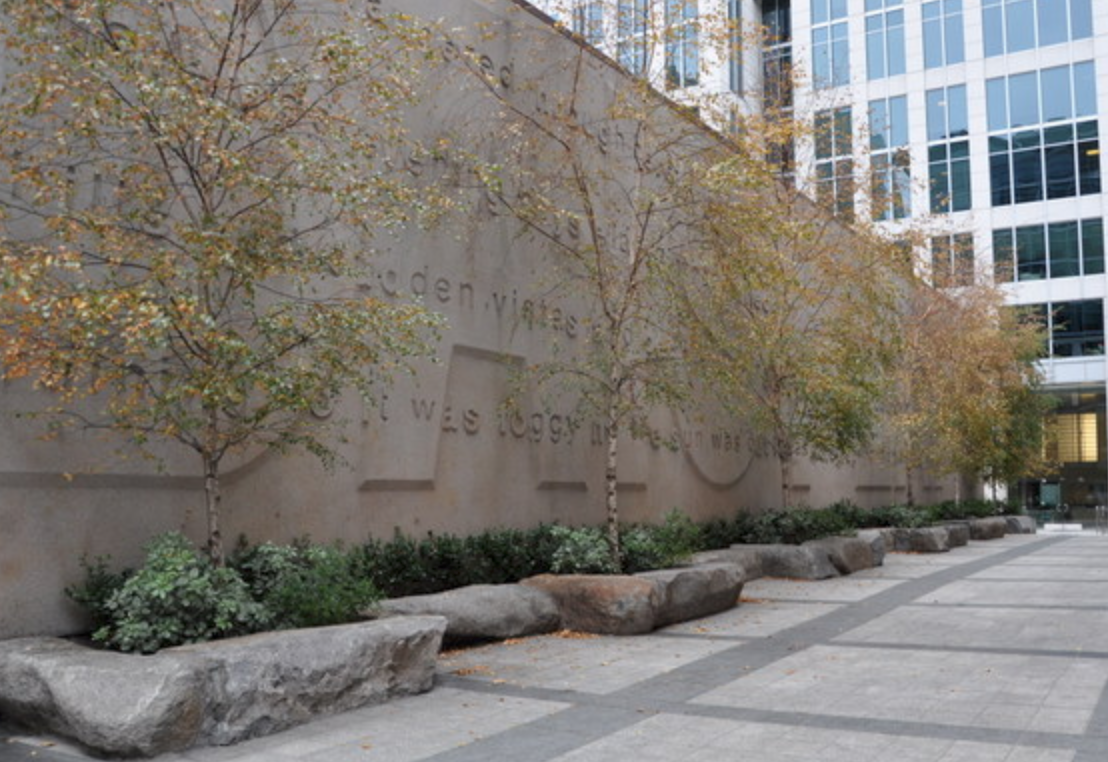
The plaque on the side of the wall explains the area like this:

199 Fremont poetry/sculpture garden is a unique collaborative piece that combines the talents of Robert Hass, a world famous poet, and Paul Kos, a world-class sculptor.

The garden is composed of three major elements:

A large installation of the plaza’s Sierra granite as a sculptural form.

Sculptor Kos’s setting of Poet Hass’ words in the wall of the plaza.

In the place of a fountain, a small, witty set of faucets, sited quietly in the back of the plaza and designed to drip – or “tick like a clock” in a way that makes a sort of rhyme with Hass’ words – which evoke the times of day and times of year, and the passage of time in a busy downtown plaza.

The plaza is configured with rough granite seating stones with plantings of birch trees, mountain shrubs and flowers meant to be suggestive of the Sierra Mountains.

The center of interest in the plaza is a massive 86-ton boulder Kos found in Soda Springs. This “Big Bertha” boulder casts its own reflection…somewhat like an impressionist painting as the reflecting brushstrokes are comprised of smaller boulders and sliced pavers.

Behind the large boulder Kos’ minimalist fountain is one of the smallest of any in a display of public art. Housed like a small grotto with a small reflecting pool, the fountain functions as a witty small clock, a recollection of the way time is measured out; an evocation of gardens and leisure to be had elsewhere than in a busy city. It is a subtle reminder of how precious water is to the life of California

The combination of fountain, clock, grotto and pool ticks off seconds for Hass’ time-based words: when? NOW why? “DAYS ELAPSE” Or, as Hass’ punning, half hidden inscription has it “DAISY LAPS”.

The whole installation – the granite stone, the faucet/clock and the sculptural setting of the poem, peeking out between birch leaves and the midday sun, manages to convey something of the life of the city, something of the regional roots of its building materials, the post-modern playfulness of its early twenty-first century artist, and to provide a warm escape into an idea of a garden, or a back country meadow in the middle of the busy city.”

Photo Credit: the artist and Gallery Paule Anglim

About the artists

One of America’s greatest know poets, Robert Hass, a former Poet Laureate of the United States, a professor of English at UC Berkeley, is also a native San Franciscan.

Paul Kos, an acclaimed sculptor in the conceptual and minimalist tradition, has undertaken many public art projects in the Bay Area – from a stained glass window, fashioned from color television sets in the shape of a Gothic arch in an underground chapel in the Napa Valley to a relief at the the State Archive Building in Sacramento.

The poem is difficult to read with the trees – I was unable to find entire thing, but here is a snippet for your pleasure:

“An echo wandered through here what? an echo wandered through hear it? there was morning and later/there was evening days elapse what? a reck oh! wan where are we going this city of stone and/hills and sudden vistas and people rushing to their various appointments what points the way?”

 Big Bertha by Paul Kos

The site also includes the Marine Electric Building, which houses a child care center and Town Hall Restaurant.

The Landscape Architect on the project was Antonia Bava.

UPDATE September 2018.  As of this date, the only portion of the art installation remaining is Big Bertha.  The fountain and the poetry wall are gone.

The reasons are explained in this San Francisco Chronicle article, that author agrees with me that it was a shame to do what they did to this public space.

Missing Poetry Wall

SOMA – Waterwall

 Posted by on December 9, 2011
Dec 092011
 
SOMA
100 First Street
2nd Floor
Scattered across downtown San Francisco are almost seventy semi-secret spaces, privately owned but open to the public. Subject to the fine print of a little-known pact between the city and business, these POPOS (Privately Owned Public Open Spaces) allow alluring vistas of San Francisco and access to its intimate interiors.  This little gem is up a flight of exterior stairs off Mission Street.
*
This black granite and glass piece is titled Waterwall by John Luebtow.  Over the past 30 years, John Luebtow has become one of the most respected names in contemporary glass sculpture. He holds a BA from California Lutheran College, and two distinct MFAs from UCLA (one in ceramics and one in glass).
Luebtow has devoted much of his career to teaching in Los Angeles.  His website shows off his amazing work.
*
This area is really rather lovely, there is a delicatessen on the plaza level, should you wish to stop in for a nice outdoor lunch, there are also public restrooms available, last time I looked.

Art at One Market Street

 Posted by on January 18, 2000
Jan 182000
 

1 Market Street
The Embarcadero

Float by Mark Lere

San Francisco has many laws regarding open space and art work. This piece sits just inside the doors of 1 Market Street. Both pieces of this installation are available to view through the windows, or are available to see up close between 7:00 am and 6:30 pm.

This installation is part of the POPOS and the 1% for Art programs.

Privately-owned public open spaces (POPOS) are publicly accessible spaces in forms of plazas, terraces, atriums, small parks, and even snippets that are provided and maintained by private developers. In San Francisco, POPOS mostly appear in the Downtown office district area. Prior to 1985, developers provided POPOS under three general circumstances: voluntarily, in exchange for a density bonus, or as a condition of approval. The 1985 Downtown Plan created the first systemic requirements for developers to provide publicly accessible open space as a part of projects in C-3 Districts. The goal was to “provide in the downtown quality open space in sufficient quantity and variety to meet the needs of downtown workers, residents and visitors.”

The Downtown Plan also established the “1% Art Program”. This requirement, governed by Section 429 of the Planning Code, provides that construction of a new building or addition of 25,000 square feet or more within the downtown C-3 district, triggers a requirement that provide public art that equals at least 1% of the total construction cost. Beginning January 1, 2013, public art will be required beyond the traditional downtown for non-residential projects within South of Market, DTR and certain EN and C-2 zoning districts.

Art at One Market Street, SFFloat by Mark Lere – Metal/Bronze

Mark Lere was born in LaMoure, ND in 1950.  He received a Bachelor of Fine Arts from the Metropolitan State College, in Denver, Colorado, and a Master of Fine Arts from UC Irvine. Language, used in a title or as part of a piece, is an important element in his work. He currently lives and works in the Los Angeles area.

error: Content is protected !!