Skydancing

 Posted by on June 28, 2018
Jun 282018
 

Laguna Honda Hospital
Pavillion Atrium
375 Laguna Honda Boulevard
Forest Hill

Sky Dancing by Takenobu Igarashi

This is Skydancing by Takenobu Igarashi they are painted aluminum sculptures, reminiscent of blossoms and suspended from aircraft cables.

Sky Dancing by Japanese artist Igarashi has taught at Chiba University and the University of California, Los Angeles (UCLA). He collaborated in the foundation of the Faculty of Design at Tama Art University (Kaminoge Campus) to set up the first computerized design education in Japan and was the first Head of the Design Department.

In 1994, he ended his 25 years of design activity and moved to Los Angeles to become a sculptor. After working with marble, he discovered terracotta and wood as his material. He returned to Japan in June 2004.

Representative works are in the permanent collection of over 30 museums worldwide including MoMA. He has been awarded the Commendation of the Minister of Foreign Affairs, Katsumi Masaru Award, the Mainichi Design Award, the IF Design Award and the Good Design Award for his achievements and activities in the field of graphics and product design.

Igarashi has been an emeritus professor at Tama Art University since April 2015.

The hospital had a $3 million budget for the artwork within the new wing of the hospital, thanks to the 1% for art requirement in San Francisco public buildings.

The budget for the three pieces provided by Takenobu Igarashi was $238,686

Much of the art at Laguna Honda is not accessible to the general public, so only 2 of Igarashi’s 3 pieces appear in this website.

Laguna Line

 Posted by on June 14, 2018
Jun 142018
 

Laguna Honda Hospital
375 Laguna Honda Boulevard
Forest Hill


Laguna Line by Cliff Garten

Laguna Line (The possibility of the Everyday), 2010 Bronze with patina

By observing Laguna Honda residents using wheelchairs and the handrails located throughout the building, Cliff Garten saw the potential for a public artwork in the form of a handrail. While meeting all codes and functional requirements, he transformed a ubiquitous handrail into a sensuous sculpture that addresses the space at a visual, tactile and psychological level. The Esplanade features approximately 600 feet of sculptural handrail elements that interpolate the interactive qualities of the handrail into other situations and activities in the hospital. The handrail is cast in bronze and embellished with the color palette of the Esplanade, providing additional visual cues as people navigate through the space.

Cliff Garten has been on this site before.

Laguna Line by Cliff Garten

*Laguna Line by Cliff Garten

The 604 linear heet of Handrails was commissioned by the SFAC at a cost of $238,108.

Reflections

 Posted by on June 12, 2018
Jun 122018
 

Laguna Honda Hospital
135 Laguna Honda
Forest Hills

Reflections by Diana Pumpelly Bates

This bi-fold, water-cut, stainless steel access door is by Diana Pumpelly Bates. The design incorporates selected elements of the new architecture of the hospital and imagery derived from the surrounding environment. The relationship of the lines and shapes in the imagery are intended to suggest a “landscape of reflection.”

Reflections by Diana Pumpelly Bates

Diana Pumpelly Bates is a sculptor and public artist working in bronze, iron, and steel. Her work has been included in exhibitions at the Oakland Museum, Oakland, The Triton Museum in Santa Clara,  the Oliver Art Center at California College of Arts and Crafts; the National Civil Rights Museum, Memphis, Tennessee; and John Jay College, New York. She has completed several public art commissions for transportation agencies, and a number of Public Art Programs in Northern California.

The backside of the door shows its workings.

Reflections by Diana Pumpelly Bates

The gates were commissioned by the SFAC for $100,000.

Breath Between Sky and Ocean

 Posted by on August 9, 2017
Aug 092017
 

San Francisco General Hospital
1001 Potrero Avenue
Potrero Hill
Roof Garden of the Acute Care Building
7th Floor

Breath Between Sky and Ocean by Masayuki Nagase

Breath Between Sky and Ocean by Masayuki Nagase was created in 2015 and consists of two hand-carved granite boulders (4 ft. by 4 ft. by 4 ft.), five polished and carved granite benches (5 ft. by 6 ft. by 18 in. each) and eight polished and carved pavers.

Masayuki Nagase SFGHThe artist’s design depicts a series of ripples carved into the boulders to express themes of water and wind, and the design on the stone pavers has polished surfaces and carved cloud-like forms.

SFGH Roof Garden

Masayuki Nagase was born in Kyoto, Japan. He began his career as an artist by studying painting at the Academy of Fine Arts in Tokyo from 1968-1971. From 1971-1976 he trained in a traditional stone-carving apprenticeship in the granite quarries of Inada in Ibaragi-ken, Japan.

In 1995, Nagase became a resident of the US and established a studio with his wife, Michele Ku in Berkeley, California.

These pieces were purchased by the San Francisco Arts Commission for $200,000.

The Park Emergency Hospital

 Posted by on August 29, 2016
Aug 292016
 

811 Stanyan
Golden Gate Park

San Francisco Emergency Hospital The Park Emergency Hospital is part of a system of Emergency Hospitals that existed in San Francisco during the early 1900s.  There were four of them.  Park, Central (in Civic Center and still functioning), Alemany and Harbor (since torn down).

This particular hospital has been designated City Landmark #201. Built in 1902, at a cost of $8488, it functioned as a hospital until 1978.  It remained an ambulance station until 1991, and it now serves as offices for the Rec and Park District.

San Francisco architecture Emergency HospitalsThe architect was Newton J. Tharp.  The San Francisco ran his obituary on May 13, 1910:

THARP, NEWTON J. An architect, died in New York City, May 12, 1909. He was born in Mount Pleasant, Iowa, July 28, 1867, and with his parents moved to California in 1874. He spent four years at the San Francisco School of Design and in 1896 went to Europe to study. At the time of his death, he was City Architect of San Francisco. Among the public buildings designed by him in this capacity are the Hall of Justice, the Infirmary, and a group of hospital buildings.

Sudden Death of City’s Architect, Newton J. Tharp
Succumbs After Brief Illness While in New York City

Stricken with pneumonia while in the full vigor of manhood, Newton J. Tharp, city architect of San Francisco, succumbed to the disease yesterday at the Knickerbocker hotel in New York city, and gloom now pervades his home in this city, the municipal offices, where he was respected as an honorable and able official, and the Bohemian club, where he had been styled a “prince of good fellows.” Engaged in the study of modern eastern municipal structures, the knowledge from which he was to use for the benefit of San Francisco, the deceased thought little of his own personal comfort or health, and as a result he leaves a widow prostrated with grief, and a host of friends stunned by the news of his death.

It seems like the irony of fate that when he was attacked by the disease which caused his death Newton Tharp was engaged in the work of studying the modern hospitals of New York and gathering data for use in drawing plans for a hospital where San Francisco’s poor could be restored to health.

Studying Hospitals

Having completed the plans for all of the other municipal buildings contemplated, Tharp was sent east by the board of supervisors April 25 to gather data on the construction of hospitals. He was accompanied by his son, Laurence, 13 years of age. Prior to his departure he talked enthusiastically of his plans with friends at the Bohemian club, of which he was a member.

The architect wrote daily to his wife, who remained at their home, 1600 Lyon street until a week ago, when the letters ceased. The next heard from him was a telegram to Mrs. Tharp, received Saturday night, which read:

“Have been slightly ill, but will be all right tomorrow. Do not mind Laurence’s letter.”

The letter referred to was written by his son, and stated that Tharp was very ill. The first warning of real danger came Tuesday evening in a telegram from Ernest Peixotto of this city, but now in New York, to his brother, Edgar Peixotto, well known local attorney and lifelong friend of Tharp.

Widow Is Overcome

Mrs. Tharp was told that her husband was seriously ill and was preparing to go to him yesterday, when messages announcing his death were received simultaneously at the office of the board of supervisors and by Edgar Peixotto. The shock proved too much for the widow’s strength, and she collapsed. She is attended constantly by her sister Mrs. E. M. Polnemus of Los Angeles, who is here on a visit.

Flags were lowered to half mast on all municipal buildings as soon as the news reached here, as well as at the Bohemian club. Grief and astonishment were expressed on all sides.

Edgar Peixotto, at the request of Mrs. Tharp, took charge yesterday of the disposition of the remains. It was decided last night to have the body cremated in New York, and have the ashes brought home.

Newton J. Tharp was born in Petaluma [Iowa] 42 years ago, and was one of eight children. He spent his early years in that town [Petaluma], and was a playmate of Luther Burbank, the renowned scientist. During his youth he went to Chicago, where he took up the study of architecture and painting. Later he went to Paris, where he attended the institute of Beaux Arts. Having traveled in Europe for two years he returned to the United States and practiced his profession as an architect in New York and Chicago, but decided to settle in San Francisco in 1889.

Tharp was married to Miss Laura Hanna in Los Angeles in June, 1892, and is survived by her and their young son.

Well Known as Architect

The deceased architect was first employed by the late Edward R. Swain in this city; and on the death of the latter perfected the plans for the present ferry building. He became the senior member of the firm of Tharp & Holmes and designed the Dewey monument in Union square, as well as the Grant building, the Sloane building, the Whittier residence, the beautiful Martin home in Ross valley and other well known structures. He became city architect in October, 1907, and planned all of the new municipal structures now under course of erection.

Tharp was one of the most beloved members of the Bohemian club, of which he was a prominent member. He acted as sire of the midsummer jinks of 1904, when the “Quest of (unreadable)” was the theme. He was also a member of the American Institute of architects and a director of the San Francisco art institute.

Funeral Services for Newton Tharp: Throngs of Friends of the Late City Architect Crowd Grace Episcopal Church: Ashes Laid to Rest in Columbarium Odd Fellows’ Cemetery

In the presence of a large gathering, which included Mayor Taylor and the city officials, funeral services were read over the remains of Newton J. Tharp, the late city architect in Grace Episcopal church, yesterday afternoon.

Besides the officials there were present many of his old friends from the Bohemian club and from among the ranks of his profession, who completely filled the church and, by their numbers gave evident indication of the esteem in which Tharp had been held.

The funeral oration, delivered by Rev. David Evans the rector of the church, was extremely brief. “He shall be remembered as a man by his virtues and his characteristics,” said the speaker, “and as a laborer and workman by the material monuments of his profession.”

The services opened with the playing of Mendelssohn’s “Funeral March” by H.J. Stewart, the church organist. The Bohemian club quartet sang, “Lead Kindly Light” and “Abide With Me.” The urn containing the ashes was surrounded by a wealth of flowers, among them being wreathes from Mayor Taylor, Tharp’s office and from the classmates of Laurence Tharp. At the conclusion of the services the ashes were removed to their final resting place in the columbarium at Odd Fellows’ Cemetery.

An Ambulance in front of the hospital when it first opened.

An Ambulance in front of the hospital when it first opened.

The hospital after the 1906 earthquake

The hospital after the 1906 earthquake

Historic Old Clock

 Posted by on July 27, 2013
Jul 272013
 

400 Parnassus
UCSF Medical Center
Inner Sunset

Clock at UCSF*

DSC_1915

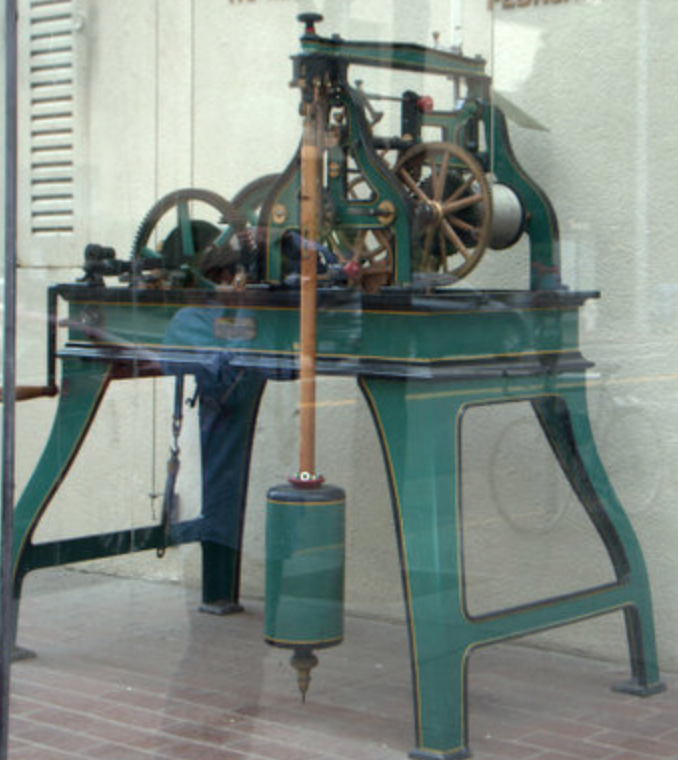
Carried by ship around Cape Horn, this Seth Thomas Clock was installed on the medical school of the affiliated colleges in 1897. Surviving the 1906 earthquake, it served the university and community for 70 years. Members of the UCSF family have made possible its restoration as a campus landmark.

February 20, 1982

Seth Thomas was born in Wolcott, Connecticut, in 1785. He was apprenticed as a carpenter and joiner, and worked building houses and barns. He started in the clock business in 1807, working for clockmaker Eli Terry. Thomas formed a clock-making partnership in Plymouth, Connecticut with Eli Terry and Silas Hoadley as Terry, Thomas & Hoadley.  They made tall clocks with wooden movements.

In 1810, he bought out Terry’s share of the clock business, and in 1812 he sold his partnership and moved to Plymouth Hollow, Connecticut .  Here  he set up a factory with the intention to make metal-movement clocks. In 1817, he added shelf and mantel clocks. By the mid-1840s, he changed over to brass movements.  He died in 1859, and the company was taken over by his son, Aaron.  Aaron added many styles and improvements after his father’s death. The company went out of business in the 1980s.

DSC_1916

Regardless of History

 Posted by on July 20, 2013
Jul 202013
 

400 Parnassus
UCSF Medical Center
Inner Sunset

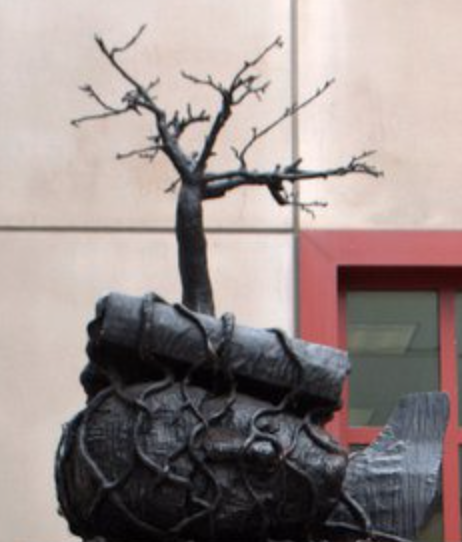
Regardless of HistoryRegardless of History by Bill Woodrow

 Bill Woodrow (1948) was one of a number of British sculptors to emerge in the late 1970s onto the international contemporary art scene.

Woodrow’s early work was made from materials found in dumps, used car lots and scrap yards, partially embedded in plaster and appearing as if they had been excavated. He went on to use large consumer goods, such as refrigerators and cars, cutting the sheet metal and allowing the original structure to remain identifiable, with the cut-out attached as if by an umbilical cord to the mother form. Collecting all manner of things, altering them and giving them a new context, allowed Bill Woodrow an element of narrative in his work.

Regardless of History is a quarter scale version of a sculpture with the same title created for the empty fourth plinth in Trafalgar Square in London, England, which was installed there from the spring of 2000 to the summer of 2001. Bill Woodrow chose to explore a recurring theme in his work—challenging and questioning man’s inability to learn the lessons of the past. A critic has observed that by placing the book over the man’s ears and the tree’s roots over his eyes, Bill implies that mankind listens to history but cannot see the lessons. We carry on ‘regardless of history’—an appropriate symbol and reminder for the entrance to a library. However, the work also evokes the theme of human frailty and of the strength and importance of knowledge and understanding.

Bill Woodrow

error: Content is protected !!