Haig Patigian’s Creation at the GGIE

 Posted by on February 3, 2021
Feb 032021
 

February 3, 2021
300 Filbert / Filbert Steps

Haig Patigian is represented on this site with many of his works. Patigian (1876-1950) was born in the city of Van in the Ottoman Empire. His parents were teachers at the American Mission School in Armenia. He was largely self-taught as a sculptor.Patigian spent most of his career in San Francisco, California and most of his works are located in California.

This piece of art is now on private property, but proudly displayed.  It is the studio model of Haig Patigian’s Creation that was sculpted for the Golden Gate International Exposition.  It sat in the Court of the Seven Seas.

Photo from Wish You Were Here at the Treasure Island Museum website

The main exhibits of the fair were placed in buildings that were interspersed with broad courts. One of these was the Court of the Seven Seas. The walkway that ran through the Court of the Seven Seas led to the Tower of the Sun which you can see in the background.

The walkway of the Court of the Seven Seas was lined  by sixteen equally spaced  64 foot pylons crowned by prows of galleons making a stroll a little humbling.

Patigian had four more sculptures at the GGIE. These sat around the great pool in the Court of the Moon and were titled Earth Dormant, Sunshine, Rain and Harvest.

Robert Reid and the GGIE

 Posted by on September 9, 2018
Sep 092018
 

Palace of Fine Arts
Location now: Unknown

Robert Reid and the GGIE

Robert Reid working on the Palace of Fine Arts murals                                                             Photo: Smithsonian

In keeping with the mission of this website to catalog all art owned by the San Francisco Art Commission, we would be remiss if we did not include one of the greater pieces of art from the Golden Gate International Exposition, that has been lost.

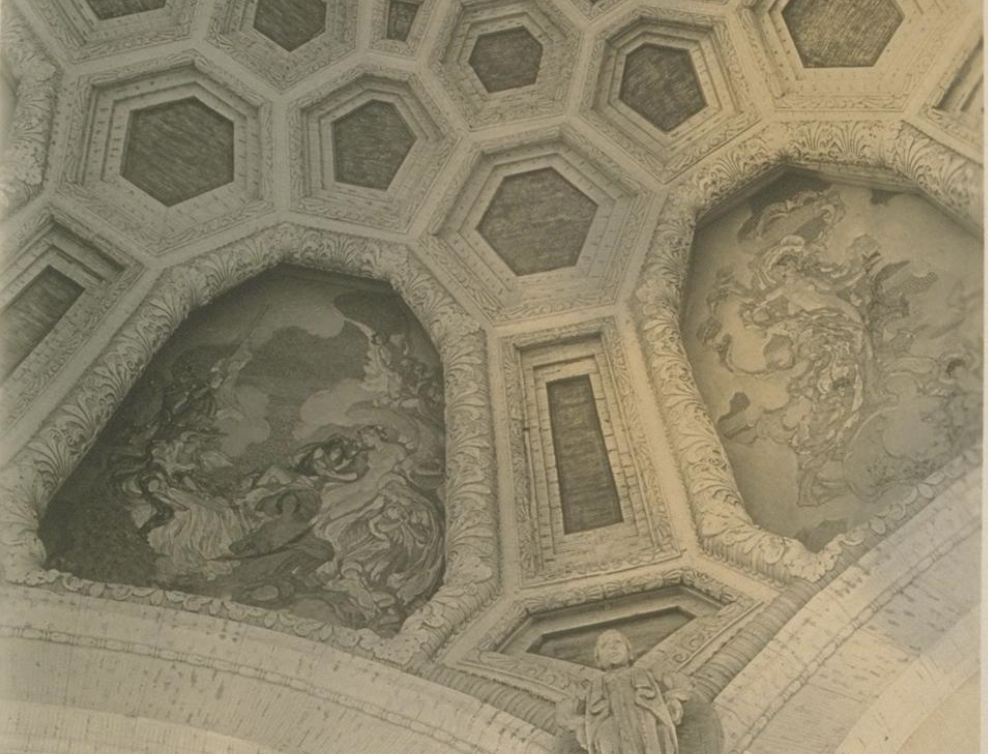
Robert Lewis Reid’s murals for the Palace of Fine Arts building at the Panama–Pacific International Exposition in San Francisco, in 1915 was an extraordinary tribute to the Arts. Eight huge panels graced the ceiling of the rotunda: The Four Golds of California (Golden Metal, Wheat, Citrus Fruits, and Poppies); plus Ideals in Art, Inspirations of All Arts, the Birth of European Art and Birth of Oriental Art. San Francisco’s Palace of Fine Arts was re-built in the 1960s and these paintings no longer exist.

Robert Reid GGIE Palace of Fine Arts

From The Jewel City Chapter 12: Above, in the dome, Robert Reid’s eight murals, splendid in color, are too far away to be seen well as pictures. Two separate series are alternated, one symbolizing the Progress of Art, the other depicting the Four Golds of California. The panel in the east, nearest the altar, is “The Birth of European Art.” The sacred fire burns on an altar, beside which stands the guardian holding out the torch of inspiration to an earthly messenger who leans from his chariot to receive it. On the right is the Orange panel, representing one of the California golds.

“Inspiration in All Art” comes next. The veil of darkness, drawn back, reveals the arts: Music, Painting, Poetry, and Sculpture. A winged figure bears the torch of inspiration. The second of the California golds, the Wheat panel, follows, and then “The Birth of Oriental Art.” The allegory here is the ancient Ming legend of the forces of earth trying to wrest inspiration from the powers of air. A Chinese warrior mounted on a dragon struggles with an eagle.

Gold, the yellow metal, is the subject of the next panel, followed by “Ideals in Art.” In this appear concrete symbols of the chief motives of art, the classic nude of the Greeks, the Madonna and Child of Religion, Joan of Arc for Heroism, Youth and Material Beauty represented by a young woman, and Absolute Nature by the peacock. A mystic figure in the background holds the cruse wherewith to feed the sacred flame. A winged figure bears laurels for the living, while the shadowy one in the center holds the palm for the dead. Last of all comes the Poppy panel, representing the fourth gold of California.

“The entire scheme – the conception and birth of Art, its commitment to the earth, its progress and acceptance by the human intellect, – is expressed in the four major panels. They are lighted from below by a brilliant flood of golden light, the sunshine of California, and reach up into the intense blue of the California skies.” This, as well as much of the interpretation of the eight pictures, is drawn from Reid’s own account.

Title: Oriental Art

Title: Oriental Art –

Photo from The Sculpture and Mural Decorations of the Exposition – A. Stirling Calder.  Website: Books About California

Photo from The Sculpture and Mural Decorations of the Exposition - A. Stirling Calder Found at

Titled:  The Golden Wheat – Photo from The Sculpture and Mural Decorations of the Exposition – A. Stirling Calder.  Website: Books About California


Dudley Carter the GGIE and CCSF

 Posted by on August 7, 2018
Aug 072018
 

CCSF Campus
Phelan Avenue
Diego Rivera Theater and Conlan Hall

During the second season (1940) of the Golden Gate International Exposition, organizers began the Art in Action program in the Hall of Fine and Decorative Arts.  During the 1939 season, the hall had housed the art collections of European and Pacific cultures.  The concept was a  working art exhibit in which artists of many media, including sculptors, painters, muralists, weavers, stained glass artists, printmakers, potters, and engravers were invited to move their studios into the Hall and create their art while the public watched.

Artists included sculptor Ruth Cravath, mosaic artist Herman Volz, sculptor Frederick Law Olmsted, etchings artist Elizabeth Ginno Winkler, muralist Diego Rivera, and wood carver Dudley C. Carter.

A view of the Hall of Decorative and Fine Arts from the San Francisco Bay

A view of the Hall of Decorative and Fine Arts from the San Francisco Bay. The building served as the Palace of Fine and Decorative Arts during the GGIE and was constructed to serve as one of two hangar buildings built for the San Francisco airport that was planned for the island. (Library of Congress)

This is when Dudley Carter created The Ram. The sculpture, a bighorn mountain ram, was carved in just 30 days from a single redwood log using primitive instruments such as a wood axe.

At the conclusion of the fair, the college architect, Timothy Pfleuger, presented The Ram to Archibald J. Cloud, president emeritus of the college. It was to serve as the symbol of the college mascot.

Timothy Pfleuger was on the GGIE committee, it was his idea for the Art in Action project, and due to his also being the college architect, much of the finished art from Art in Action was always slated to end up at what was then  San Francisco Junior College and after the war became City College of San Francisco (CCSF).

For five years The Ram was stored in the men’s gymnasium because of the absence of a place considered appropriate for it. With the acquisition of the west campus The Ram was placed outside, periodically changing locations, and from time to time students would paint it in the campus colors of red and white. Sometimes rival schools would repaint The Ram in their own school colors. In spring of 1983, The Ram was restored by Carter (who was by then 90 years old) with the use of a pickaxe and its original, natural redwood.

The Ram by Dudley C. Carver was originally carved at the GGIE and now stands in Conlan Hall at CCSF

The Ram by Dudley C. Carver was originally carved at the GGIE and now stands in Conlan Hall at CCSF

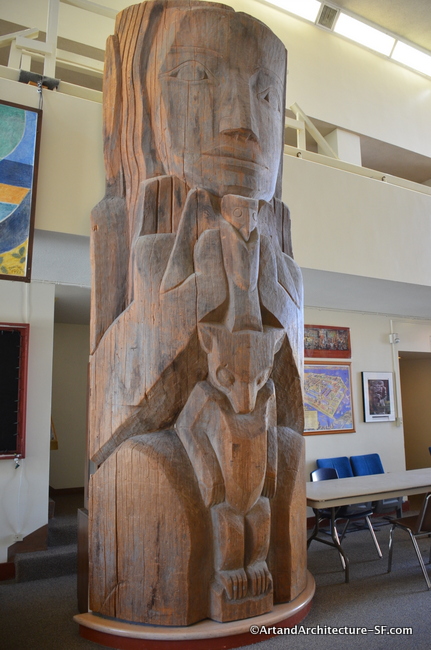
The Goddess of the Forest is another redwood sculpture created by Carter during the GGIE. It was originally 26 feet tall, and had a girth at the base of 21 feet, for many years this piece was located in Golden Gate Park. The sculpture suffered extensive water damage to the lower half before being restored by CCSF Art Department instructor Roger Baird in 1992. It is now only 15 feet tall and stands facing the Diego Rivera mural in the Diego Rivera Theater.

It almost did not make it to CCSF. Difficulties arose in regards to paying for the statue’s move from Golden Gate Park when, then CCSF President Carlos B.Ramirez, decided that the estimated $8,000 moving fee was too high.

The actual moving fee was $3,000 and eventually paid for out of the Student Union’s budget.

Goddess of the Forest originally carved by Dudley C. Carter for the GGIE now stands in the Diego Rivera Theater of CCSF

Goddess of the Forest originally carved by Dudley C. Carter at the GGIE now stands in the Diego Rivera Theater of CCSF

Diego Rivera worked directly across from Carter at the Golden Gate International Exposition and they became friends.  Rivera said the following about Carter, “Here in the Fine Arts Building there is a man carving wood. This man was an engineer, an educated and sophisticated man. He lived with the Indians and then he became an artist, and his art for [a while] was like Indian art—only not the same, but a great deal of Indian feeling had passed into him and it came out in his art. Now, what he carves is not Indian anymore, but his own expression—and his own expression now has in it what he has felt and that is right, that is the way art should be. First, the assimilation and then the expression, only why do the artists of this continent think that they should always assimilate the art of Europe. They should go to the other Americans for their enrichment because if they copy Europe it will always be something they cannot feel because after all, they are not Europeans.”

Carter shows up in Rivera’s mural that, while originally painted at the GGIE, was always slated for CCSF.

Dudley Carver depicted in Diego Rivera's mural carving The Ram

Dudley Carter depicted in Diego Rivera’s mural carving The Ram

The third sculpture by Carter is also in Conlan Hall in the first-floor hallway.  This is titled The Beast.

The Beast was actually sculpted by Dudley Carter at Porter College at the University of California in Santa Cruz in 1983. The piece was given to  City College by Carter on the urging of the then college president, Carlos Ramirez.

Beast by Dudley C. Carter

Beast by Dudley C. Carter

Born in New Westminister, Canada on May 6, 1898, Dudley Carter was the son of a woodsman. He was six years old when he began helping out in his father’s lumber camp.

Raised among the totem-carving Kwaquit and Tlingit tribes, he took part in their ceremonies. About 1929, he moved to Seattle where he had art lessons at the Cornish School and studied sculpture at the Art Institute.

Moving to California in the mid-1930s, he lived in San Francisco and worked for the Federal Art Project. He later lived in Carmel where he built houses out of trees that he felled himself. He died in 1992 in Bellevue, Washington.

Carter working on The Ram during the GGIE surrounded by wood chips

Carter working on The Ram during the GGIE surrounded by wood chips (Bancroft Library)

Carver standing with one of his axes in front of his likeness in the Diego Rivera Mural

Carter standing with one of his axes in front of his likeness in the Diego Rivera Mural (Bancroft Library)

Goddess of the Forest in Golden Gate Park 1951 (SFPL)

Goddess of the Forest in Golden Gate Park 1951 (SFPL) – Notice the lower portion of the goddess’s legs are still intact.  The sculpture now ends just below the feet of the small animal at her knees.

The Whales of the GGIE

 Posted by on July 26, 2018
Jul 262018
 

Originally created for the Golden Gate International Exhibition
Moved to Steinhart Aquarium
Moved to CCSF
In Storage

Photo from: OpenSFHistory / wnp37.03052.jpg

Photo from: OpenSFHistory / wnp37.03052.jpg

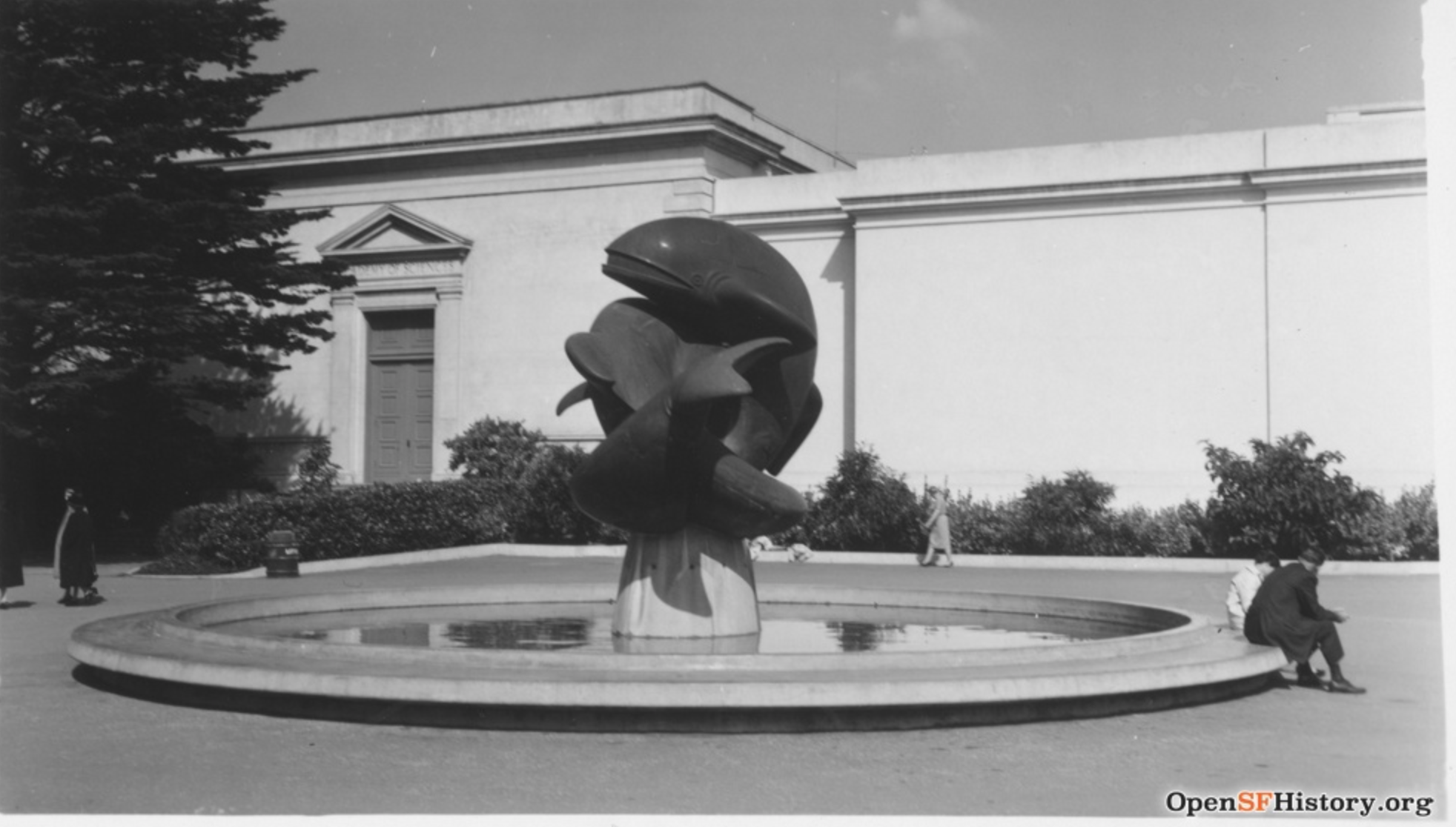
These whales were in the San Francisco Building at the Golden Gate International Exhibition and were sculpted by Robert Howards.

After the GGIE closed the whales were moved to a prominent place in front of the Steinhart Aquarium in Golden Gate Park

Photo from: OpenSFHistory / wnp27.5859.jpg

Photo from: OpenSFHistory / wnp27.5859.jpg

Robert Boardman Howard (1896–1983), was a prominent American artist active in Northern California in the first half of the twentieth century. He was celebrated for his graphic art, watercolors, oils, and murals as well as his Art Deco bas-reliefs and his “Modernist” sculptures and mobiles.

Howard was born in New York City on September 20, 1896, to architect John Galen Howard and society belle Mary Bradbury. When he was six years old, the family moved to Northern California. They settled in Berkeley where John G Howard was hired to supervise the erection of the Hearst Memorial Mining Building at the University of California. Robert completed grammar school, but dropped out of Berkeley High School and was tutored privately.

Between 1913 and 1916 he studied at Berkeley’s California School of Arts and Crafts (today’s California College of the Arts). He became acquainted with Alexander Calder in 1915. After graduation, he traveled across the country on a motorcycle to New York City to continue his training at the Art Students League under Kenneth Hayes Miller and F. Luis Mora. He returned to California in 1918, joined the U.S. Army Signal Corps, and was sent to France. At the end of World War I, he studied in Koblenz and in Paris at the Academie Colarossi and the Academie de la Grand Chaumiere.

Notable work by Howard includes: a bas-relief of a phoenix at Coit Tower, the reliefs at the Paramount Theatre (1931–32; specifically the reliefs on the auditorium walls, stage and ceiling),  the 1935 cast-iron bas-relief for the Badger Pass Ski House in Yosemite National Park, four massive murals and assorted sculptures for other G.G.I.E. pavilions, including the Brazil Building, California Building, Western State Building, and Ghirardelli Building, two bas-reliefs in cast stone titled Power and Light, at the Pacific Gas and Electric Mission Substation in San Francisco, the City Club of San Francisco’s grand staircase balusters, the linen-based mural in the Mural Room at the Ahwahnee Hotel in Yosemite National Park,  the massive bas-reliefs of dancing and musical figures on the exterior of the Berkeley High School Community Theatre,  and the 1958 sculpture Hydro-Gyro at the San Jose IBM Research Center.

This sculpture is owned by the San Francisco Arts Commission but is stored on the CCSF campus waiting for restoration and installation. The CCSF administration, the CCSF Works of Art Committee, and other faculty and staff are working with the Arts Commission to arrange funding.

Jul 042018
 

Presently in storage at Golden Gate Park

Dolphin by Cecilia Graham

This statue is from the Golden Gate International Exposition.  It is by Cecilia Bancroft Graham.

Graham was born in San Francisco, on March 2, 1905.  She studied at the California School of Fine Arts, graduated from Mills College in Oakland, and studied sculpture with Oscar Thiede in Vienna, Louis de Jean in Paris, and with Carl Milles at Cranbrook Academy in Michigan.  She passed away in Carmel, California in 1984.

Photo courtesy of Anne Schnoebelen of the Treasure Island Museum.

Photo courtesy of Anne Schnoebelen of the Treasure Island Museum.

The statue was placed around the Fountain in the San Francisco Building.  The center whales were by Robert Howards.

Robert Howard's Whale Sculpture for GGIEThe whales sculpture was moved to a fountain in front of the Steinhart Aquarium, now the Academy of Science, in Golden Gate Park.  They are no longer there.

Cecilia Bancroft Graham, court of Pacifica, GGIE

The Dolphin is, sadly,  badly damaged.

Thank you to the Landscape department of Golden Gate Park for aiding me in finding the statue.

Treasure Island Artwork Spread Far and Wide

 Posted by on September 12, 2017
Sep 122017


The Pacific Fountain on Treasure Island

Sometimes you are given an opportunity to peek behind the scenes and today I had just one of those magical moments.  Anne Schnoebelen, the passionate author of the website TreasureIsland1939.com asked me to come see the Pacific Fountain and bring along my friend Deborah Blake of Sullivan Masonry, to see about the restoration of the fountain.

The fountain has quite a fabulous history.  It was part of The Golden Gate International Exposition (GGIE) a World’s Fair held on Treasure Island. The fair, celebrated, among other things, the city’s two newly built bridges. The San Francisco–Oakland Bay Bridge which opened in 1936 and the Golden Gate Bridge which had opened in 1937. The exposition was open from February 18, 1939, through October 29, 1939, and from May 25, 1940, through September 29, 1940.

The fountain, which was situated in the Pacific House during the GGIE, was a massive coordination between artist Antonio Sotomayor, architect Philip Newell Youtz and the Gladding McBean Company of Lincoln, California.

I highly suggest you head to Anne’s site to read all about the history of the fountain and its construction.

Pacific Fountain GGIE

This is what the fountain looks like today.

Pacific Fountain GGIE

The restoration would be a major undertaking, including finding an appropriate place to house it, but the Treasure Island Museum hopes to do just that.

The fountain was accompanied in the Pacific House by six murals by Jose Miquel Covarrubias titled Pageant of the Pacific.

Mural by Jose Miquel Covarrubias

Jose Miguel Covarrubias, “Flora and Fauna”

Five of the murals still exist and are on loan from the San Francisco Treasure Island Development Authority to the DeYoung Museum.

It would be a wonderful San Francisco moment if these items could be brought together into one location and enjoyed together as a tribute to the Pacific.

Pacific Fountain GGIE Treasure Island

The statues at the back of the room are some of the twenty sculptures created for the Court of the Pacific.  Some are available for viewing in front of Building One. 

If you are interested in donating to the  Treasure Island Museum you can do so here.  You are welcome to earmark your dollars for the restoration of the fountain.  If you are a history buff and a financial angel, the museum would love to hear from you, you can reach out to Anne Schnoebelen through the museum.

The artists:

Antonio Sotomayor (1902-1985) was born in Chulumani, Bolivia on May 13, 1902, Sotomayor began his art studies in La Paz under Belgian master Adolf Lambert and by age 15 was contributing illustrations to Bolivian periodicals. After settling in San Francisco in 1923, he continued his art training at the CSFA. He taught art at Mills College in Oakland (1942-43) and at the CSFA (1946-50) Sotomayor contributed greatly to California art for over 60 years.

Antonio Sotomayor

Philip Newell Youtz (1895-1972) was born April 27, 1895, in Quincy, Massachusetts. He was educated at Amherst College (1918) and Oberlin College (1919). During the period 1920-1922, he built schools and a non-sectarian Chinese Christian College in Canton, China. Upon his return, he taught at Teachers College, Columbia University. After receiving his architectural degree from Columbia University in 1929, he became curator of the Sixty-Ninth St. branch of the Pennsylvania Museum of Art in Philadelphia. In 1933 he became assistant director of the Brooklyn Museum of Art and served as director from 1934 to 1938. From 1938 to 1940, he was director of Pacific House at the Golden Gate International Exposition and the Pacific Area in San Francisco. Following the war where he served with the War Production Board, Youtz was a practicing architect in the New York City area. Here he invented the “lift slab” method of construction in which concrete slabs are raised on supporting columns to form different stories of a building. He eventually landed at the University of Michigan in 1957, where he was soon named dean of the College of Architecture and Design, a post he held until his retirement in 1964.Philip Newell Youtz

Jose Miguel Covarrubias (1904 — 1957)  was born November 22, 1904, in Mexico City. After graduating from the Escuela Nacional Preparatoria at the age of 14, he started producing caricatures and illustrations for texts and training materials published by the Mexican Ministry of Public Education. At the age of 19, he moved to New York City armed with a grant from the Mexican government. Mexican poet José Juan Tablada and New York Times critic/photographer Carl Van Vechten introduced him to New York’s literary/cultural elite. Soon Covarrubias was drawing for several top magazines, eventually becoming one of Vanity Fair magazine’s premier caricaturists.

Jose Miquel CovarrubiasGladding, McBean is a ceramics company located in Lincoln, California. It is one of the oldest companies in California, a pioneer in ceramics technology, and a company which has “contributed immeasurably” to the state’s industrialization. During the heyday of architectural terra cotta, the company “dominated the industry in California and the Far West.

Jaques Schnier on Treasure Island

 Posted by on June 11, 2013
Jun 112013
 

Treasure Island
Building #1

Jacques Schneir on Treasure Island

These two cast stone sculpture represents India and were done by Jacques Schnier for the Golden Gate International Exposition.  They have been known by several names, including “The Tree of Life,” but the preferred name is “Spirit of India.”  These are just two of  twenty that were part of the Unity sculptures placed in the Court of the Pacifica.  Jacques Schnier designed at least seven pieces of sculpture displayed at the fair.

Jacques Schnier at Treasure Island

*DSC_0877

Jacques Schnier was born in Romania and came to the United States with his family in 1903.  He grew up in San Francisco.  He received an AB degree in engineering from Stanford n 1920 and an MA decree in Sociology from Berkeley in 1939.

An interest in city planning led to his abandoning a successful career in engineering and enrolling in the Department of Architecture at Berkeley.  This in turn gave him his first experience in art, since architecture students were required to take art courses. He eventually dropped out of architecture school to devote full time to his sculpture.

Schnier spent 30 years teaching at Berkeley, first as a lecturer in the Department of Architecture, he retired as Professor of Art, Emeritus, in 1966.

Following his retirement he expanded into many mediums, having previously favored such materials as stone, wood, bronze, marble and coper, he later focused on the medium of carved and polished clear acrylic resin (Plexiglas). His excitement with the material led him to exclaim in 1975 that “at last I’ve found my medium”  It’s as though I am sculpting pure light. At 76, I’m hitting my stride”.

Jacques Schnier died March 24, 1988 a the age of 89.

Adaline Kent sculptures on Treasure Island

 Posted by on June 10, 2013
Jun 102013
 

Treasure Island
Building #1

Adeline Kent on Treasure Island

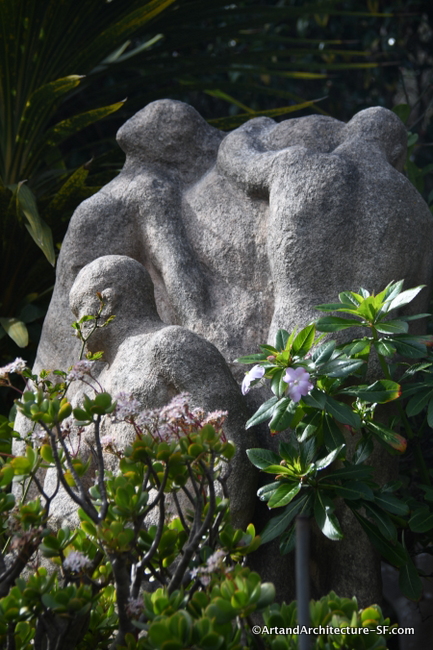
These cast stone statues are part of Adaline Kent’s group of three Pacific Islander statues that were among the twenty Pacific Unity sculptures produced for the Court of the Pacifica at the 1939-1940 Golden Gate International Exposition.  The two  shown here are listening to a stringed instrument (most likely a ukelele) played by a young boy, the third statue, that is unfortunately lost.

Pacific Islander Statue part of the Unity Group for the GGIE

Adaline Kent was born in Kentfield, California in 1900. She attended Vassar College and upon graduation she returned to the Bay Area, where she studied for a year (1923-24) with Ralph Stackpole at the California School of Fine Arts (now the San Francisco Art Institute). Stackpole was a leading proponent of the “direct-cut” sculpting method. She then traveled to Paris in 1924 to study at the Academy de la Grand Chaurniere with Emile Antoine Bourdelle, a disciple of and former assistant to Rodin.

Kent returned to San Francisco in 1929 and set up a studio in North Beach. She soon established a reputation as an innovative and original sculptor of great originality, developing an abstract style rooted in surrealism and becoming a prominent member of the San Francisco Art Association. Kent exhibited or juried in the prestigious Annual show nearly every year from 1930 until her death in 1957. She served on the Board of Directors from 1947-57, and taught at the California School of Fine Arts in 1955.

Following a trip in 1953 with her husband, sculptor Robert Howard to Egypt and Greece, her work evolved toward simplified columnar forms.

In 1957 Adaline Kent died in an automobile accident on the Pacific Coast Highway south of Stinson Beach.

Edison and DaVinci by Olmsted

 Posted by on April 23, 2013
Apr 232013
 

CCSF Ocean View Campus
50 Phelan
Sunnyside

Leonardo DaVinci by Olmstead

*

Edison at CCSF

According to CCSF’s website “Archibald Cloud, the Chief Deputy Superintendent of the San Francisco Unified School District, began in 1930 to vigorously articulate a long held educational dream: that the “premier” county in the State—San Francisco—must have the same educational “jewel” as did 38 of the State’s 58 counties. That is, it must have a junior college! Cloud hired world prominent architect, Timothy Pflueger. The two rapidly moved ahead with the design and the construction of the gymnasiums as well as Science Hall, a building they were determined to make into “a showplace of monumental architecture.”

As Vice Chairman of Fine Arts at the 1939-1940 Golden Gate International Exposition on Treasure Island, Pflueger was able to have transferred to the College, at no cost , several of the culturally significant projects created by artists during the fair.  These include these two sculptures carved by Fredrick Olmsted.  They are 7 feet high, four foot square, and 9 tons of granite, representing Leonardo DaVinci and Thomas Edison.  (In researching these two pieces I have also found reference that they are limestone or Tuff stone, my personal opinion is that they are limestone.)

The sculptures were carved for the WPA exhibition “Art in Action”.  Art in Action was an exhibit of artists at work displayed for four months in the summer of 1940 at the Golden Gate International Exposition (GGIE) held on Treasure Island. Many famous artists took part in the exhibit, including Dudley C. Carter, woodcarver and Diego Rivera, muralist.

Screen Shot 2013-04-13 at 6.56.22 PM

Frederick Olmsted (April 10, 1911-February 14, 1990) was born in San Francisco. A collateral relative of landscape architect Frederick Law Olmsted, Olmsted studied science at Stanford and art at the California School of Fine Arts, where he met and married Barbara Greene. In 1937, the couple visited fellow student Helen Phillips in Paris and spent time working at Atelier 17.

Olmsted worked in the WPA, assisting John Langley Howard and George Harris in the Coit Tower, creating his own mural on a three-foot panel above the main entrance. He also assisted Diego Rivera with his mural at the Art Institute in San Francisco. Olmsted created numerous murals and sculptures for public works in San Francisco, including the Theory and Science mural at San Francisco City College. He taught art for a while at Arts and Crafts in Oakland.

After Barbara and he divorced, he continued to work as a sculptor, moving to Cleveland where he designed medical equipment for the Cleveland Clinic. It was there he developed a machine to shock the diseased heart of one of his dogs, a prototype for today’s pacemaker. Olmsted then worked at Woods Hole, Massachusetts, designing equipment and machinery for the Oceanographic Institute.  He died in Falmouth, Massachusetts.

DSC_0479

*Edison and DaVinci by Olmsted

error: Content is protected !!