Topo in Cloth and aluminum

 Posted by on November 27, 2013
Nov 272013
 

San Francisco International Airport
Departure Lobby
Terminal 2

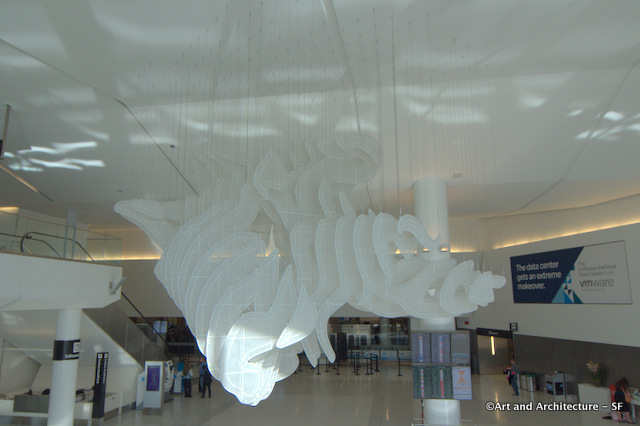
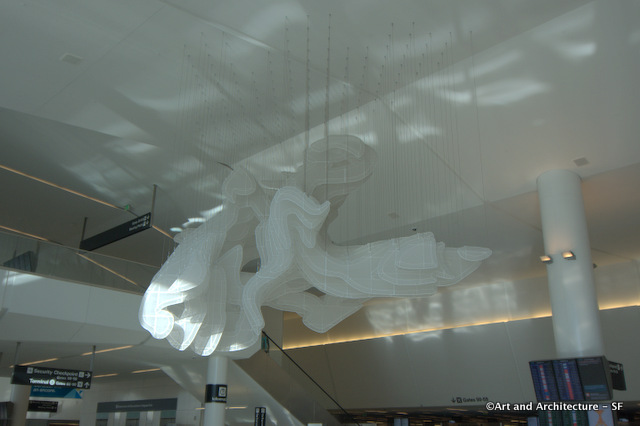
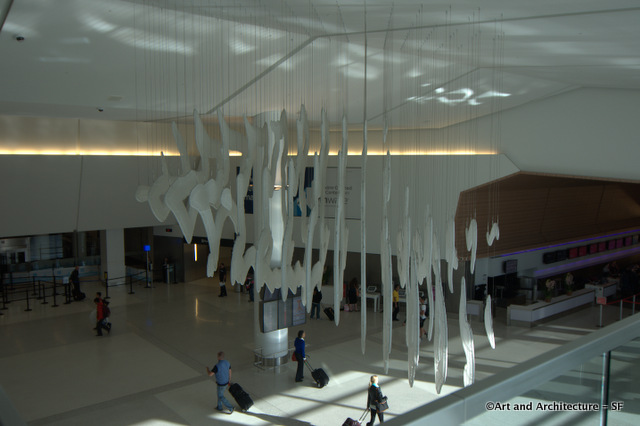
Topograph 1 & 2Kendall Buster -Powder coated steel tubing; greenhouse shade cloth- 288 in. x 288 in. x 192 in

Topograph I & II

Kendall Buster earned a BFA degree from the Corcoran College of Art and Design in Washington DC and an MFA in Sculpture from Yale University as well as participating in the Whitney Museum’s Independent Study Studio Program in New York City.

Kendall Buster SFO

His website explains the piece:

Topograph was designed and constructed for the San Francisco International Airport Terminal 2 departures area. A raised entryway forms a kind of narrow bridge above a massive open space in the main floor of the terminal and this presented very specific opportunities both functionally and formally. Travelers are typically moving quickly across the bridge and through the lower level. The form was intended to participate in what I saw as rapidly and sequentially changing positions of viewer to object. The work is constructed out of a series of vertically hung planes that behave like slats. As one moves in relation to the work, whether looking from above into the sculpture or from below, the planes seem to pivot. At one point when one is perpendicular to the thin slats that form the sculpture the form almost disappears. Alternatively, from some vantage points there is a suggestion that the planes have been compressed into a single form. But viewed from other points these vertical planes decompress and expand. Perhaps suggesting clouds dispersing or shifting landscapes.

The design grew out of my interest in these dynamic viewing points from above and below as well as an interest in how I might create a single sculpture in two sections – one on either side of the bridge in such a way that a viewer would walk between fragments of a kind of ephemeral landscape. To this end Topograph consists of two groups of vertically hung panels sighted on either side of the bridge/mezzanine to create a fragmented topography map.

Topograph I and II

Rigging by Methods and Materials
Project management by Mark G. Anderson Consultants

Welcome

 Posted by on November 26, 2013
Nov 262013
 

San Francisco International Airport
Terminal 2
Baggage Claim Level 1

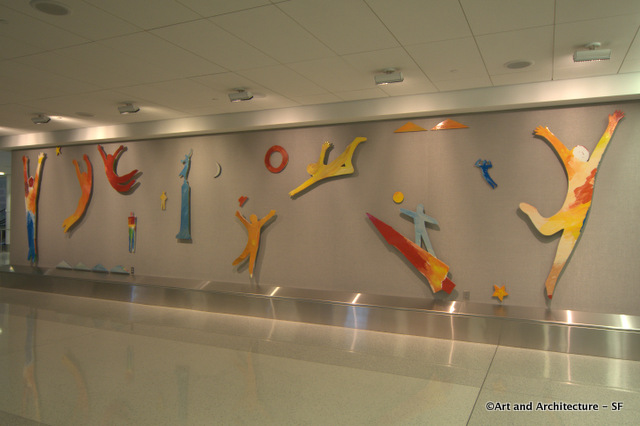
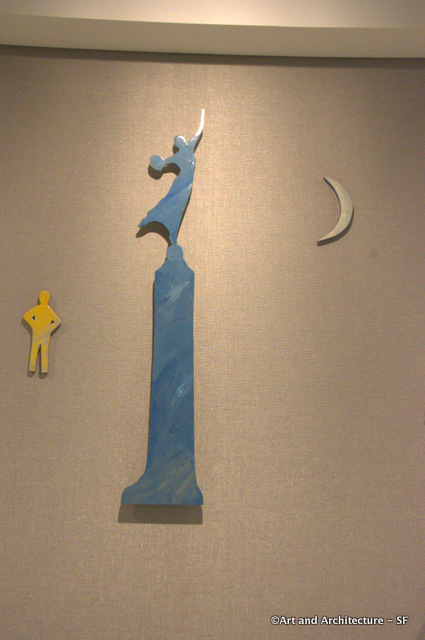
Dan Snyder at SFODan Snyder – Polyurethane Paint on Aluminum -1983

Titled Welcome North, Welcome South, Welcome East, Welcome West, is designed to greet visitors from around the world.

According to Mr Snyder’s website:

Dan was born in St. Thomas in the Virgin Islands in 1941. His father was a naval officer stationed there at the time. Growing up he lived largely in seaport towns in the United States. After graduating from Wesleyan University in Connecticut with a major in theater, he attended the School of the Museum of Fine Arts in Boston and then went on to the University of New Mexico where he received an MFA in studio art and art history.

For many years Mr. Snyder taught both art and theater in private schools in Massachusetts and Connecticut. After teaching he worked as an illustrator for advertising, editorial illustration for The Hartford Courant, and children’s book illustration, as well as designing and painting sets for local theater productions. Then for three years he was head designer of exhibits at the Science Center of Connecticut.  In 1995 Dan moved to Maine with fellow artist Betsy Gardiner. He continues to paint and exhibit his work, as well as do design and illustration for businesses and organizations. 

DSC_5747*

Welcome at SFO


Caduceus

 Posted by on November 25, 2013
Nov 252013
 

110 Sutter Street
Financial District

French American Bank

This was originally designed in a skeletal Chicago School manner by the important but little-known firm of Hemenway and Miller and remodeled with an overlay of Beaux-Arts details by architect E. A. Bozio.

****

This slightly stuffy, but excellent article, written in 1979, explains the building and its environs perfectly.

In 1902, the architectural supplement to the San Francisco periodical Town Talk called the original design “A modern, superbly appointed, fire-proof building, now in the course of construction.” It was designed for the Bullock and Jones Co., who occupied the lower two floors, with offices above. At that time it was a two-part vertical composition, strongly skeletal in expression with the principal differentiation between the 2-story base and the shaft being the color of the decorative tile cladding. The shaft was terminated in a frieze punctuated by small round windows recalling Sullivan’s Guaranty and Wainright buildings, among others. Ornamentation was Renaissance/Baroque, applied in a purely decorative manner except in the traditional cornice and cresting. Unfortunately the tile cladding of the steel frame failed in the fire and the exterior was badly damaged. In 1907, it was apparently rebuilt to its original design.

110 Sutter Street

At some point after 1907 the building was taken over by the French American Bank. In 1913, it was enlarged and remodeled by E. A. Bozio for the French Bank. As remodeled, although the facade was still skeletal, its composition and ornamentation became even more elaborate and its base and columns were treated as rusticated masonry. Piers were clad in gray Colusa sandstone; spandrels and cornice were copper. The design and placement of the decorative iron grilles above the spandrels are taken directly from Ernest Flagg’s first Singer Building in New York, of 1904, as is a certain quality of the overall conception, albeit in miniature. The building was extended for three bays down Trinity Street and is fully ornamented for the length of that alley facade. Although part of that facade is hidden by the California Pacific Building, much of it is visible above the low buildings on Montgomery Street. The small but sumptuous marble banking hall, with its coffered ceiling, has been partially remodeled. In composition, the present building is a three-part vertical block.

Sutter Street Architecture

Apart from its great architectural value, the French Bank (now the French branch of the Bank of America) is extremely important as a supportive structure to the Hallidie Building and as a part of one of the finest rows of buildings in downtown San Francisco in this block of Sutter (and extending west another block to Grant). The block can be viewed as a capsule history of downtown San Francisco architecture which has come together in an aesthetically highly successful group. This building represents both the skeletal, Chicago-derived aspect of the city’s buildings and the influence of the Ecole des Beaux-Arts, and also serves as an integral element in the progressively taller buildings on the block whose cornices change in design and color at every step.

Michael R. Corbett – 1979
Splendid Survivors: San Francisco’s Downtown Architectural Heritage
Hemenway & Miller designed several significant buildings in San Francisco during the first decade of the twentieth century. Comprised of architects Sylvester W. Hemenway and Washington J. Miller, the firm was responsible for several prominent pre-quake commercial buildings in downtown San Francisco including the Aronson building at the corner of 3rd and Mission, also done in the Chicago Style.

110 Sutter StreetThe ground floor columns display a handsome scrolled shield with a caduceus, the symbol of Mercury, the god of commerce.

One of only Two Octagonal Houses in San Francisco

 Posted by on November 22, 2013
Nov 222013
 

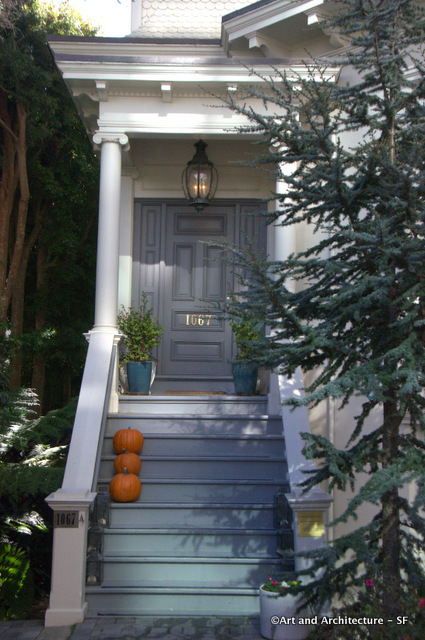
1067 Green Street
Russian Hill

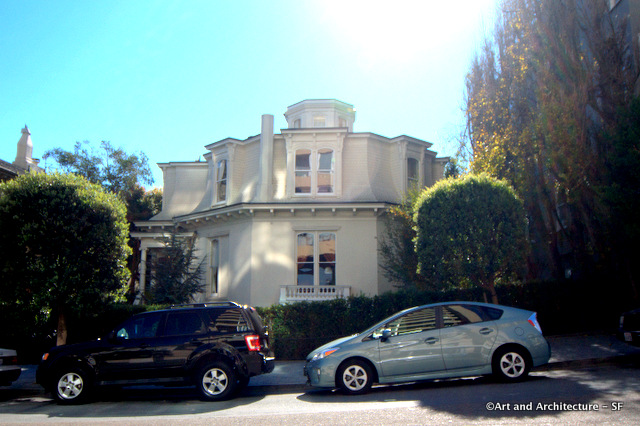
Feusier Octagon House


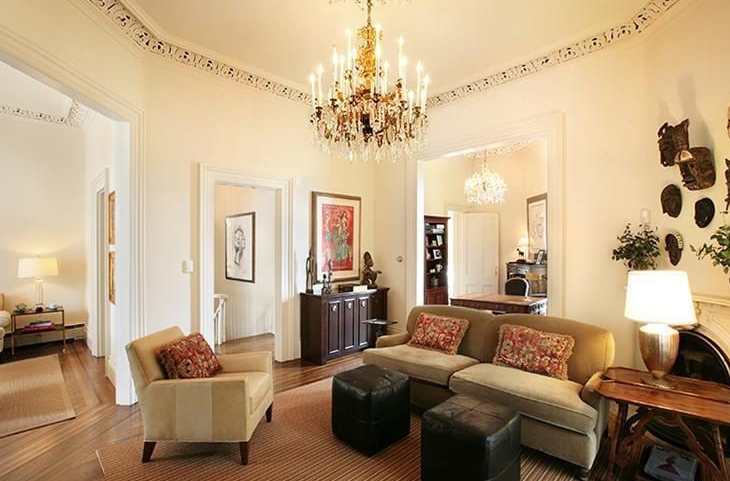
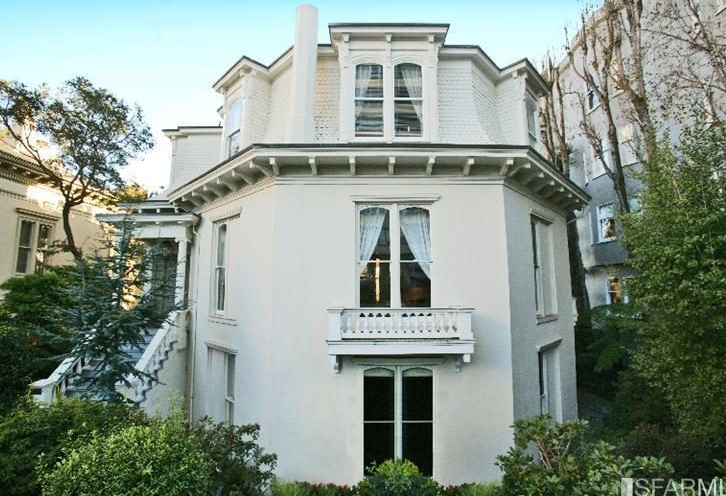
The Feusier Octagon House, built between 1857 and 1858, is one of only two surviving octagon plan houses in San Francisco. The other is the Colonial Dames Octagon on Gough Street. Both Houses retain their original exterior construction and reflect their eight-sided shape in the interior. This house was originally two stories and copied from a plan in a book on octagon houses by Orson Squire Fowler.

Phrenologist, Orson Squire Fowler published The Octagon House: A Home For All, or A New, Cheap, Convenient, and Superior Mode of Building in 1848. He started a 19th century fad in house building. Fowler maintained that the most efficient shape for a house is a circle, but that an octagonal house is almost as efficient and much easier to build, especially for carpenters of that period with their expertise in bay windows, towers, turrets and other fashionable follies. According to Fowler, octagons enclose more space with less material, provide more light and are more efficiently heated in winter and cooled in summer.

The house, originally built by George Kenny, his grandson Robert W. Kenny was Attorney General of California from 1943 to 1947. George Kenny was an agent for H. H. Bancroft, the famous bookseller, publisher and historian. (The Bancroft Library at UC Berkeley, named in his honor, was founded when the University of California purchased his book collection in 1905.)

Octagon House

The house was sold to  San Francisco businessman Louis Feusier  in 1875, and his family remained there until they sold it in 1954.

According to the family history, Louis Feusier arrived in California about 1852, spent the years 1857-1867 in Nevada, and then returned to San Francisco, later marrying Louise Guerne, daughter of the pioneer for whom Guerneville was named.

Feusier is said to have been a companion of such San Francisco notables as Leland Stanford and Mark Twain. Feusier’s many business interests include wholesale produce, mining, salmon canning, winemaking, and importation of oriental goods. His wife Louise lived in the house until her death, as did their son Clarence who died in 1951. In 1954 the Feusier Octagon was sold by the family.

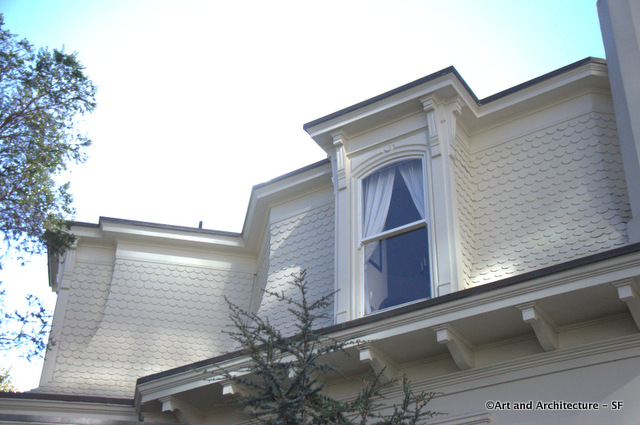
The original two-story house was modified late in the century when the Feusiers added a third story with Mansard roof, topped by an octagonal cupola. Like other buildings on Russian Hill, the Feusier House escaped the 1906 Earthquake, but because of the fire, the outbuildings were dynamited but the main house was saved.

Octagon House on Green Street

It is San Francisco Landmark 36. On March 24, 1974, it was added to the National Register of Historic Places.

The House was listed for sale in 2012 for 5.2 million.  These pictures are from that real estate listing.

Octagon House on Green Street


*

Russian Hill


Bernstein’s Fish Grotto

 Posted by on November 21, 2013
Nov 212013
 

123 Powell Street
San Francisco

Bernstein's Fish Grotto 1940's*

Bernstein's Fish Grotto Mermaid

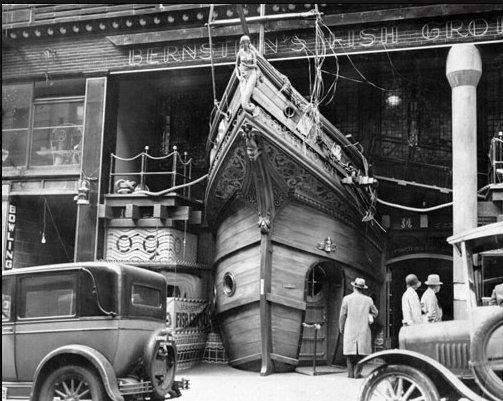
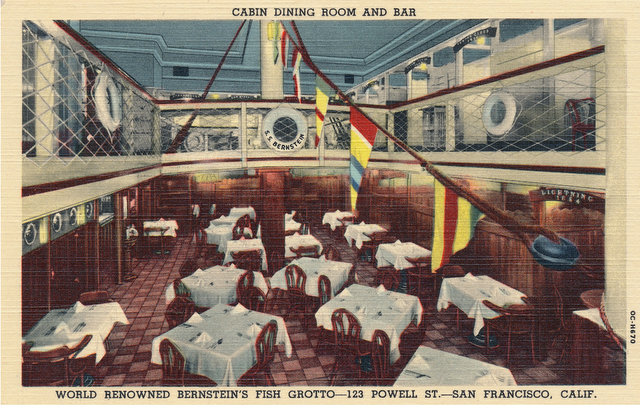
Bernstein’s Fish Grotto was opened by Maurice Bernstein (1886-1932) in 1907.  It was known for its unique entrance, a ship’s bow jutting into the sidewalk. The ship was a faithful reproduction of Christopher Columbus’s Nina. Inside the restaurant, the marine theme continued. Bernstein’s had seven colorful dining rooms: the Fisherman’s Cave, the Pilot Room, the Sun Deck, the Main Salon, the Cabin Nooks, the Upper Deck, and the Porthole Counter.

Bernstein' Fish grotto Interior

Located near the end of the Powell cable car line, the Grotto was a popular tourist attraction for many years.

Advertising called it “The Ship that Never Sailed.”  Despite the fact that the restaurant never saw the sea, they did serve fresh fish and a number of signature dishes. Maurice Bernstein was an Oakland fish merchant who ran a number of eateries in the Bay Area. According to San Francisco’s Lost Landmarks the Fish Grotto served three dishes found nowhere else in the city: abalone steaks, mussels bordelaise and and coo-coo clams (from Coo-Coo Cove).

Bernstein’s Fish Grotto closed in 1981

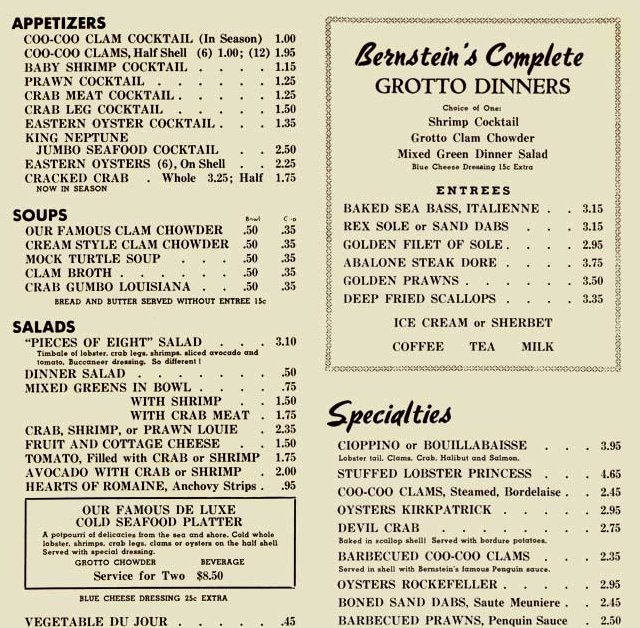
Bernstein's Fish Grotto Menu

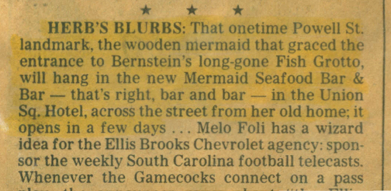
In 1988 the owners of the Mermaid Seafood Bar and Bar opened across the street.  Michael H. Casey Designs was asked to make a mold of the original and repair the original.

She sat outside for many years with a plaque that read:
We dedicate the opening of the Mermaid Seafood Bar and Bar at the Hotel Union Square with this mermaid whose journey began across the street at Bernstein’s Fish Grotto in 1907. Though she has lain dormant for many years, she is again ready to lift the spirits of those who sight her and welcome them for a respite from the sidewalk seas. May she again shine like a beacon in this city’s future as well as illuminate the memories of her past.
February 1989

The restaurant has since closed and I have no idea where the original went, but I know where a copy graces someone’s backyard.

Herb Caen about Bernstein's Fish Grotto

Herb Caen about Bernstein's Fish Grotto

Cilindro Construito

 Posted by on November 21, 2013
Nov 212013
 

San Francisco International Airport
Terminal 2
Baggage Claim Level 1

Cilindro ConstruitoCilindro Construito by Arnaldo Pomodoro
1983. Cast bronze, 192 in. x 18 in

Aside from the great exhibits put on by the SFO Museum, there is a considerable collection of art that is owned by the San Francisco Arts Commission at the airport.  I have often had a problem with this, as by definition of public art, this is not.  Most pieces are behind the walls of TSA, which by itself is the antitheses of Public.  However, I am aware that much of the art was placed there before we had TSA, and that much of the new work going in, is in an area that is accessible to the general public.

While not perfect, you now can view the pieces on-line.

After a delightful afternoon strolling the airport viewing the SFO Museum pieces (funded by airport taxes, so a completely different animal), I decided to take in as many pieces as possible of SFAC art that I could find.

Pomodoro

Arnaldo Pomodoro was originally trained as an engineer. This slender column, with its strong architectural form and its precisely crafted, multi-faceted surface, clearly reflects Pomodoro’s early background as an engineer and a jewelry maker.

Born in Morciano, Romagna, Italy, June 23, 1926, Pomodoro currently lives and works in Milan.

Pomodoro is probably best known for his  “Sphere Within Sphere” (Sfera con Sfera).  Sfera con Sfera is probably one of my favorite pieces of bronze monumental sculpture.  The piece, recast many times, can be seen in the Vatican Museums, Trinity College, Dublin, the United Nations Headquarters in New York, the Hirshhorn Museum and Sculpture Garden in Washington, D.C., Christian Theological Seminary in Indianapolis, the de Young Museum in San Francisco, Tehran Museum of Contemporary Art, American Republic Insurance Company in Des Moines, Iowa, the Columbus Museum of Art in Columbus, Ohio, the University of California, Berkeley and the Tel Aviv University, Israel.

Arnaldo Pomodoro

Tudor Revival and Craftsman Style Firehouse

 Posted by on November 20, 2013
Nov 202013
 

1088 Green Street
Russian Hill

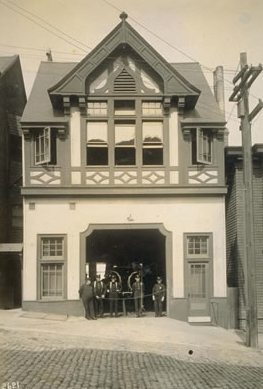
1088  Green Street Fire Station #31

The SFFD History site says:

After the 1906 Earthquake and Fire, Newton J. Tharp was named city architect and was charged with rebuilding city government buildings.  He designed this firehouse along with a number of Beaux Arts-style firehouses.  Located on top of Russian Hill, this firehouse was designed to conform to the neighboring architecture and is the only firehouse of the Tudor Revival and Craftsman styles.

1915 Engine #31 SFFD1915

During the horse-drawn era, the Department chose to build their firehouses at the top of the City’s many hills as it was quicker to respond to fires that were “downhill.”  To get the four ton steam engine back to the firehouse took time.  All San Francisco steam engines and trucks were drawn by a three-horse hitch, and at times the double horse team from the hose wagon was also hooked up to the steam engine, making a five horse team.  Even with five horses, the return trip up the hill to the firehouse was often difficult.  On the steepest return up Leavenworth to Green Street, there was a mechanical pulley system to move the steam engine up the hill.  In 1918 the company received a 1917 American LaFrance Type 45, registry #2623, chain drive 6 cylinder 120 HP engine with a 900 GPM rotary gear pump and hose wagon and the horses were retired.  In 1952, and the Company was deactivated and the firehouse was closed.

DSC_5827

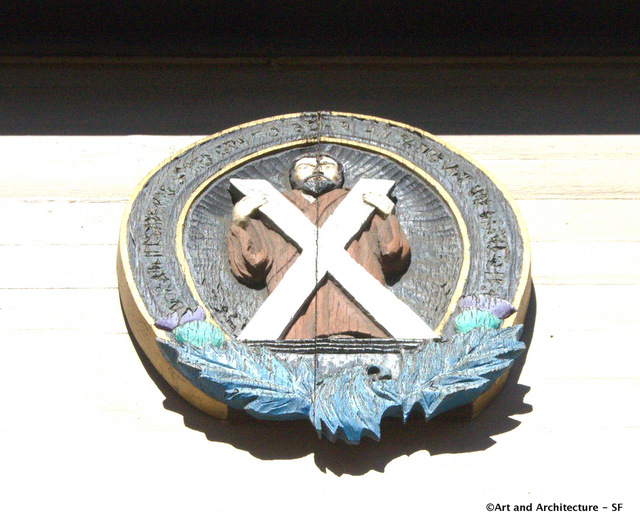
In 1959, philanthropist Mrs. Louise M. Davies bought the firehouse at a sealed bid City surplus property auction for $17,500.  Mrs. Davies had the communications area on the main floor remolded into a sitting room that featured the 1855 Knickerbocker No. 5  hand engine and other fire memorabilia.  The wooden apparatus floor was used for social receptions, banquets and dancing.  The upstairs dormitory and officer’s rooms were converted into living areas.  Mrs. Davies, an Honorary Chief of Department, often opened this firehouse, her city home, to neighborhood associations and charitable organizations for fund-raising events.  During the 1970’s and 80’s, Mrs. Davies hosted many fund-raising parties for the SFFD Museum in this firehouse.  In 1978, Mrs. Davies donated the firehouse to the National Trust for Historic Preservation.  In the 1998, the Trust sold the firehouse to the Scottish American St. Andrew’s Society.

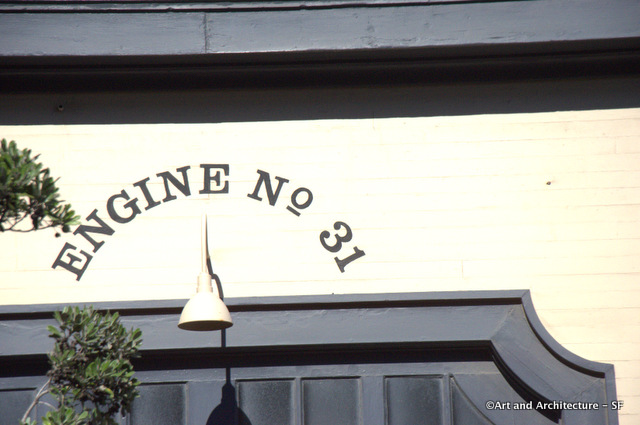
Engine No. 31


Takaroa

 Posted by on November 19, 2013
Nov 192013
 

1086 Green Street
Russian Hill

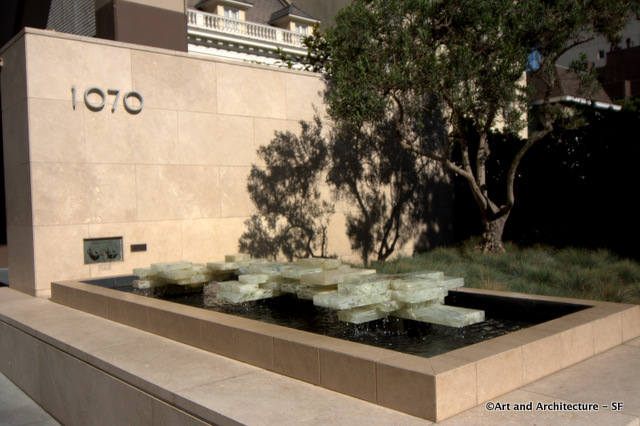
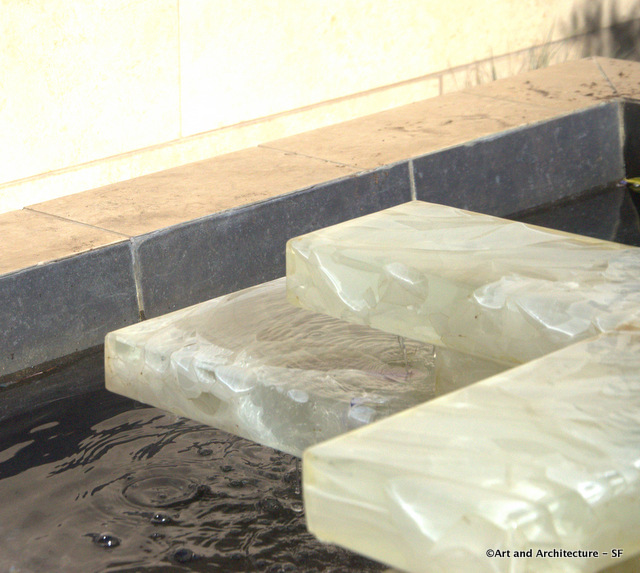
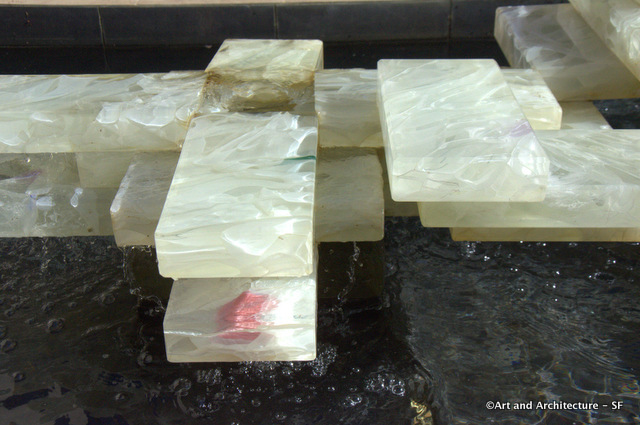
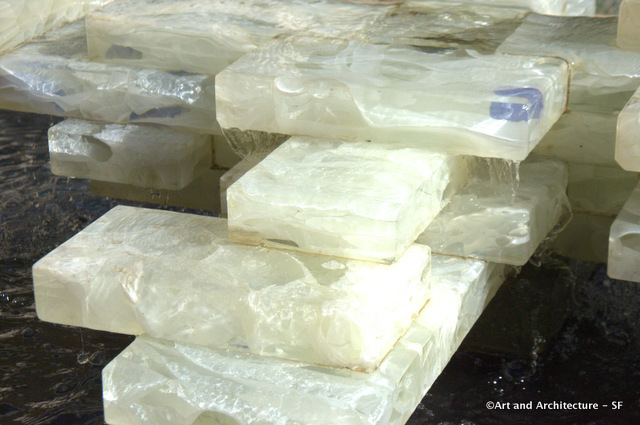
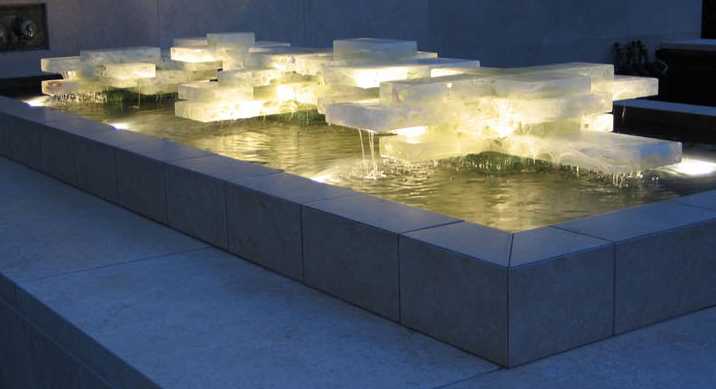
Takaroa FountainTakaroa Fountain by David Ruth 2004
Pyrex Glass

This fountain sits outside a condominium complex on Green Street, and was a private commission.

According to David Ruth’s website:

The Look of ice comes from the fusing of borosilicate glasses like Pyrex. After I was introduced to the material I tried to erase the white veils but ultimately saw that they offered a new style of fused glass that resembles ice. Rather than the liquid flow I had been used to, the ice gave me a different way of conceptualizing my sculpture and fired my interest in ice as a metaphor for making glass.

White Ice David Ruth*

David Ruth on Russian Hill

David Ruth is an Oakland based artist.  He received an M.F.A. from California College of Arts and Crafts, in 1987  a B.A. in American History from Porter College, UC Santa Cruz.

Takaroa Fountain*

Takaroa Fountain at nightNight time photo from David Ruth website

Underwriters Fire Patrol

 Posted by on November 18, 2013
Nov 182013
 

147 Natoma
SOMA/Financial District

Underwriters Fire Patrol

According to the History Department of the SFFD:

On May 24, 1875, the City’s insurance companies joined together to organize and fund the Underwriters Fire Patrol.  The UFP was like a fire department; it had its own firehouses, alarm system and firemen whose only task was salvage practices.  The patrol worked at fires in conjunction with the SFFD.  These firemen often worked below the fire floor and spread waterproof covers over merchandise threatened with water damage.  They also saved and removed business records from the fire building.

DSC_5793

The insurance companies realized that if valuable items could be saved from fire damage that their business expenses could be controlled.  Due to the reduction of these expenses, their policy holders would not have to pay higher premiums.  On this premise, the Underwriters Fire Patrol was organized.

On March 27, 1911, the company received a 1911 American LaFrance, registry #25, Type 5 Fire Patrol Wagon with a 4 cylinder 50 HP engine, the first motorized apparatus in San Francisco.

DSC_5794

This three-story brick structure, designed by Clinton Day, has a terra-cotta bracketed cornice with egg and dart molding, and an arched entry ornament in bead and reel pattern molding.

DSC_5791

Clinton Day is also responsible for the Union Trust Company Building, he has been in this site before here.

The building was sold at public auction in 1956.  The construction fence  is part of the new expansion of SFMOMA.

Stefan Novak and Redwood

 Posted by on November 15, 2013
Nov 152013
 

Clipper and Diamond Heights Blvd
Noe Valley/Twin Peaks

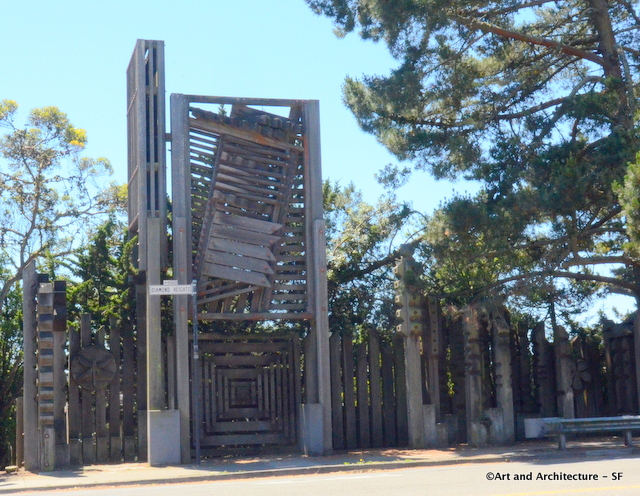
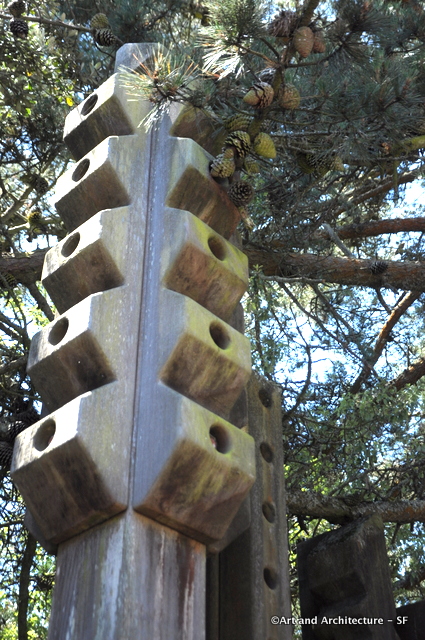
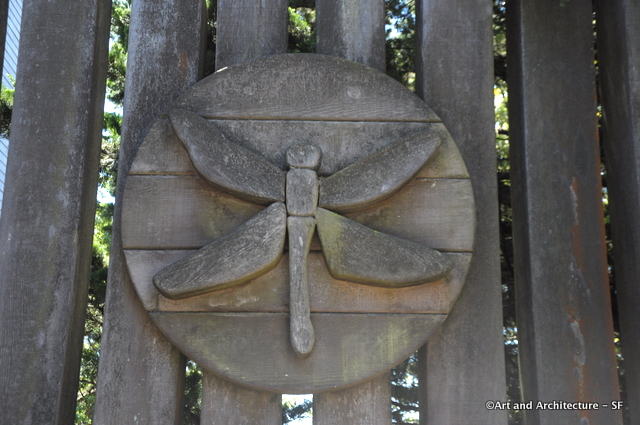
Redwood Sculpture by Stephan Novak

This piece titled Redwood Sculpture, was done in 1968 by Stefan Novak.

Stephan Novak

Mr. Novak and his family are very private people, so there is little information regarding the artist.  He was an instructor in the architecture department at UC Berkeley. He was born on August 22, 1918 and died on April 29, 2006 at 87 years old.

DSC_0932*

DSC_0933*

Stefan Novak architectThe piece is owned by the SFAC.

Stephan Novak

Engine Company #13

 Posted by on November 14, 2013
Nov 142013
 

1458 Valencia Street
Mission

Oldest Firehouse in San Francisco

Built in 1883, this is the City’s oldest standing firehouse.  In the heart of the Mission District, this rare brick firehouse in the Victorian Italianate style has a front surface made entirely of cast iron detail.  Such buildings are very rare in San Francisco with most clustered in the Jackson Square area.

On the conversion from horse drawn to motorized apparatus, the company was assigned a 1916 American LaFrance Type 12 Chemical and Hose Car with a 35 gallon chemical tank with a 6 cylinder 100 HP engine.

Engine Co. No. 13 remained assigned here until 1958.  The firehouse was sold at the City’s surplus property auction and is now privately owned.

Company History:
1883   Engine Co. No. 13 organized and assigned to quarters
1906   Earthquake or Fire damage to the firehouse, $2,000
1917   Converted to motorized apparatus
1918   August 15th, Battalion 6 organized and assigned to quarters
1941   November 1st, Battalion 6 relocated to the quarters of Engine Co. No. 7, 3160 – 16th Street
1941   November 1st, Division 3, commanded by an Assistant Chief, is organized and assigned to quarters
1954   October 14th, Division 3 relocated to the quarters of Engine Co. No. 10, 2300 Folsom Street
1958   February 7th, Engine Co. No. 13 relocated to new quarters at 3880 – 26th Street
1959   Sold at a City & County of San Francisco public auction

Front Doors of Firehouse on Valencia Street

Experiences Engine Company #13. 1458 Valencia St. San Francisco

On the morning of the earthquake April 18th, 1906, our Company first removed the horses and apparatus to a place of safety in the street, from where we responded to a still alarm at 22nd & Mission Sts. Arriving there we found Lippman’s Drygoods Store on fire, and took the hydrant on the corner of Bartlett & 22nd Sts., but could get no water; therefore we canvassed the neighborhood testing all hydrants but were not successful in obtaining water until we reached Valencia & 22nd Sts. We worked under directions of Battalion Chief McKittrick and with the aid of other Companies were able to extinguish this fire at 12 M, April 18th, 1906.

Our next move was to Hayes Valley where we reported to Chief Dougherty who sent us to Laguna & Oak Sts., but finding three engines in line from that hydrant we searched the neighborhood for water but were unable to obtain any. Battalion Chief Dolan directed us to the corner of Gough and Eddy Sts. and in connection with Engine Company #24, we led a line to the corner of Gough & Grove Sts., fighting the fire at that point under command of Battalion Maxwell. We fought the fire in this vicinity for sixteen hours finally saving the corner of Gough & Golden Gate Ave.

On April 19th, at about 4 A. M. we were ordered to Fifteenth & Shotwell Sts., reporting to Battalion Chief McKittrick. We were able to save the East side of Shotwell St., north of Fifteenth St. and worked in this vicinity until three P. M. of April 19th, 1906. Finding water at Fifteenth & Valencia Sts., we led down to Mission St., fighting the fire at that point, but finding the pressure inadequate we removed to Eighteenth & Howard Sts., connecting with a broken main.

We next endeavored to obtain water at Church & Twentieth Sts., but finding other Companies in line at this point, we assisted in this vicinity until the fire was extinguished on Twentieth St. We were finally ordered to our quarters at 11 A. M. April 20th, 1906, having been in duty 53 hours.

S. & P.

(signed) Daniel Newell, Capt

(From the UC Berkeley Library Archives of there 1906 Fire and Earthquake)

Engine Company #13 San Francisco pre 1906


Kokeshi to Kaiju

 Posted by on November 13, 2013
Nov 132013
 

San Francisco International Airport

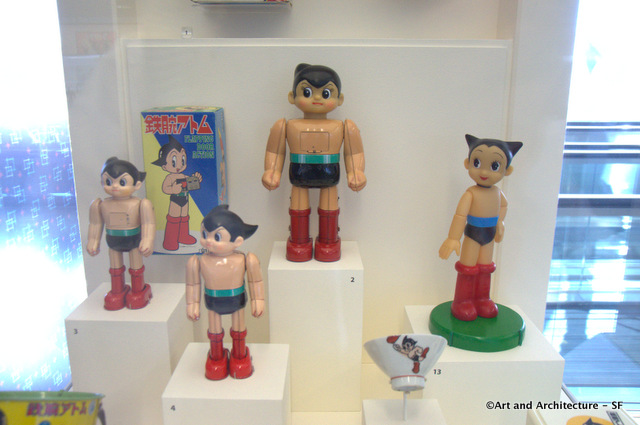
Astro BoyAstro Boy (Tesuwan Atomu)

When the SFO Museum began Twittering about their upcoming Japanese Toy exhibit, I knew I needed to see it. Sadly, it is behind TSA. It is in Terminal Three for all you lucky people flying in and/or out of SFO in the next 6 months.

I contacted the museum, and Exhibits Curator, Nicole Mullen, was kind enough to get me past TSA to view the exhibit.

I was a kid in a candy shop. I have been a fan of Astro Boy and Ultraman since I was a child. I have a huge collection of both, to say nothing of my Robot and Godzilla collection (all from Japan).

This collection was put together from private collectors that include Boss Robot Hobby, The California Academy of Sciences, Chizuko Kuroda, Kalim Winata, Kimono My House, Mark Nagata, Reed Darmon, Rory Yellin and Sanrio.

Sanrio donated a huge Hello Kitty, as well as, a dress made of pink and white stuffed Hello Kitty’s. Being a Badtz Maru fan myself, I am afraid I didn’t get any Hello Kitty photos, my apologize to her fans.
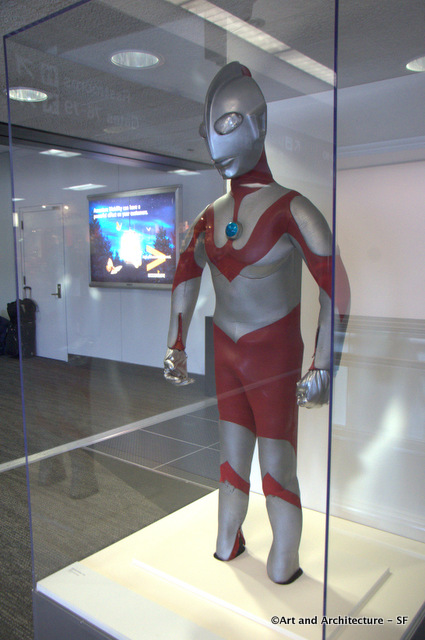
UltramanUltraman costume

The exhibit is titled Japanese Toys! From Kokeshi to Kaiju and runs through April of 2014.  Beautifully laid out by category, the exhibit covers an amazing diversity of toys and history.  There is also a wonderful handout that accompanies the exhibit that you can pick up.
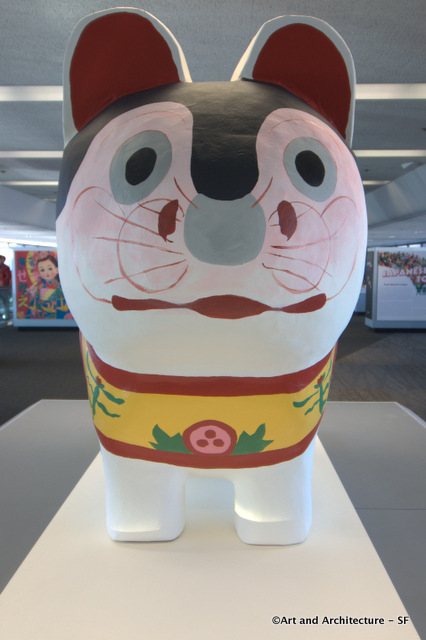
Japanese Paper Mache Dog

As you enter the exhibit from the street side you are first greeted by this huge Dog.  (don’t worry, I thought it was a cat too).  This dog was done by a member of the exhibits staff, Steven Villano.

Colorful, mythical Japanese characters have traditionally appeared in the form of papier-mâché, a centuries-old craft technique in Japan. Guardian dogs are among some of the most popular papier-mâché figurines.

Many legendary stories about guardian dogs developed during the Edo period (1615–1868) in Japan. One story tells the tale of Kobo Daishi (774–835), a Buddhist monk who spent the night at a local farmer’s home during a pilgrimage. This courteous farmer told Daishi that he was troubled by boars in his fields and asked him for a protective amulet. Kobo Daishi allegedly created a paper-dog charm, which he folded, sealed, and gave to the farmer to hang in his fields to protect his crops. When the farmer, curious about the highly effective amulet, eventually opened it, the paper dog flew away.   From the SFO Museum Website
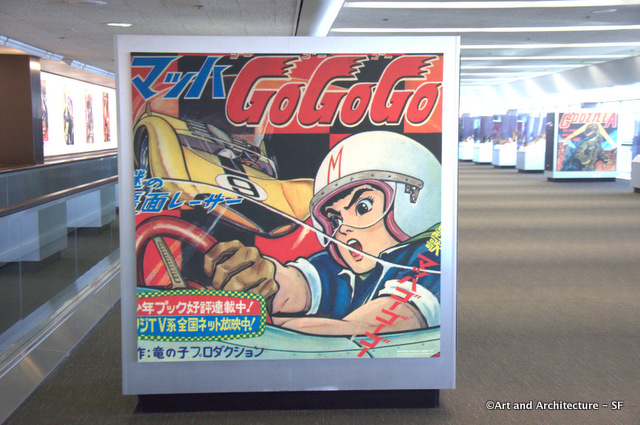
 

Speed RacerIf you were a Saturday cartoon nut, you should recognize Speed Racer.  Introduced in 1966 by Tatsuo Yoshida as car racing manga, Mach Go Go, the figure was influenced by American culture so the characters were western in appearance. Mach Go Go was syndicated for TV in the US in 1967 as Speed Racer.  Although not as technically advanced as cartoons in the US, the moral themes, the complex plots and the unique sound effects and camera angles were very different from cartoons popular at the time.
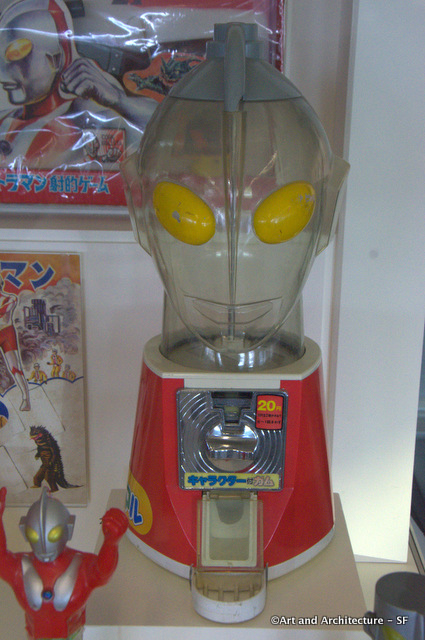
DSC_5716Ultraman’s central characters were created by Eiji Tsuburaya  a pioneer in special effects who was responsible for bringing Godzilla to life in 1954. To learn more about Ultraman you can read about him at the SFO site  here.
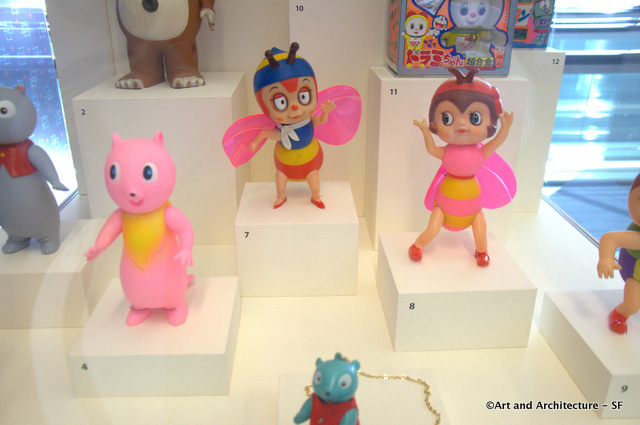
animeKawaii Dolls

Kawaii means cute or childlike, a term used for the obsession that the Japanese tend to have with cutesy characters, toys, stationary, housewares and fashion.
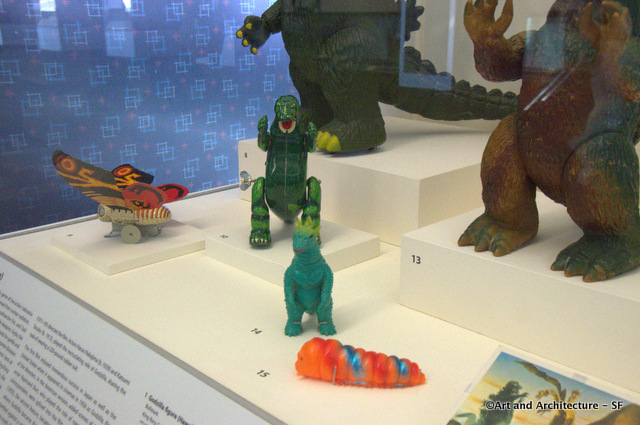
Godzilla

With the nuclear bombings of Hiroshima and Nagasaki and the Lucky Dragon 5 incident still fresh in the Japanese consciousness, Godzilla was conceived as a metaphor for nuclear weapons. As the film series expanded, some stories took on less serious undertones portraying Godzilla as a hero while other plots still portrayed Godzilla as a destructive monster. The other character you see here is Mothra an adversary of Ultraman, as was Godzilla.
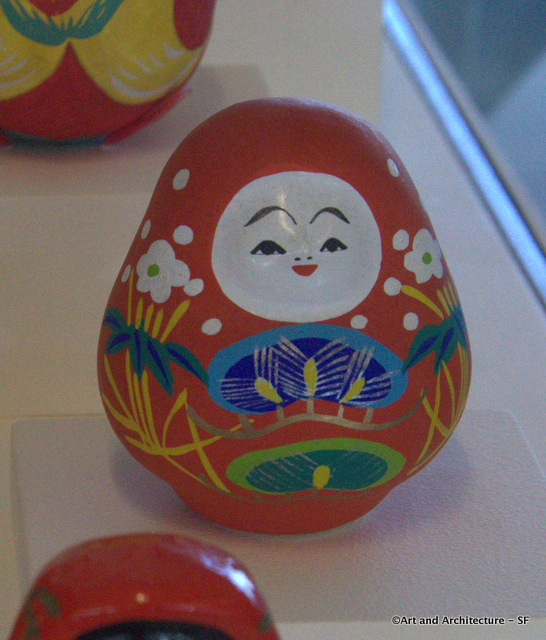
Japanese DollsDaruma Doll

The traditional Daruma doll represents the silhouette of Bodhidharma in deep meditation, sitting in the customary zazen position. Daruma is closely associated with a beloved Japanese proverb, Nana korobi yaoki, which states, “Fall down seven times, get up eight”. The Daruma doll’s unique rounded shape allows it to return to its original position even if knocked over, representing such persistence.
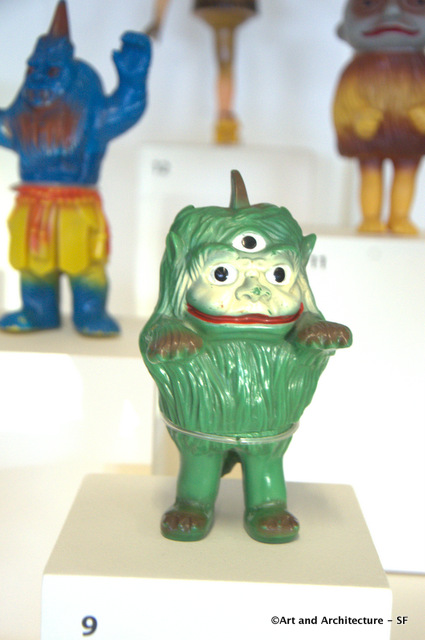
Japanese Toys

Yokai Monster Figures

Long before kaiju, Japan had a long tradition of yōkai or supernatural ghouls, some imported from China, others spawned directly from local lore and superstition. Yōkai lurked in the mountains, forests, and fields of Japan, and are depicted in folktales, woodblock prints, and paintings. During the 1960s, the Daiei Motion Picture Company also produced a series of tokusatsu films featuring yōkai monsters. Today, they even make appearances in video games, manga, and popular toys. – From the SFO Museum Website
Japanese dolls
Kokeshi Dolls

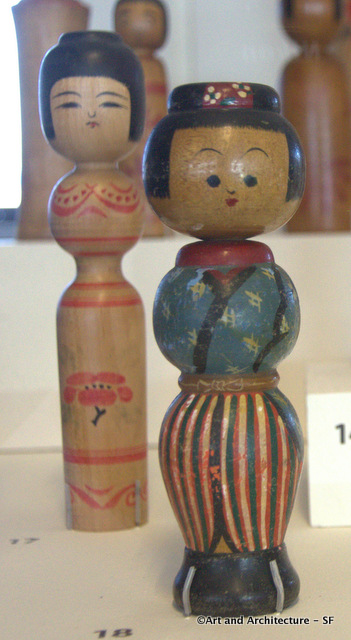
Kokeshi, probably the most beloved folk dolls in Japan, stem from a tradition that dates at least to the 1800s. Craftsmen first made kokeshi in the northern region of Tohoku during the cold winter months. Kokeshi dolls are characterized by their lack of arms and legs and the brightly painted floral or geometrical designs on their cylindrical bodies. The process for making these rounded, wooden dolls is similar to the lathe-turning method employed to make legs for chairs or tables. These dolls served as simple toys for children and were also purchased at hot springs as souvenirs. Over time, the popularity of these figures spread and craftsmen in other regions began to make the dolls. Each area developed its own unique decorative traits allowing one to distinguish a doll’s region of origin. – From the SFO Museum Website.

I can’t thank the SFO museum enough for letting me wallow in my fantasies of Japanese toys and manga.  I also would like to thank DC Denise Schmitt of the SFPD Police Department – SFO.  Despite the fact that she wouldn’t let me play with the toys, we had a great chat.
A Museum for the Cost of a BART Ticket

 Posted by on November 12, 2013
Nov 122013
 

San Francisco International Airport

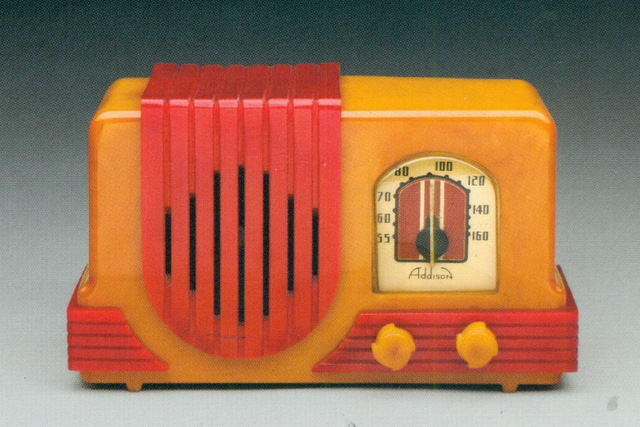
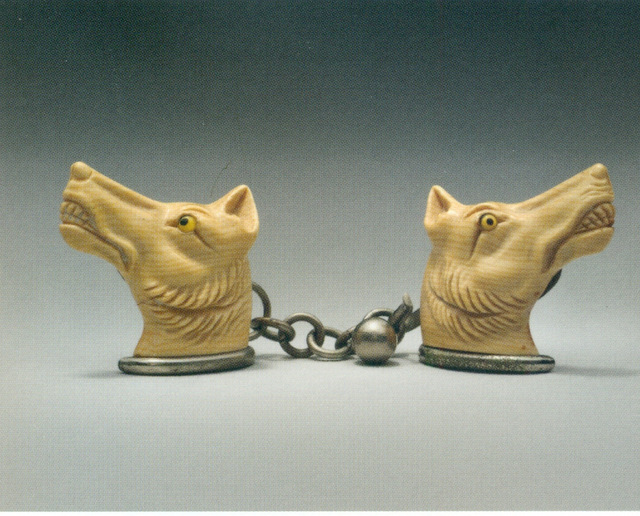
SFO Plastic ExhibitionAddison Model 2A Radio c. 1940

Many people know that there is art at SFO, but did you know there is an actual museum?  Much of the art you see scattered around the airport as single pieces belong to the SFAC, however, the exhibits you see, carefully crafted for your enjoyment, are by an entirely different organization.

The SFO Museum was established by the Airport Commission in 1980 for the purpose of humanizing the airport environment.  In 1999, SFO Museum became the first exhibitions program in an airport to receive accreditation from the American Alliance of Museums.  The museum contains more than twenty galleries throughout the airport with a rotating schedule (every 6 months) of art, history, science and culture.
Plastic Exhibit at SFOCape Clasp c. 1875

I recently had the absolute pleasure of meeting Nicole Mullen, the curator of exhibitions at the SFO Museum.  She let me loose at the Japanese Toy Exhibit (more on that in the future).  Our airBART ride to the exhibit was most informative.  She explained that the museum had a chance to engage with the public for just a short period of time, most often when they were anxious, tired or hungry.  To curate exhibits for SFO was different than a typical art gallery, engaging people of all walks of life, many different cultures and different age groups, and all in a hurry to get somewhere, is challenging and very rewarding.

The collections are often put together with private collectors, giving the museum a unique pool to pull from of varying items.

There are four public displays in the International Terminal that don’t need a ticket to view.  There is also an Aviation Museum and Library off International Terminal A that is open to the public.

SFO Museum has an excellent on-line map with links to all of the exhibits throughout the airport.  You can view it here.

The photo above is from the Classic Plastics 1870’s – 1970’s.  It runs until January of next year.

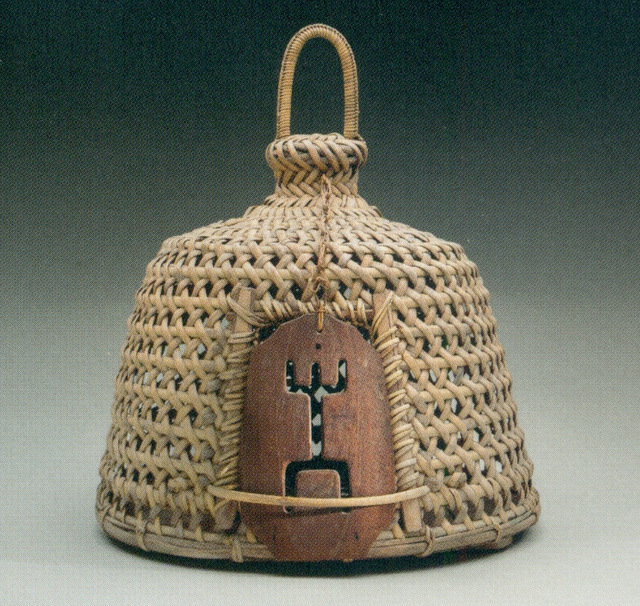
Philipines basketryChicken Coop (Ubi) 20th Century

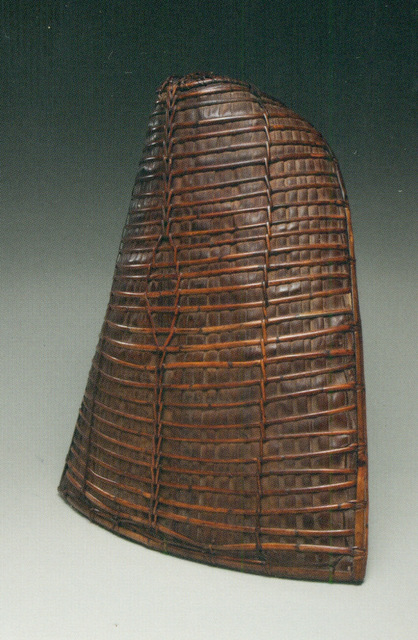
The Philippine Basketry is from the Fowler Museum at UCLA and also runs through January of 2014.

These photographs come from beautiful handouts that accompany the exhibits.  They are gorgeous, well-organized and extremely informative.

If you are looking for a unique museum experience, hop on BART and head to SFO.  You can view their many exhibits before you go and plan your visit by going to their website and seeing what is currently showing.

Philipines basketryWoman’s basket and rain cape (tudang) 20th century

Wally Heider Recording Studio

 Posted by on November 8, 2013
Nov 082013
 

245 Hyde Street
The Tenderloin

DSC_5456

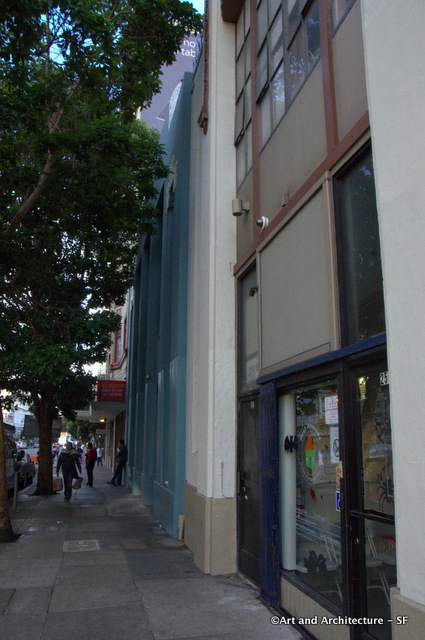
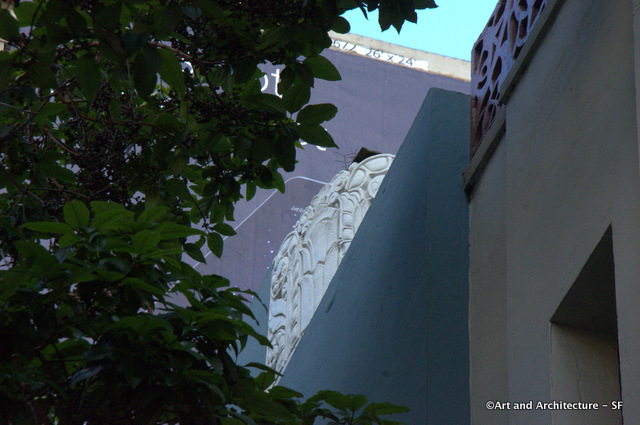
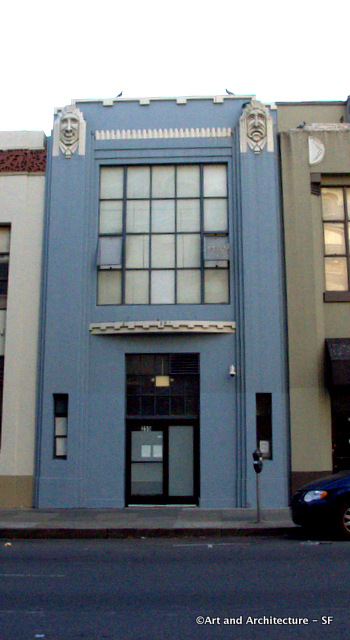
The blue building hidden behind this tree (the fourth film vault) has a prominent place in San Francisco Music history as well.

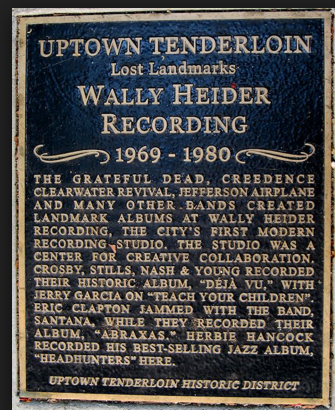
Wally Heider Recording

In early 1969, Wally Heider opened the San Francisco Wally Heider’s Studio at 245 Hyde Street.  Heider had reportedly apprenticed as an assistant and mixer at United Western Recorders in Hollywood, CA, with Bill Putnam, “The Father of Modern Recording”, and he already owned and ran an independent recording studio and remote recording setup called Studio 3, in Hollywood, California.

In 1967, Heider had been involved in live recording at the Monterey Pop Festival. Artists like Jefferson Airplane, Quicksilver Messenger Service and The Grateful Dead had been recording in Los Angeles and New York, and Heider saw the need for musicians involved in the San Francisco Sound to have their own well equipped and staffed recording studio close to home.

The studios were built by Dave Mancini while Frank DeMedio built all the studios’ custom gear and consoles, using UA console components, military grade switches and level controls, and a simple audio path that had one preamp for everything. The console was designed with 24 channels and an 8-channel monitor and cue, which was replicated in both the Studio 3 setup in Los Angeles and the remote truck. The monitor speakers were Altec604-Es with McIntosh 275 tube power amps.

Wally Heider Studios

This building still houses Hyde Street Studios.

DSC_5454

There are several Tenderloin plaques.  They celebrate all parts of Tenderloin history and culture, including the first hard-core adult feature film shown in the U.S. at the Screening Room, 220 Jones Street, Sally Rand’s burlesque fan dances at the Music Box now Great American Music Hall, 859 O’Farrell Street, the former B’nai Brith, 149 Eddy Street, the former Original Joe’s, 144 Taylor Street, and the former Arcadia Dance Pavilion/Downtown Bowl at the corner of Eddy and Jones Streets at Boedekker Park.

A $12,500 grant from SF Grants for the Arts funded the sidewalk plaque project. Centrix Builders provided expertise in metal work with installation by Michael Heavey Construction.

DSC_5457

Further reading from people that were there, about the amazing history of this building under Wally Heider and other recording/ film studios:

Beyond Chron

Found SF

Film Vaults of the Tenderloin

 Posted by on November 7, 2013
Nov 072013
 

245-259 Hyde Street
The Tenderloin

 Film Vaults of San Francisco 1930's

I have driven by this area with these stunning Art Deco/Art Moderne buildings all in a row, and never pursued the history.  An evening of beers at the Brown Jug with Mark Ellinger and my eyes were opened.

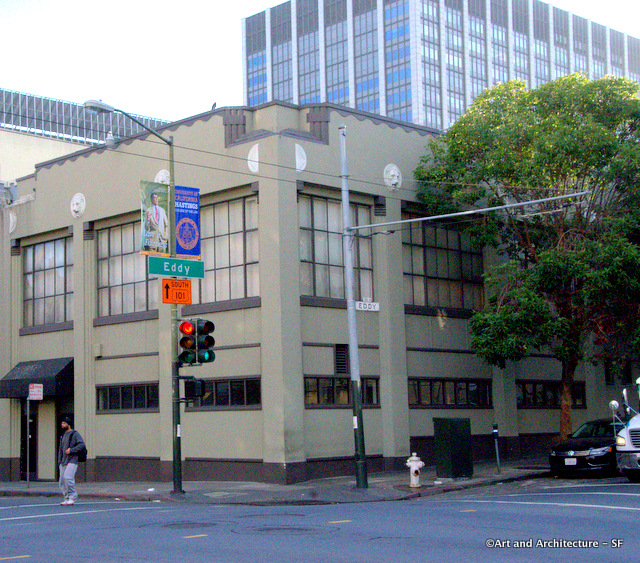
Originally theaters purchased the films they showed their patrons. Then Harry, Herbert and Earle C. Miles, San Francisco brothers, realized there was a business in buying films in bulk and renting them to movie houses. Their original distribution centers were on Market Street/Golden Gate Avenue.

Inside these four buildings were film vaults with thick concrete walls and big iron doors with elaborate sprinkler and ventilation systems.  The reason is, the original films were highly flammable nitrate-based.  Movie theaters frequently caught fire because of these flammable films, even more reason for a delivery system.  In the 1950’s a less flammable form of acetate based film, actually called safety film, came into existence.


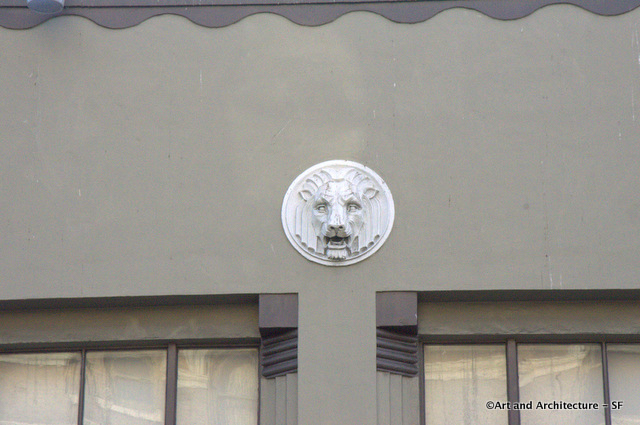
MGM Lion

The first building of the series is the MGM Film Vault, distinguished by the MGM Lion.

 MGM Grand Film Vault SF

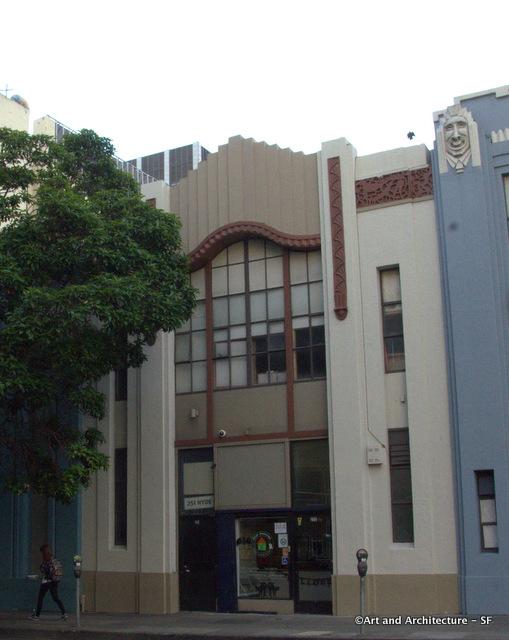
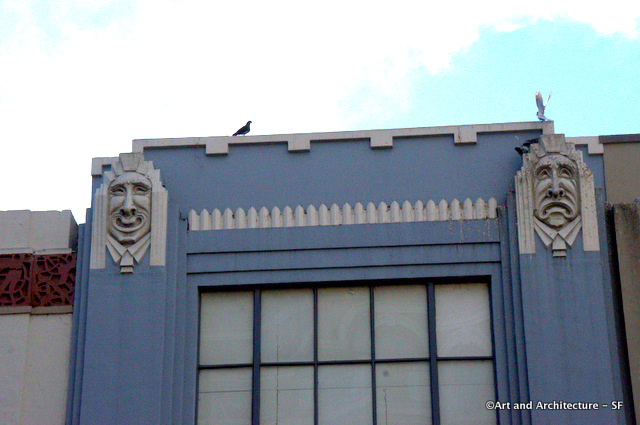
These four buildings are built on two lots.  The MGM and the Comedy and Tragedy buildings were on one lot (255-259) and the brown building and the blue building hidden behind the tree were on a second (245-251).  These now all sit on one lot.

According to Mark’s article at Found in SF  the original owners of the corner building were the Bell Brothers in 1930 and then Frank and Ida Onorato in 1947.

Until the end of the 1980s, businesses along this stretch of Hyde Street and around the corner on Golden Gate Avenue included Wally Heider Studios (now Hyde Street Studios), Monaco Labs and Leo Diner Films—a recording studio and motion picture labs/post-production facilities that, with the advent of acetate-based Kodacolor and black-and-white reversal motion picture film in the early 1950s, had taken over film exchange buildings.

Comedy and Tragedy on Hayes Street, SF

*Hyde Street Film Vaults

The architects were O’Brien Brothers and W.D. Peugh (1930). These gentlemen worked together on several buildings in San Francisco including the Art Deco Title Insurance Company Building on Montgomery Street, where you can read about their long history with San Francisco.

These buildings housed 20th Century Fox, Loews, and United Artists film exchanges as well.

Film Vaults of San Francisco's Tenderloin

*

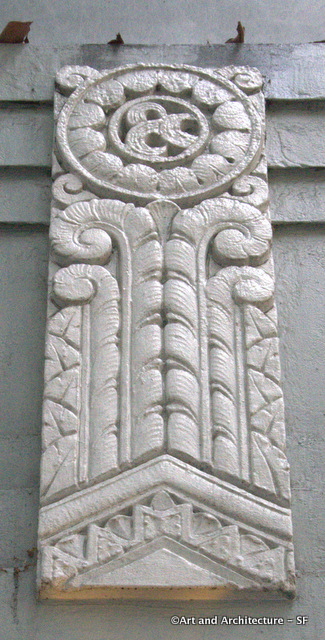
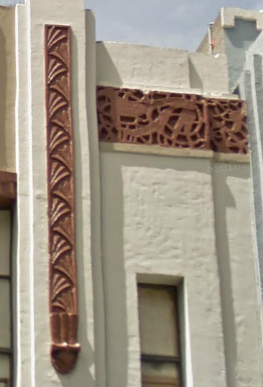
Ornamentation on one of the fil vaults


Grain Silos in San Francisco?

 Posted by on November 6, 2013
Nov 062013
 

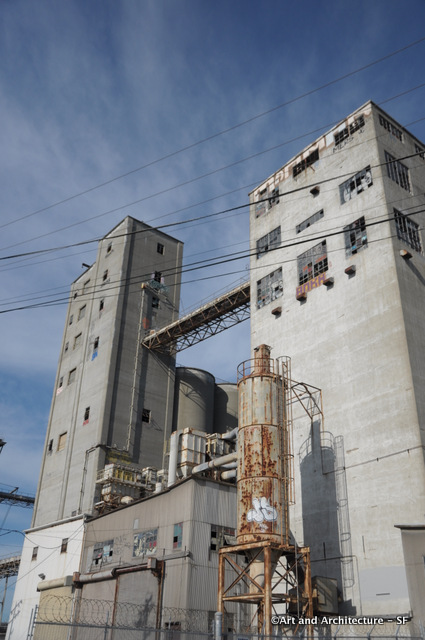
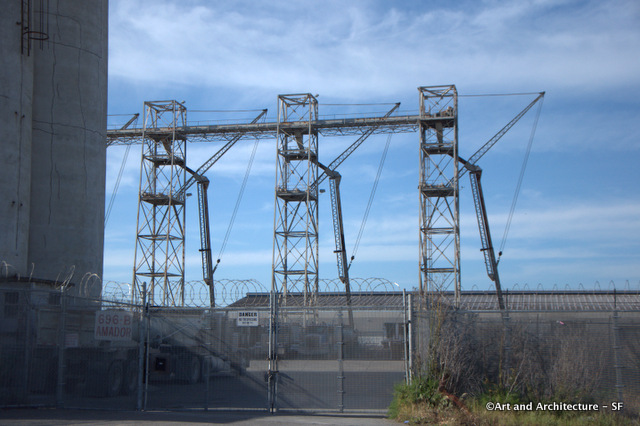
696 Amador Street
off 3rd Street / Pier 90/92
Bayview/Hunters Point

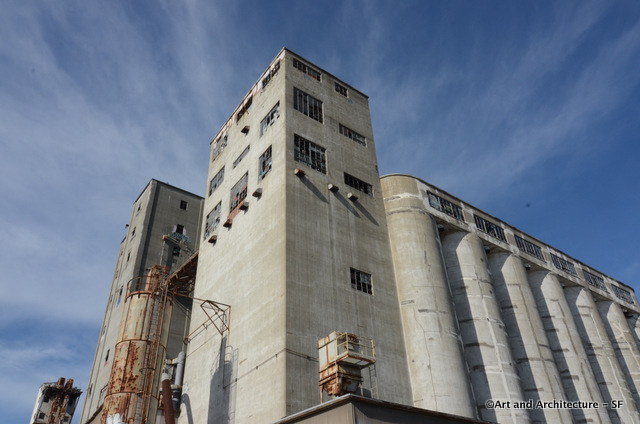
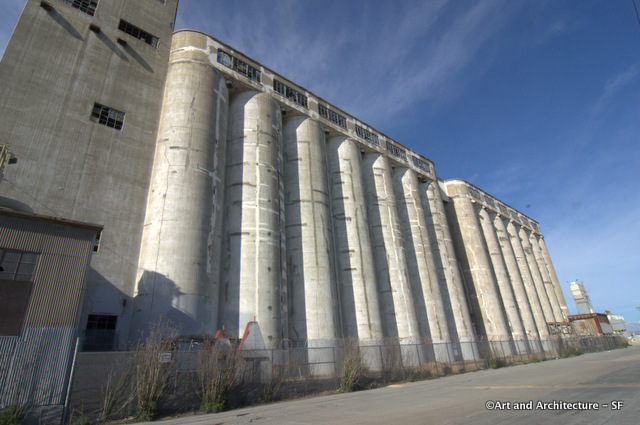
Grain Silos in San Francisco

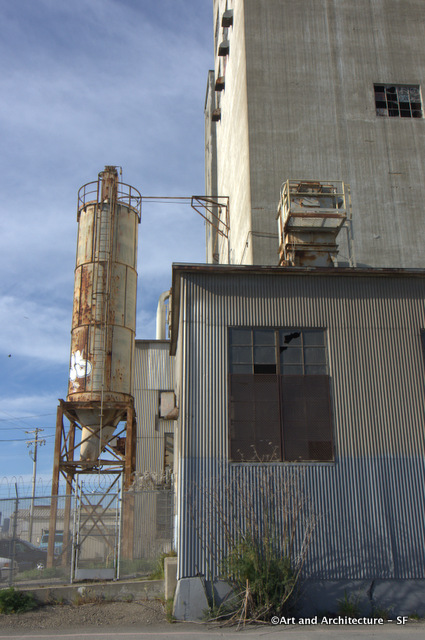
 These abandoned silos on Pier 90/92 formerly stored grain that was brought in by rail and then loaded from the silos onto ships for export. These operations were discontinued following the 1989 Loma Prieta earthquake.

Pier 90/92 was created in 1918 by the State Harbor Commission.  In the 1920’s the grain terminal also had a mill to serve local needs.  The terminal could hold 500,000 bushels, the principal grain that flowed through them was barley.  In the 1970’s the terminal was used to export grains to Russia during their severe drought.

DSC_2345

They are slated to become an art installation soon.

The Pier 92 Grain silo project is being funded through the Port’s Southern Waterfront Beautification funds, a policy established by the Port Commission.

The Port of San Francisco retained the Arts Commission to assist in the commissioning of a public artwork to be located at Pier 92, along San Francisco’s southern waterfront. Four artists/ artist teams were selected as finalists to propose a public artwork for this site that serves as an entrance to the Bayview community: Ball-Nogues Studio; ElectrolandHaddad/Drugan; and Rigo 23.

The committee chose Haddad/Drugan and their “Bayview Rise” Project.  It will be a long-term temporary installation, expected to be in a place for a minimum of 5 years. The artwork will be reversible in that it may be painted over or removed.

Abandoned Grain Silos*

Grain Silos Pier 92 San FranciscoI am not young enough, nor have the physical dexterity to climb over barbed wire fences, however, Joseph Schell does – check out his photographs of the interior of the grain silo structure.

Grain Silos Pier 92 SF

This portion of San Francisco is covered with historic and abandoned buildings.  While the city and the Port of San Francisco is dedicated to keeping the buildings intact and pushing the concept of reuse rather than destruction, only time will tell.

Oslos has already put their grain silos to re-use by putting in dormitories, check it out here.


The Royal Theater – Another Lost Gem

 Posted by on November 5, 2013
Nov 052013
 

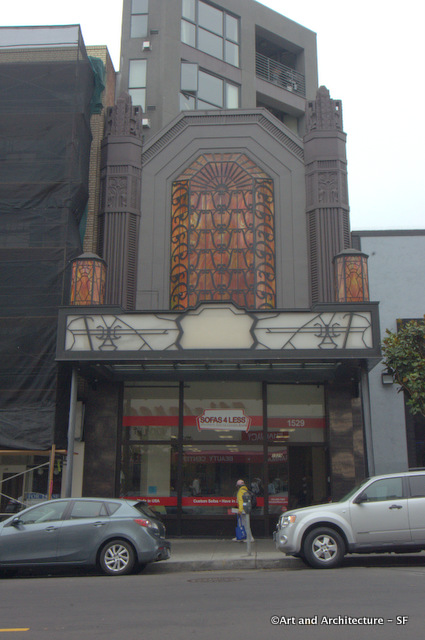
1529 Polk Street
Nob Hill

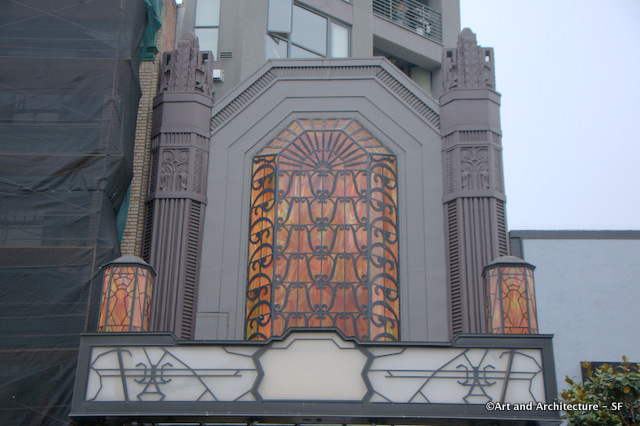
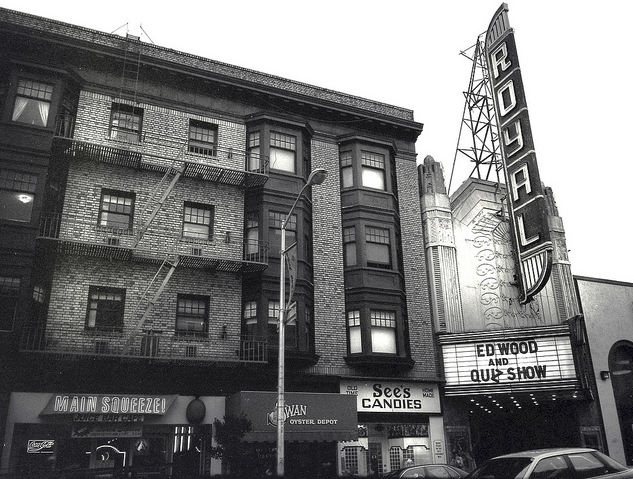
The Royal Theatre was built in 1916 and began its life as a Nickelodeon. Originally designed by the Reid Brothers for the same family that owned two other theaters in San Francisco, the Castro and the Alhambra. It was completely remodeled by Timothy Pflueger during the mid-1930’s for the Nasser Brothers chain which operated it at the time.

The theater contained 1515 seats when it opened.

Polk Street Old TheaterAs time passed Polk Street became run-down, but still the theater’s vertical sign was a local landmark. The same decorative motif found on the front also gracefully decorated the organ grilles.

The Royal Theatre was demolished in June of 2003 except for the facade and a few of the architectural elements, which were incorporated into the six-storied housing unit constructed on the site.


Royal Theater on Polk Street San Francisco

Two of San Francisco’s most prominent architects, James William Reid (1851-1943) and his brother Merritt J. Reid (1855-1932), created a number of San Francisco landmarks during the “City Beautiful” period.

In 1886, the founders of the Coronado Beach Company invited the Reid Brothers to San Diego to design the Hotel Del Coronado. When it opened in 1888, it was the largest resort hotel in the world and the first to use electrical lighting. One year later John D. Spreckels, who was investing heavily in San Diego, bought a one-third interest in the company. Spreckels eventually took over as owner of the hotel when the builders were unable to repay a loan to him. The ‘Del’, as it is affectionately known, was added to the National Register of Historic Places in 1971 and further designated a National Historic Landmark in 1977.

In 1889, both James and Merritt were made Fellows of the American Institute of Architects. That year Merritt opened an office in San Francisco. He was later joined by James.

Royal Theater on Polk StreetFrom their San Francisco office, in 1892, the Reid Brothers designed the first steel-frame building west of Chicago, for the Portland Oregonian newspaper.

The Reid Brothers became known for their Classical Revival mansions. The Reid Brothers essentially became the Spreckels family architects, designing several mansions for them. The firm designed the Spreckels Car House at 2301 San Jose (1899-1901), known today as the Geneva Car Barn and now San Francisco Landmark #180.

The Reid Brothers are perhaps best known for many classic movie theaters, including the Coliseum Theater (745 Clement, 1918), the Alexandria Theater (5400 Geary, 1923), the Metropolitan (2055 Union, 1924), the Balboa Theatre (3630 Balboa Street, 1926), the Grand Lake Theater in Oakland (1926), the Fox in Redwood City, and Golden State Theatre in Monterey (1926).

The Reid brothers worked in San Francisco until 1932, when Merritt Reid died and James, a founder of the San Francisco Opera Company, turned full-time to his hobbies of oil painting and music.


Timothy Pflueger has appeared in this site before.  He is responsible for the designs that you see in these photographs.


Goldsworthy III

 Posted by on November 1, 2013
Nov 012013
 

San Francisco Presidio
Main Parade Ground
Anza and Sheridan

Andy Goldsworthy Presido Tree

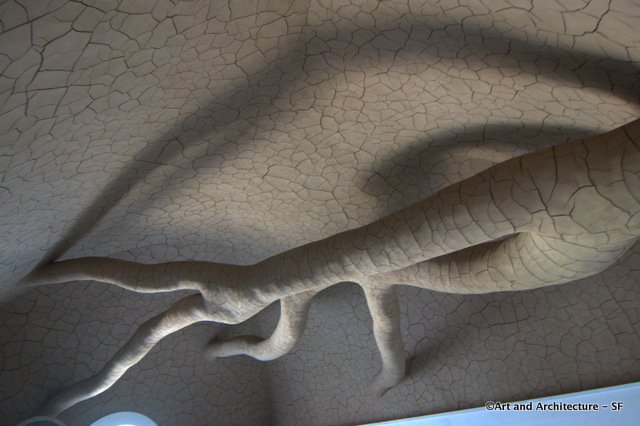
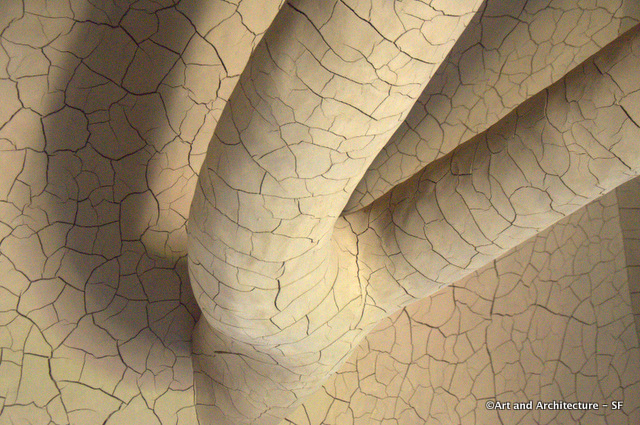
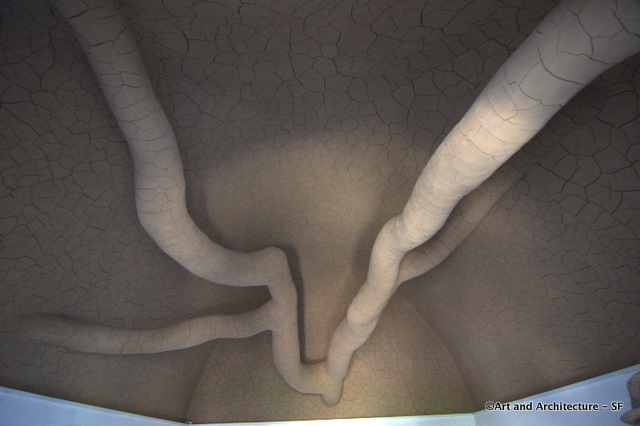
This is the third installation of Andy Goldsworthy’s at the Presidio in San Francisco.  It is titled Tree Fall.  There are two other Goldsworthy’s on the Presidio Grounds that have appeared in this site before and can be seen here.

Munitions Depot SF Presidio

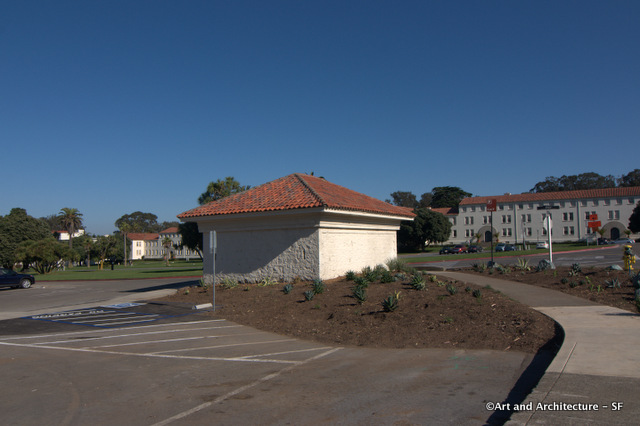
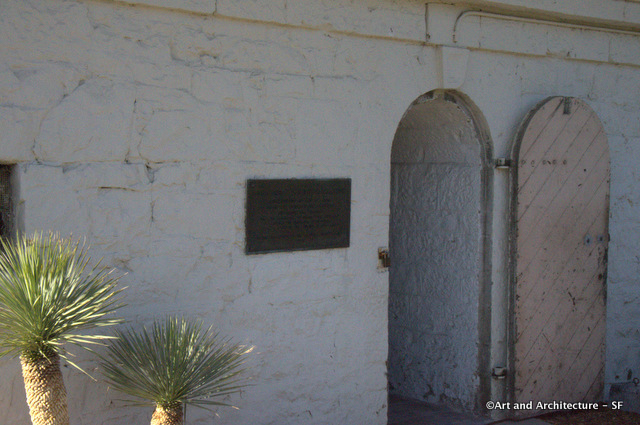
The exhibit is in the Old Stone Powder Magazine on the Main Parade Ground.  The room is 20 X 17 feet with walls two feet thick.  The building dates to 1863, is one of the oldest structures at the fort and has never been opened to the public.  Originally a domed roof topped the structure.  This was so that in the event of an explosion the blast would project upward. The tile roof was added in 1941 as the post adopted a uniform Mission style of architecture.  The building was used to store blank rounds for the daily 5pm evening gun salute until 1994 when the Army departed the post.

Goldsworthy’s team was not allowed to touch the walls.  They built four walls inside the four walls with ventilation holes along the bottom, they then put in a dropped ceiling and poured a cement floor.

The tree is a Eucalyptus felled during the reconstruction of Doyle Drive.

An assembly line of community volunteers were brought in to mix the clay. The primary material was dirt unearthed during excavation for the nearby officers’ club restoration. The binding agent is a combination of straw and human hair from local salons.  The clay was then put on by Goldsworthy himself.

“There is a lot of love and understanding with clay that has been won over many years,” he says, “and you never know how it will turn out.”

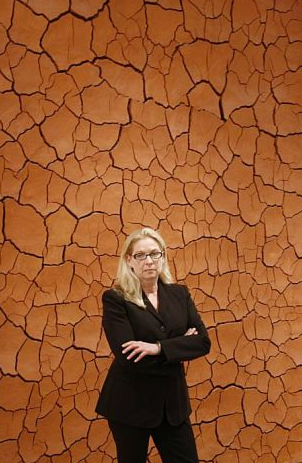
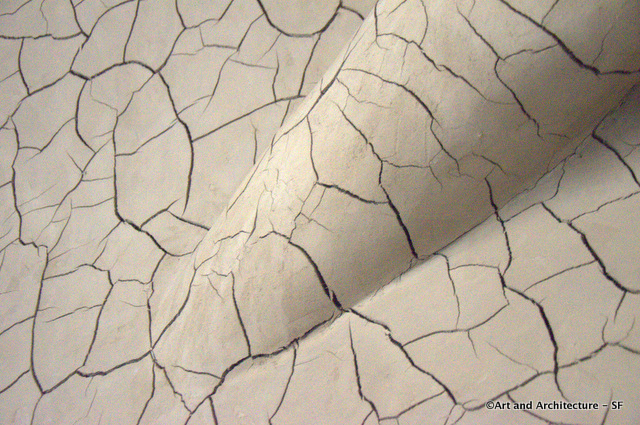
His hope was that the clay would dry and crack into puzzle pieces, to give the art detail and intricacy. This is a concept that Goldsworthy has been refining since he first built a clay wall, at the Haines Gallery at 49 Geary St., in 1996 (shown here in a San Francisco Chronicle Photograph).  The Haines Gallery is the founder of the Fore-Site Foundation, and curator of all three of Goldsworthy’s installation at the Presidio.

Haines Gallery Andy Goldsworthy

Please don’t get me wrong.  I have been a big, big fan of Andy Goldsworthy since I first discovered his book Stone in 1994, and I do own every one of his books.  I also have traveled out of my way by many miles to see an installation if there is one near where I am.  However, it is time, Presidio Trust and For-Site Foundation, to give other artists space.  We have so very many great artists in California, and especially the city of San Francisco, it is time we honored them with space as unique and fabulous as the public space of the Presidio.

Andy Goldsworthy Clay at the Presidio

The textures and play of light in this exhibit are a photographers dream.

Andy Goldsworthy at the Presidio

*

Old Gun Powder Magazine PresidioThis is the only light that enters the magazine.

 The plaque reads:

OLD STONE POWDER MAGAZINE
Constructed by the U.S. Army
After the presidio was occupied
by American Forces
Built of materials salvaged from earlier
Spanish of Mexican structures
It dates back to the period of 1847-1863
Plaque presented by the Presidio Society Inc.
1958


The public can view the exhibit on Saturdays and Sundays from 10 am to 4 pm through December 1, or on weekdays by reservation.

Andy Goldsworthy Tree Falls

error: Content is protected !!